

My Thien pottery craft is closely associated with the economic , cultural and spiritual life of the community of residents of My Thien village, Chau O town, Binh Son district (now Binh Son commune, Quang Ngai province).
My Thien pottery craft was included in the List of National Intangible Cultural Heritage by the Minister of Culture, Sports and Tourism in Decision No. 2208/QD-BVHTTDL dated June 27, 2025.
My Thien pottery practice process
My Thien pottery has a history of more than 200 years. According to the documents of the Department of Cultural Heritage, the distribution space of the heritage is mainly concentrated in My Thien village - the land located along the Tra Bong river, where there is an abundant source of good quality clay and clean water, very favorable for pottery making.
This unique geographical location not only creates favorable conditions for production activities but also helps My Thien ceramic products to be easily traded and spread to neighboring areas and further, becoming a famous craft village brand in the South Central region.
The subjects practicing and passing on the heritage are the community of My Thien village residents through many generations, most of whom are households that have been doing pottery for a long time. The profession is passed down from generation to generation, many families have been involved in the profession for three to four generations, preserving their own secrets in shaping, decorating and firing pottery.
The elderly artisans are not only skilled workers but also “living treasures” preserving traditional craft knowledge, ready to teach the younger generation. In addition, traders, merchants and regular customers also play an important role in maintaining and developing the craft village through product consumption and promotion.
The process of making My Thien pottery is a harmonious combination of traditional experience and the craftsman's ingenuity, including many elaborate stages, most of which still retain the manual method.
First is the process of mining clay - the main raw material - taken from the land along the Tra Bong River or areas with smooth, flexible soil with few impurities. After being brought back to the village, the clay is dried, crushed, soaked in water for many days to remove impurities, then "clay refining" - kneading continuously until the soil reaches a smooth and flexible consistency.
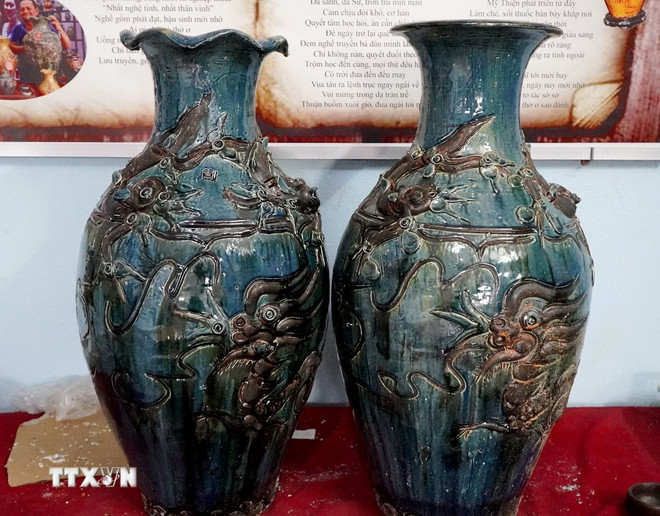
When the clay has reached the required level, the craftsman puts it on a turntable or a table to shape it. This is a stage that requires high technique and sophistication. With skillful hands and tools such as wooden sticks, cutting wire, turntable, etc., the craftsman shapes and strokes to shape the product - from household items such as pots, pans, bowls, plates, jars, and urns to fine art products such as vases and ceramic statues. During this process, each product must be balanced, have a smooth surface, and be free of cracks.
After shaping, the product is placed in a ventilated place, away from strong sunlight to dry gradually, helping to firmly shape and limit cracking when fired. When the product reaches a moderate dryness, the artisan proceeds to decorate.
The patterns on My Thien ceramics have a strong traditional aesthetic with engraved, embossed or raised motifs, depicting images of flowers, birds, geometric patterns, etc. All are done by hand, requiring meticulousness and creativity.
The firing stage is the decisive step for product quality. My Thien pottery still maintains the traditional firing method using wood or rice husk kilns. The craftsmen arrange the products in the kiln in a reasonable order so that the heat spreads evenly. The firing process lasts for hours, even all day, with the temperature adjusted flexibly based on the experience and senses of the artisan.
Keeping the fire stable, not letting it get too hot or too cold is the key factor to ensure the product has durability, beautiful color and standard sound (for some types of ceramic). When the products cool, they are checked, classified and prepared for consumption. My Thien ceramic products are rich in design, function and size.
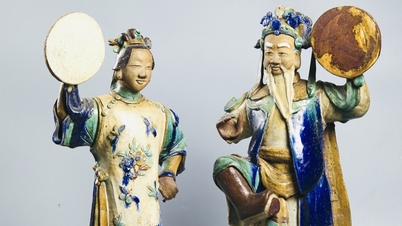
In addition to household products such as water jars, pickle jars, cooking pots, bowls, and plates, there are also products for religious purposes, decoration, or custom-made products.
The ceramic colors are mainly natural brown, red, and earthy yellow tones - rustic but durable - clearly showing the characteristics of traditional handmade ceramics from the South Central Coast region.
Quang Ngai regional identity
The value of My Thien pottery is deeply expressed in many aspects, not only in economic but also in cultural, social and artistic aspects.
Pottery has long been the main source of livelihood for many households in My Thien village, creating stable jobs and sustainable income for local people.
My Thien ceramic products are widely consumed not only in Quang Ngai province but also in many other provinces and cities in the South Central and Central Highlands regions. This has contributed to promoting the exchange of goods, developing trade, and enriching the local rural economic picture.
Besides, in the context of developing cultural-craft village tourism, My Thien pottery also has the potential to become a typical product serving tourists, bringing economic value combined with the value of promoting local image.
My Thien pottery is a vivid testament to the creativity and ingenuity of Quang Ngai people. Generations of artisans have preserved and promoted traditional manual crafting methods, from selecting soil, refining soil, shaping to firing. Each product is the crystallization of intelligence, experience and dedication, demonstrating high technical level and delicate aesthetic sense.
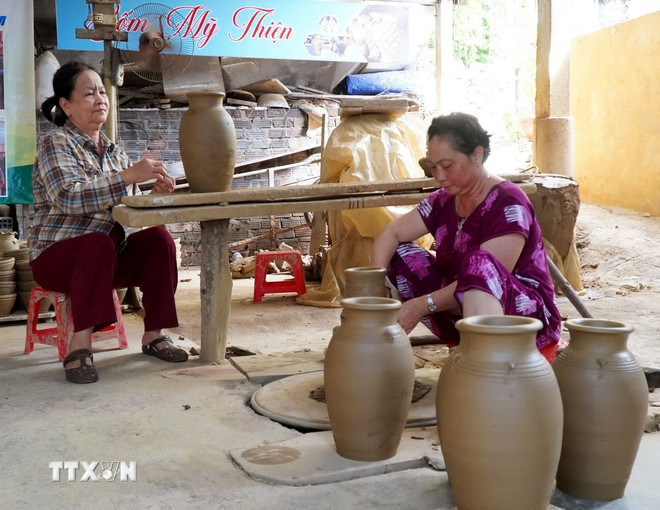
In the hands of the craftsmen, the simple blocks of clay are “breathed into life” into useful objects. The lines and decorative motifs on the pottery reflect the typical views, lifestyle and aesthetic thinking of the residents of the South Central Coast region – simple, sincere but full of creativity.
My Thien pottery is also a bond that connects the community, contributing to strengthening the village spirit and maintaining the tradition of solidarity among the people. In each family, the pottery craft is passed down from generation to generation, not only as a story of making a living but also as a pride in the origin and identity of the homeland.
The occasions of making pottery together, tending the kiln fire or sharing professional experiences have become typical cultural activities of the craft village. Through that, the spirit of hard work, creativity and perseverance of Quang Ngai people is clearly demonstrated.
In addition to its economic and socio-cultural value, My Thien pottery also has great research value. Ancient ceramic products preserved locally are a valuable source of materials for the fields of archaeology, history, fine arts and ethnology. Through that, we can clearly see the development of handicraft techniques, folk aesthetics and spiritual life of the residents of Tra Bong-Quang Ngai region through each period.
With hundreds of years of tradition and diverse values, My Thien pottery is not only a livelihood but also a cultural symbol of Quang Ngai.
In the endless rotation of the pottery wheel, under the talented hands of the craftsman, simple clay bars are breathed into works containing the breath of life.
Preserving and promoting My Thien pottery not only helps maintain a valuable intangible cultural heritage but also affirms the unique and rich identity of Quang Ngai land - a convergence of tradition, creativity and the enduring vitality of the people of the Central region./.
Source: https://www.vietnamplus.vn/kham-pha-di-san-nghe-gom-my-thien-o-vung-dat-nam-ven-song-tra-bong-post1075042.vnp

![[Photo] Closing of the 14th Conference of the 13th Party Central Committee](https://vphoto.vietnam.vn/thumb/1200x675/vietnam/resource/IMAGE/2025/11/06/1762404919012_a1-bnd-5975-5183-jpg.webp)
















































Comment (0)