

When installing fog lights on a car, owners need to be aware of certain regulations to avoid failing the vehicle inspection.
According to observations by reporters from Giao Thong Newspaper, many vehicle owners are now choosing to install additional fog lights to increase visibility when driving at night or on mountain roads, in foggy weather, or when visibility is limited.
This is considered a necessary requirement to ensure traffic safety, and the installation does not alter the vehicle's structure.
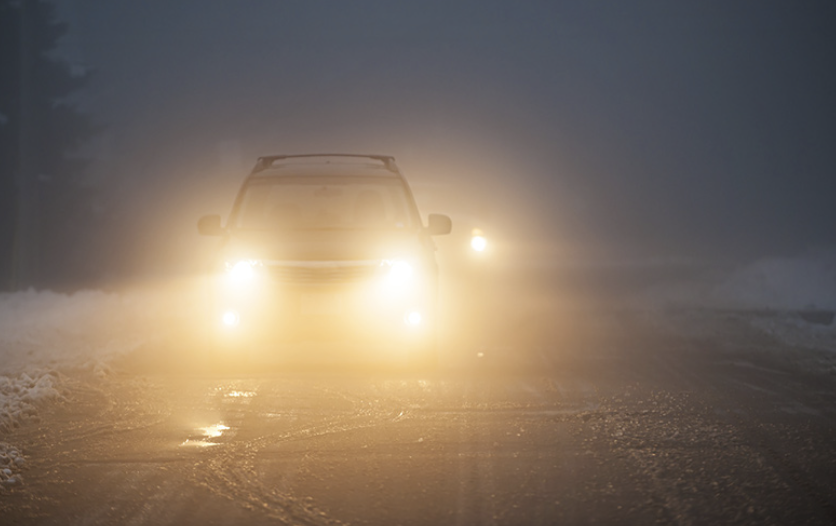
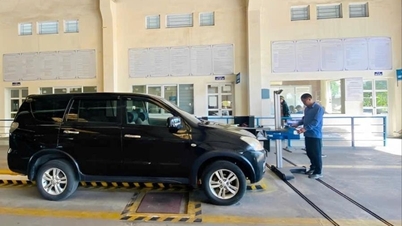
According to regulations, cars are allowed to be fitted with fog lights (if they weren't originally equipped), however, car owners need to be aware of 5 common mistakes when installing these lights to avoid failing the vehicle inspection (illustrative image).
The National Technical Standard on Motor Vehicles, Trailers, Semi-Trailers, and Four-Wheeled Motorized Cargo Vehicles in Technical Safety and Environmental Protection Inspection (QCVN 122:2024) also clearly states that motor vehicles are permitted to be equipped with additional fog lights.
However, vehicle owners should note that there are 5 mistakes when installing fog lights that can cause their car to fail the vehicle inspection.
This includes: Installation location greater than 400mm from the outermost edge of the vehicle and lower than 250mm in height; light color not white or yellow; number not 2 lights and not asymmetrical; not independently switchable on/off from the headlights; installation above the headlights.
Therefore, when installing fog lights, car owners need to choose a reputable garage, ensuring that the installation location is no more than 400mm from the outermost edge of the car, the height is no less than 250mm, and they are positioned above the front headlights.
There must be two lights, installed symmetrically, emitting white or yellow light. Their on/off function must be independent of the front headlights.
According to a representative from the vehicle inspection center, using fog lights with the same switch as the headlights is very dangerous, especially when driving in the city or on non-highway roads such as village roads, district roads, provincial roads, and national highways.
The reason is that the light emitted simultaneously from these two types of lights can cause glare, even temporary blindness, for drivers coming from the opposite direction, reducing their visibility and increasing the risk of traffic accidents.
Source: https://www.baogiaothong.vn/5-loi-lap-den-suong-mu-khien-o-to-truot-dang-kiem-192250120170549632.htm
![[Photo] Prime Minister Pham Minh Chinh receives the Governor of Tochigi Province (Japan)](/_next/image?url=https%3A%2F%2Fvphoto.vietnam.vn%2Fthumb%2F1200x675%2Fvietnam%2Fresource%2FIMAGE%2F2025%2F12%2F16%2F1765892133176_dsc-8082-6425-jpg.webp&w=3840&q=75)

![[Image] Leaked images ahead of the 2025 Community Action Awards gala.](/_next/image?url=https%3A%2F%2Fvphoto.vietnam.vn%2Fthumb%2F1200x675%2Fvietnam%2Fresource%2FIMAGE%2F2025%2F12%2F16%2F1765882828720_ndo_br_thiet-ke-chua-co-ten-45-png.webp&w=3840&q=75)
![[Live] 2025 Community Action Awards Gala](/_next/image?url=https%3A%2F%2Fvphoto.vietnam.vn%2Fthumb%2F1200x675%2Fvietnam%2Fresource%2FIMAGE%2F2025%2F12%2F16%2F1765899631650_ndo_tr_z7334013144784-9f9fe10a6d63584c85aff40f2957c250-jpg.webp&w=3840&q=75)

![[Photo] Prime Minister Pham Minh Chinh receives Lao Minister of Education and Sports Thongsalith Mangnormek](/_next/image?url=https%3A%2F%2Fvphoto.vietnam.vn%2Fthumb%2F1200x675%2Fvietnam%2Fresource%2FIMAGE%2F2025%2F12%2F16%2F1765876834721_dsc-7519-jpg.webp&w=3840&q=75)






















































![[Video] Independence and self-reliance linked with international integration through 40 years of reform](https://vphoto.vietnam.vn/thumb/402x226/vietnam/resource/IMAGE/2025/12/16/1765899635777_1-1-8054-png.webp)






























Comment (0)