

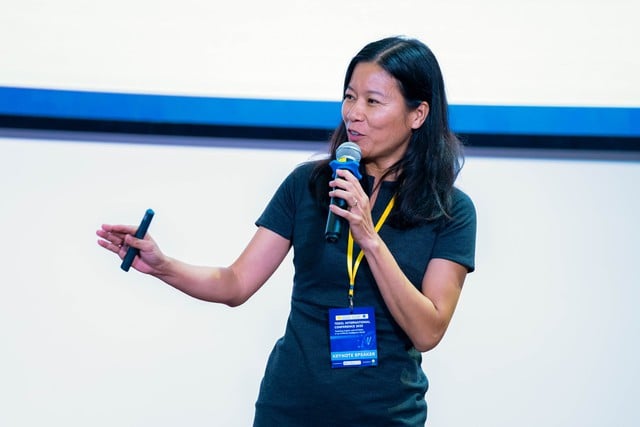
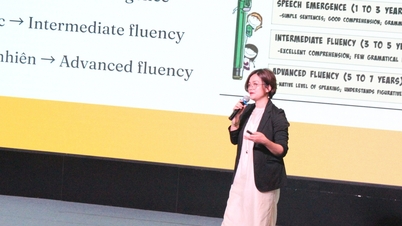
Dr. Vien Cao commented that the proliferation of AI, in addition to its benefits, also brings many new challenges for teachers - PHOTO: HUFLIT
On the morning of May 8th, INTESOL Vietnam, VEDUCON, the Center for Education and Digital Technology Development (Hanoi University of Education), in collaboration with the Ho Chi Minh City University of Foreign Languages and Information Technology, organized the first international conference on English language teaching in Ho Chi Minh City. The program, running until May 9th, brought together 65 papers presented directly by educators from Vietnam and abroad on the topic of teaching and learning English in the AI era.
The challenge of the AI trend
Speaking at the event, Professor Vien Cao, coordinator of the English program at the Graduate School of Economics and Business (ESEN) and co-founder of the Teachers Up initiative funded by the US Embassy in El Salvador, stated that AI is not a passing fad but is actually being widely used around the world. He predicted that by the end of this year, the total number of ChatGPT users will reach 1 billion, equivalent to 1/8 of the global population, according to OpenAI.
"In the past, when students encountered difficulties, they would ask their 'best friend' Google for help, but now they have a new friend, ChatGPT," she said, adding that 77% of nearly 800 educators in the US believe that AI tools are useful in lesson planning and handling administrative tasks, according to a survey conducted by Carnegie Learning (USA).
Meanwhile, a survey conducted by Professor Vien Cao with 136 teachers in El Salvador showed that 49% of teachers said they had used AI, but some only asked AI to plan trips and not to use it in the classroom. ChatGPT was the most used tool with 72 teachers choosing it, followed by Gemini (65), DeepSeek (46), Canva (33), Duolingo (25) and other tools.
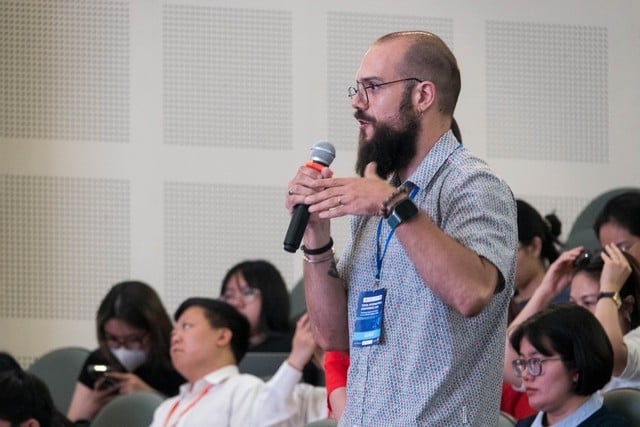
Guests engage in discussions with speakers about the use of AI in education - PHOTO: NGOC LONG
Although teachers themselves have considerable exposure to AI, some share concerns about whether students should use AI, fearing it might negatively impact their critical thinking skills. Many teachers also worry that students will only use AI to complete assignments without actually learning anything, and fear that they will become overly dependent on these tools, according to research by Professor Vien Cao.
Another noteworthy finding, according to Professor Vien Cao, is that many teachers in El Salvador are hesitant to use AI for fear of being perceived as lazy or incompetent by colleagues and school leaders, even though they know the tool offers many benefits, such as helping to provide better feedback to students, providing additional teaching materials, and reducing lesson plan preparation time.
"AI is here and it will continue to exist for a long time. Therefore, we need to learn how to overcome it, not avoid it. Humans are the 'miracle' behind AI tools," advised Ms. Vien Cao.
Despite geographical differences, the professor believes that teachers in Vietnam and El Salvador share a common challenge: how to effectively use AI in the classroom. "Society expects a lot from the teaching profession, but we lack the guidance, resources, and time to adapt to AI," she stated, but expressed confidence that AI will bring opportunities to transform teaching and learning, similar to how Covid-19 inadvertently helped digitize the education sector.
"Although people think our teachers lack power, money, and fame, they all believe that we have the power to change other people's lives. Whether or not we use AI, they still believe that teachers can make a difference in students' lives. Now, with the support of AI, hopefully we can create a greater impact and provide more opportunities for our students," the expert said optimistically.
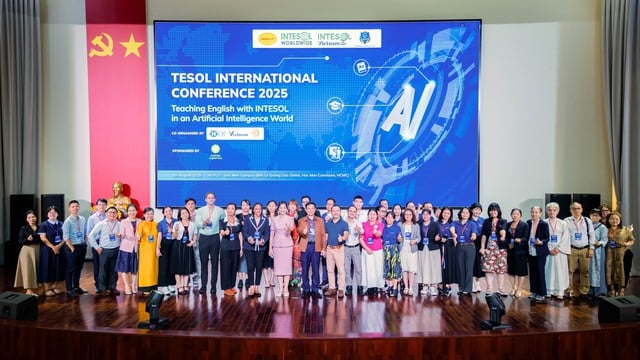
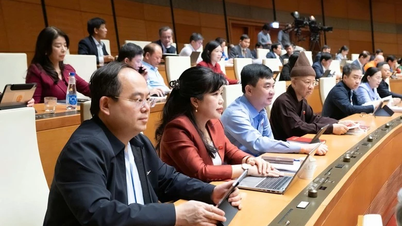
Delegates attending the workshop - PHOTO: HUFLIT
How to take tests in the age of AI
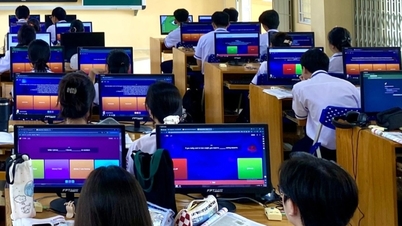
In Vietnam, a study surveying 308 students at four universities in Ho Chi Minh City found that students today tend to be overly reliant on AI tools due to their convenience and effectiveness. They use AI to complete assignments, generate ideas, or edit text. When under pressure, such as approaching deadlines or seeing their peers achieve higher grades, students also turn to AI as a lifeline.
As the author of the aforementioned research, Dr. Tran Vu Diem Thuy, Head of the Department of Applied Linguistics, Faculty of Foreign Languages, Ho Chi Minh City University of Foreign Languages - Information Technology, further explained that many factors influence students' perceptions of AI ethics, such as the frequency and level of AI use; critical thinking and digital skills; the attitude of lecturers; peer influence; and classroom culture...
"The important thing is that without clear penalties or specific warnings, students will have no standards to follow," said Ms. Thuy. "Even lecturers are often confused, not knowing what is right and what is wrong, so how can they help students get the right direction when using AI?" Dr. Thuy stated.
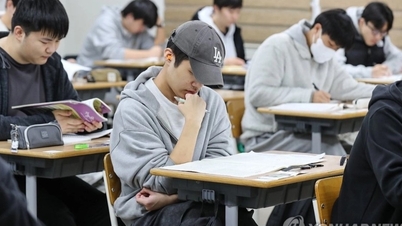
To prevent students from becoming overly reliant on AI, Dr. Thuy suggested implementing "anti-AI" assessment methods, such as oral exams, group projects, or reflective journaling. Additionally, instructors should teach students about AI knowledge and engage in open classroom discussions about its use. At the management level, organizations should issue guidelines such as manuals or handbooks that specifically define how AI should be used, ensuring students adhere to and follow these guidelines.

Dr. Tran Vu Diem Thuy noted that many students are increasingly dependent on AI, therefore the role of lecturers and universities in this context is extremely important - PHOTO: HUFLIT
Speaking to Thanh Nien newspaper on the sidelines of the event, Ms. Thuy commented that the regulatory frameworks for the use of AI in education are currently only in their initial stages. In reality, many teachers simply gather a little bit of what they've learned from various sources to implement for their students. Therefore, having a clear policy on AI from the faculty leadership in particular and universities in general is crucial in the current context.
What do the teachers expect?
From the perspective of teacher training, Dr. Nguyen Thuy Hong Van, Director of INTESOL Vietnam - an organization specializing in training and certifying English language teaching, noted that teachers' needs regarding AI are shifting. From wanting to learn how to use AI tools, teachers now expect to know how to think critically when using AI. "If we only give prompts (commands to AI), receive feedback, and apply it to teaching, we will become slaves to AI," Dr. Van said.
According to Dr. Van, similar to many countries around the world, Vietnam should also develop legal frameworks and curriculum frameworks on AI in education, clearly defining how teachers and learners can use AI effectively, responsibly, and ethically. At the same time, we also need to invest in technology to build tools that help identify content created by AI, alongside the development of AI itself.
However, a challenging reality is that the rapid growth and development of AI is "like a whirlwind," making it difficult to train teachers to adapt to AI. In fact, the training programs currently implemented at Ms. Van's institution are not yet integrated with AI, so the female doctor herself has had to incorporate AI-related content into practical sessions to meet the needs of the teachers.
"In the future, we will definitely update the curriculum, especially in the theoretical aspects, such as how to use AI, ethical issues when using AI, and how to prevent learners from misusing this tool," Dr. Van told Thanh Nien newspaper .
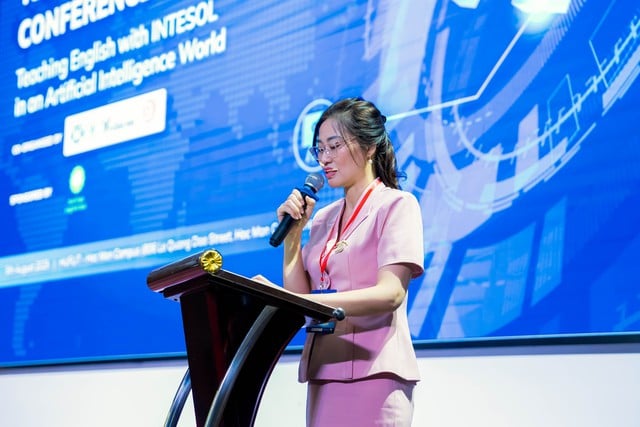
After the initial period of familiarization and learning how to use AI, teachers now have a higher demand for this tool, according to Dr. Nguyen Thuy Hong Van - PHOTO: HUFLIT
Mihaela Dascalu, an international teacher training expert and currently a senior lecturer at INTESOL Worldwide based in the UK, further shared at the event that AI can provide a private space for teachers to practice honest reflection without fear of criticism. AI can also provide analysis of "blind spots" that teachers overlook, such as student engagement levels and teacher-led instruction time, thereby helping to improve teaching methods.
Source: https://thanhnien.vn/ai-tao-ra-nhieu-ap-luc-cho-giao-vien-vi-sao-185250805212703031.htm

































![[Video] The craft of making Dong Ho folk paintings has been inscribed by UNESCO on the List of Crafts in Need of Urgent Safeguarding.](https://vphoto.vietnam.vn/thumb/402x226/vietnam/resource/IMAGE/2025/12/10/1765350246533_tranh-dong-ho-734-jpg.webp)























































Comment (0)