

According to an announcement on the Beijing Education Commission website, starting next school year, September 1st, schools in the capital will teach students at least eight hours of AI.
Schools can implement it as a standalone subject or integrate it with existing subjects such as information technology or science .
China has long harbored ambitions to become a leader in AI. However, it wasn't until early 2025 that the country gained significant attention with the emergence of DeepSeek. The startup launched a low-cost, high-performance AI inference model that rivals its American competitors.
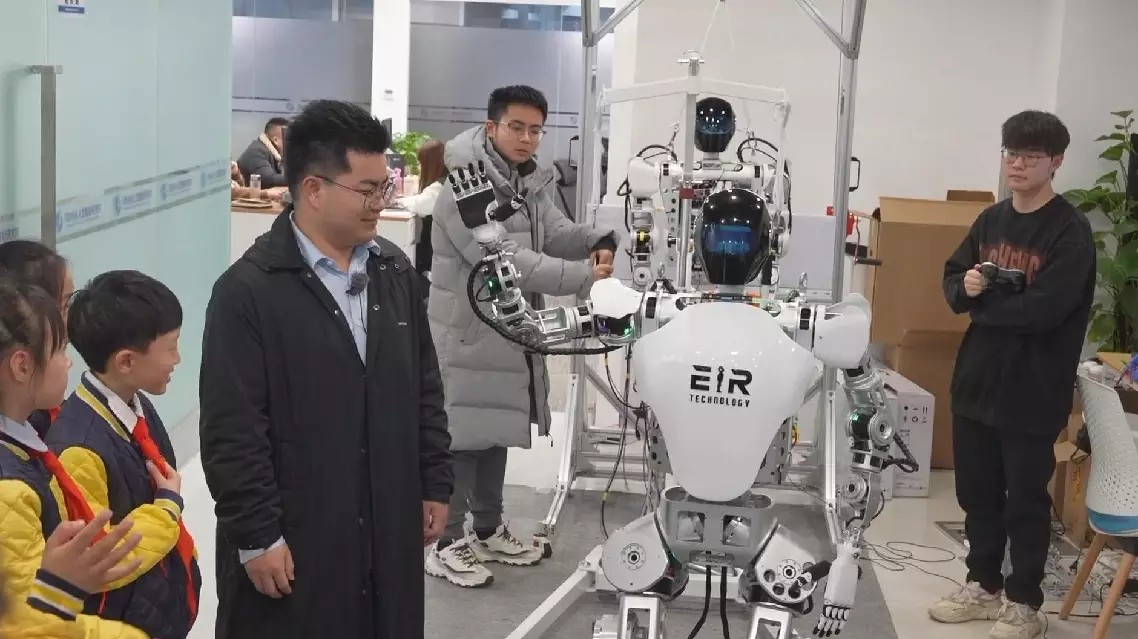
Elementary school students get acquainted with humanoid robots in Chengdu, China. Photo: bastillepost.
At the recently concluded 14th National People's Congress, the Chinese government pledged to support AI models and hardware, while also developing open-source modeling systems and investing in computing power and data for AI.
Speaking on the sidelines of the congress, Education Minister Huai Jinpeng said that the AI-led technological revolution presents great opportunities for education. He revealed that the country will publish a White Paper on AI Education this year.
In 2024, the ministry issued a major policy encouraging AI training from the primary and secondary school levels. Primary school will focus on AI experiences, while secondary school will develop skills for use in AI projects.
At the university level, institutions are also stepping up efforts to integrate AI into teaching, with an increasing number of schools offering interdisciplinary programs, as well as introducing AI courses and textbooks.
For example, Tsinghua University recently announced it would increase its enrollment by 150 students in 2025 and establish a new school to train AI professionals.
According to Xinhua News Agency , Tsinghua University's initiative aims to promote AI-related training and participate in China's efforts to strengthen its scientific and technological self-reliance.
As AI rapidly evolves, reshaping education and socio-economic development, the need for individuals with comprehensive AI knowledge and skills is becoming increasingly urgent.
Wang Xuenan, Deputy Director of the Institute for Digital Education Research under the National Academy of Educational Sciences, said that the number of AI majors last year was over 40,000, but it was still insufficient to meet the nation's needs.
Consulting firm McKinsey & Company estimates that China will need 6 million AI-savvy professionals by 2030.
(According to Chinadaily and Bloomberg)
Source: https://vietnamnet.vn/bac-kinh-day-ai-tu-tieu-hoc-2378986.html




![[Photo] Prime Minister Pham Minh Chinh receives the Chinese Ambassador to Vietnam](https://vphoto.vietnam.vn/thumb/1200x675/vietnam/resource/IMAGE/2026/04/05/1775397481797_ndo_br_dsc-5512-jpg.webp)


















































































Comment (0)