

Traditional art attracts audiences.
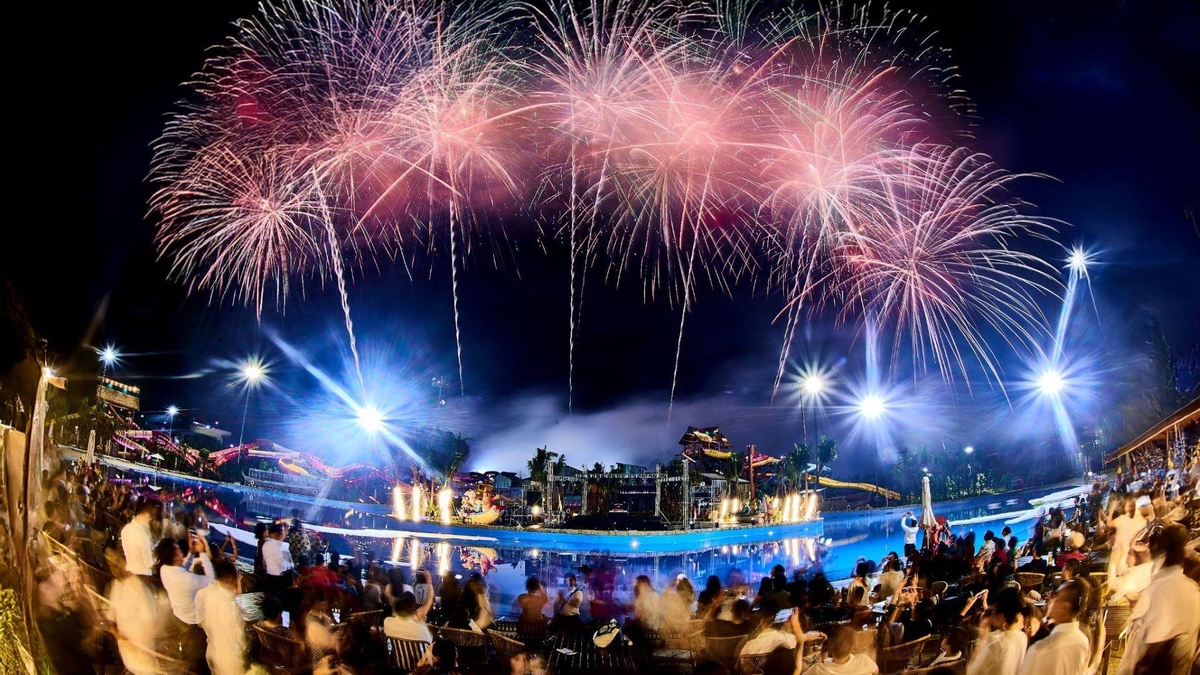
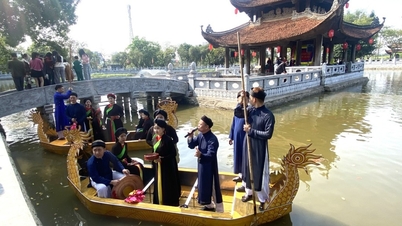
On the occasion of the 80th anniversary of National Day on September 2nd, the Nghia Long Lake area (Bac Giang ward) became a cultural gathering point attracting thousands of people to enjoy the art program "Reunion of Bamboo and Plum Blossoms" organized by artists from the Bac Ninh Quan Ho Folk Song Theater, the Bac Ninh Cheo Theater, and the Provincial Center for Culture and Tourism Promotion. On the shore was an elaborately designed stage, while five dragon boats glided gently on the lake, creating a scene that was both ancient and modern.
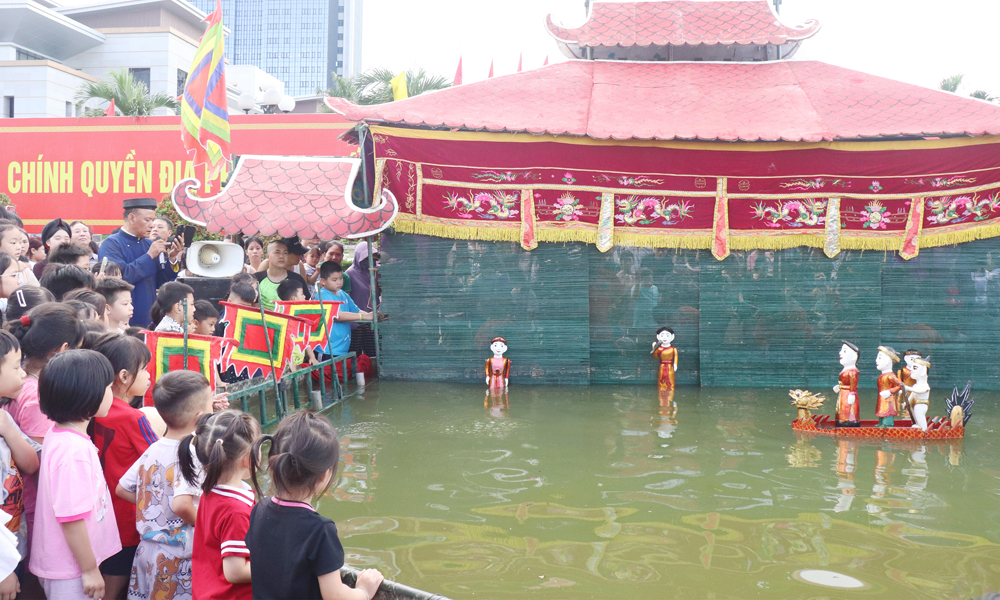 |
Water puppet show at 3/2 Square. |
In the shimmering setting with lights reflecting on the water's surface, the artists, both male and female, sang sweet melodies of Cheo and Quan Ho folk songs such as: "Joyful in Four Seasons," "The Eel Doesn't Care About Getting Its Head Dirty," "Sitting Leaning Against the Boat's Edge," "Sending You a Song of Affection," "The Ferry," etc., much to the delight of the audience. Among the crowd surrounding the lake, Ms. Than Thi Doan from Da Mai ward shared: "It's been a long time since I've heard Quan Ho folk songs on a boat in the middle of the city. I feel like I'm experiencing the atmosphere of the Lim Festival, both familiar and deeply rooted in the traditions of my homeland."
During the National Independence Day celebrations, at 3/2 Square (Bac Giang Ward) and Bac Ninh Museum No. 2 (Kinh Bac Ward), the artisans of Luy Lau Water Puppet Troupe (Song Lieu Ward) presented the public with spectacular water puppet performances. Beginning with the humorous character of Teu, the performance followed a series of stories: Plowing, Fishing, Hunting the Fox and Catching the Duck, Dragon Dance… combined with witty dialogue, drumming, rhythmic clapping, and the smooth melodies of Quan Ho folk songs. This blend created a performance space that was both lively and lyrical, prompting continuous applause from the audience. Artisan Nguyen Thanh Lai, Head of the Luy Lau Water Puppet Troupe, expressed: “The enthusiastic support from the audience made us very happy. It is a motivation for the members to continue creating and preserving this unique form of folk theater.”
Similarly, at the recent OCOP product exhibition at Ngo Gia Tu Park, the traditional art performance space created a unique atmosphere that captivated visitors. Particularly, participating in the National Achievements Exhibition at the National Exhibition Center (Hanoi) from August 28th to September 15th, Bac Ninh presented a series of folk culture experiences: demonstrations of Dong Ho folk painting, woodblock printing at Vinh Nghiem Pagoda, introductions to traditional cuisine, and performances of Quan Ho, Ca Tru, and Hat Then... spreading the cultural essence of Kinh Bac to domestic and international friends.
In recent years, localities throughout the province have regularly organized cultural and artistic programs to enhance the spiritual life of the people. Folk art has always been a highlight and has been warmly received by the public. Many young people enthusiastically film and share these programs on social media, contributing to bringing folk art closer to the community. The ancient melodies and traditional performances, when heard in today's setting, affirm the enduring vitality of this heritage in contemporary life.
Preserving and promoting the value of heritage
The folk art programs that have taken place recently are a prominent highlight in the rich tapestry of Bac Ninh's cultural life. Folk art is making a strong comeback in contemporary life, offering the community a fresh yet familiar "spiritual nourishment." According to the Department of Culture, Sports and Tourism, from the beginning of 2025 to the present, the entire province has organized hundreds of performances, exchanges, and presentations of folk heritage at the grassroots level. Distinctive forms such as Quan Ho folk singing, Cheo folk opera, water puppetry, Ca Tru folk singing, and Trong Quan folk singing regularly appear in festivals and major events, creating "cultural feasts" for the people. Behind these captivating programs and performances lies the persistent effort of artisans and artists to "keep the flame alive," renew, and spread the value of this heritage to a wider audience.
| In recent years, the cultural sector and local authorities have regularly organized cultural and artistic programs to enhance the spiritual life of the people. Folk art has always been a highlight and has been well-received by the public. Many young people enthusiastically film and share these programs on social media, contributing to bringing folk art closer to the community. |
Bac Ninh currently boasts 7 UNESCO-recognized heritage sites, 33 national intangible cultural heritage sites, and nearly 1,400 traditional festivals. This is a valuable treasure trove, but it also places a great responsibility on its preservation and promotion. The province has implemented numerous innovative policies and solutions to ensure that the heritage is not only "preserved" but also truly integrated into modern life. Traditional festivals have been restored, and unique rituals and folk games have been recreated. Many performing arts such as Quan Ho folk singing, Cheo folk opera, Then singing, Trong Quan drumming, and Ca Tru singing are preserved and taught through classes and clubs. Immediately after Quan Ho folk singing was recognized by UNESCO, the province directed the organization of the "Returning to the Quan Ho Region" Festival, maintaining Quan Ho singing on boats and bringing the heritage to major political, diplomatic, and cultural events both domestically and internationally. Research, collection, and promotion efforts have been intensified through various media channels, contributing to enriching and spreading the value of the heritage.
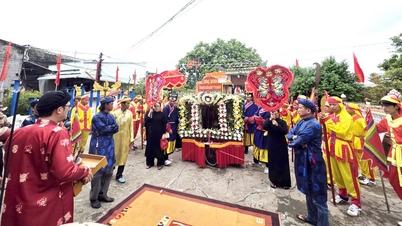
Simultaneously, traditional folk art forms such as Cheo, Ca Tru, Hat Then, and Soong Co are also celebrated and disseminated through festivals and performances, attracting artisans, clubs, and young people to participate. At the grassroots level, many localities organize competitions in Trong Quan singing, exchanges of Cheo and Quan Ho performances, etc., mobilizing the community to participate. This synergy transforms the performances into a festival, where art is not only performed but also shared and passed on. To make the art programs attractive, relevant departments and units always focus on investing in scripts, elaborate staging, and widespread promotion, thus gaining a large audience. Artisans – those who hold the essence of the heritage – are honored and supported, encouraged to continue spreading the value of the heritage to future generations. According to Mr. Trinh Huu Hung, Deputy Director of the Department of Culture, Sports and Tourism, incorporating folk art into cultural events not only serves the spiritual needs of the people but is also an effective way to preserve it. In the coming period, Bac Ninh will continue to invest in performance spaces at historical sites and tourist destinations; linking heritage with tourism development, promoting socio-economic development, and expanding artistic opportunities for the community.
Source: https://baobacninhtv.vn/bac-ninh-dua-nghe-thuat-truyen-thong-den-gan-khan-gia-postid426447.bbg
















![[Photo] Reception to welcome General Secretary and President To Lam and his wife on their State visit to the Philippines](https://vphoto.vietnam.vn/thumb/1200x675/vietnam/resource/IMAGE/2026/06/01/1780295488620_vna-potal-chieu-dai-chao-mung-tong-bi-thu-chu-tich-nuoc-to-lam-va-phu-nhan-tham-cap-nha-nuoc-toi-philippines-8798060-7855-jpg.webp)










































Comment (0)