

 |
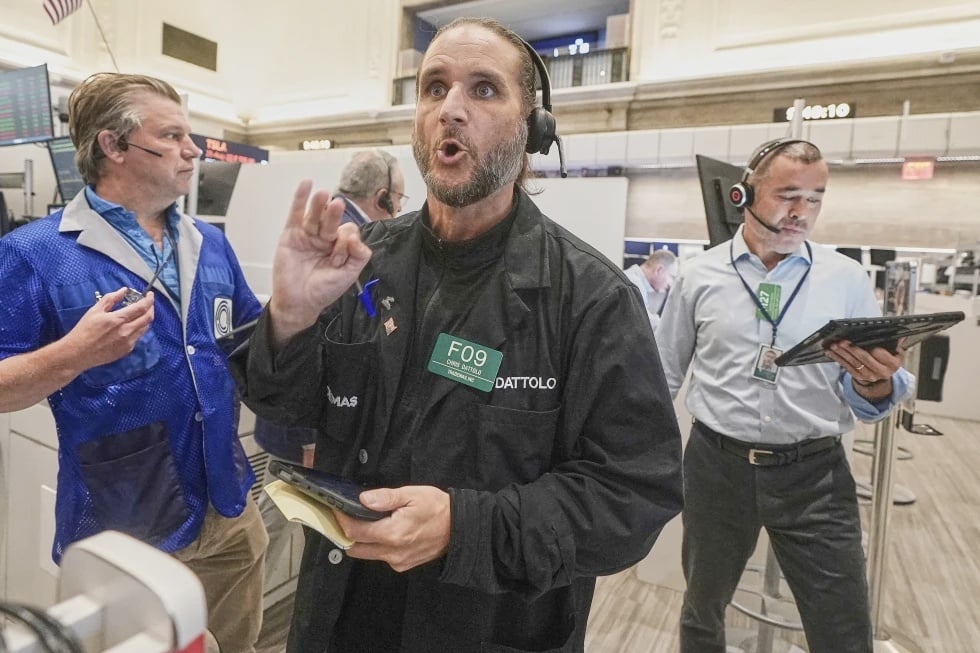
| Meta and Microsoft plummet, the Fed signals a hawkish stance, and Wall Street falters from its record highs. |
At the close of trading, the S&P 500 fell 1.0%, or 68.25 points, to 6,822.34. The Nasdaq Composite lost 1.6% (-377.33 points) to 23,581.14, heavily pressured by tech giants. The Dow Jones Industrial Average edged down 0.2% (-109.88 points) to 47,522.12. The Russell 2000, representing smaller-cap stocks, also declined 0.8% to 2,465.94.
The negative developments on Wall Street occurred immediately after the indices all hit historical highs in the previous session, partly reflecting the cooling of optimism that had been fueled by expectations of positive outcomes in US-China trade negotiations and third-quarter 2025 earnings reports from Big Tech companies.
The highlight of the session was the sharp decline in Meta Platforms, with Microsoft being one of the stocks with the greatest influence on the S&P 500.
Meta Platforms shares plunged as much as 11.3%, erasing much of their year-to-date gains, after the company revealed plans to significantly increase investment in artificial intelligence in 2026. Analysts fear that the influx of capital into AI infrastructure could put pressure on profits, amid a fierce spending spree by the tech industry.
Meanwhile, Microsoft's stock fell 2.9% despite both revenue and profit for the recently announced quarter exceeding expectations. Management's warning that capital spending will continue to increase in the next fiscal year has led many investors to worry about potential declines in profit margins, especially as Azure's growth rate is seen as slowing.
Conversely, Alphabet, Google's parent company, rose 2.5% thanks to steady growth in its advertising and cloud computing segments. However, this increase was not enough to offset losses from Meta and Microsoft, as these three Big Tech companies alone account for 14.5% of the S&P 500's market capitalization. This means that fluctuations in this group can easily influence the overall market trend.
Outside of the technology sector, Eli Lilly emerged as a rare bright spot, rising 3.8% after reporting better-than-expected revenue driven by booming demand for diabetes and obesity medications such as Mounjaro and Zepbound.
Downward pressure also stems from developments in the currency market. Although the Fed implemented the expected 25 basis point rate cut on October 29th, Chairman Jerome Powell emphasized that further rate reductions in December are not certain.
This announcement immediately dampened expectations for a third interest rate cut this year: the probability of it happening in December has fallen to around 70%, from over 90% just a few days earlier, according to CME Group data.
The yield on 10-year Treasury bonds held at 4.08%, up from 3.99% before Powell's warning, reflecting investor caution about the cost of capital in the coming period. Concerns about inflation may persist, prompting the Fed to act more cautiously to control the risk of renewed price increases.
At the same time as the market correction, the event of interest was the meeting between US President Donald Trump and Chinese President Xi Jinping. The White House described the dialogue as a success beyond expectations, even giving it a "12 out of 10" rating. President Trump also pledged to consider cutting tariffs on Chinese goods.
However, analysts believe these developments will only have a short-term psychological impact, as the structural disagreements between the world's two largest economies remain unresolved.
“The results are good, but not good enough compared to market expectations. These are just small gestures of goodwill, not a breakthrough agreement,” said Brian Jacobsen, Chief Economist at Annex Wealth Management.
The developments on October 30th showed that the market is shifting from an euphoric to a cautious state. The indices did not fall sharply, but the correction is considered necessary after a strong rally based on several positive expectations: better-than-expected earnings results; hopes that the Fed will accelerate its easing schedule; and an improving international trade environment.
However, with the supporting factors unclear, increased profit-taking sentiment is inevitable.
In the current context, investors need to pay particular attention to three factors that could drive market trends in the coming period: - The Fed's interest rate policy directly impacts stock valuations and the cost of capital. - Profit growth of Big Tech , the group that most strongly influences the index. - Substantive progress in US-China relations , impacting international supply chains and capital flows. |
The October 30th session may just be a "step back to move forward," but caution is essential for investors during this volatile period.
Source: https://thoibaonganhang.vn/big-tech-hut-hoi-thoi-bay-da-hung-phan-cua-pho-wall-172828.html
![[Photo] Prime Minister Pham Minh Chinh receives the Chinese Ambassador to Vietnam](https://vphoto.vietnam.vn/thumb/1200x675/vietnam/resource/IMAGE/2026/04/05/1775397481797_ndo_br_dsc-5512-jpg.webp)












































































































Comment (0)