

An international team of scientists has developed a pen with tiny 50-micrometer particles, made of a special material capable of ion exchange in liquids.
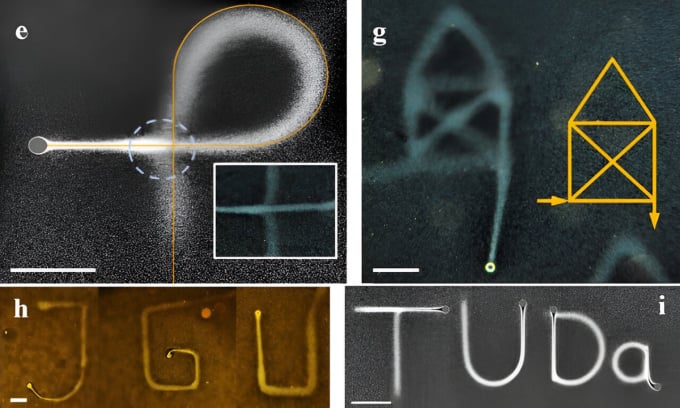
Some examples of writing in the country. Photo: Small
Water is not a preferred environment for writing because its constant movement and swirling cause ink to quickly diffuse and lose its shape. However, a research team from Johannes Gutenberg University Mainz (JGU) and Darmstadt University of Technology in Germany, and Huazhong University of Science and Technology in China, has developed a special "pen" that allows writing in this environment. The new research was published in the journal Small.
The new device is a tiny particle, only 50 micrometers wide, made of a special material capable of ion exchange in liquids, creating regions with relatively low pH. Then, traces of the particle suspended in water are drawn into an acidic solution, from which continuous lines can be created.
To keep the writing stable, the pen moves water around the particle, rather than moving the particle within the water. Initially, this was done manually, but later, the research team used a pre-programmed device.
"In an area of water no larger than a 1-euro coin, we created a model resembling a simple house, about the size of a dot on an 18-point font, and then observed it under a microscope. But we are still in the early stages," said physicist Thomas Palberg from JGU.
The pen's ultra-small size, and the fact that the water moves around it rather than the other way around, ensures the liquid remains as stable as possible. The lines remain visible for over 15 minutes and can create many different shapes by using light techniques to activate or deactivate ion exchange.
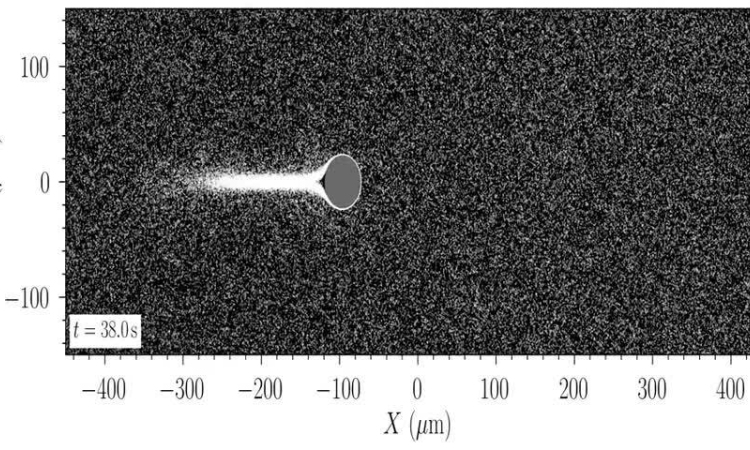
This video demonstrates how to draw a straight line. Video : Small
In addition to physics experiments, the team of experts also studied several theoretical models to uncover the underlying mechanisms. They believe this technique could be extended to other types of pens, for example, a laser-heated pen that could operate autonomously in water.
"This could even allow for the parallel writing of structures in water. Thanks to this, the new mechanism will help create complex patterns in liquids," said physicist Benno Liebchen from TU Darmstadt.
Although still in its early stages, the new type of pen has enormous potential, from creating new art forms to the ability to track chemical trails as it moves through liquids. The research team says the new method opens up flexible avenues for writing, drawing, and pattern making in liquids.
Thu Thao (According to Science Alert )
Source link





































































Comment (0)