

This was shared by Ms. Trinh Thi Thu Hien – Head of the Industrial Goods Import-Export Department – Import-Export Department ( Ministry of Industry and Trade ) at the training session “Support and guidance on import-export regulations for industrial goods to markets where Vietnam has signed FTAs” organized by the Hanoi Department of Industry and Trade in coordination with the Import-Export Department (Ministry of Industry and Trade), and the Vietnam TBT Office (National Committee for Standards, Metrology and Quality) on September 10th in Hanoi.
Things to note for export businesses.
Sharing her perspective on the application of import and export regulations for industrial goods in the context of FTA implementation, Ms. Trinh Thi Thu Hien cited the example of textiles (HS 5603). According to the rules of origin of the EVFTA, there is a requirement regarding the needle-punching process. However, recently, we have seen the production of non-woven fabrics, which do not require needle-punching but still produce finished textile products. Comparing this with actual production practices and the agreement's regulations, it is clear that we are not meeting the requirements.
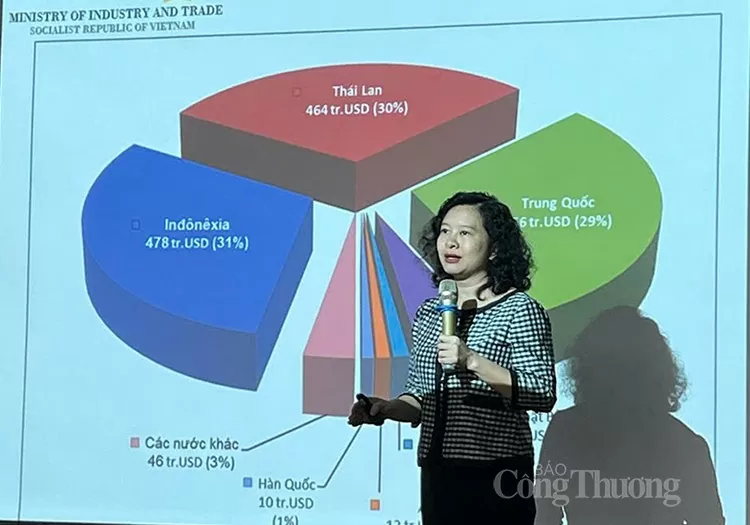 |
| Ms. Trinh Thi Thu Hien – Head of the Industrial Goods Import-Export Department – Import-Export Bureau (Ministry of Industry and Trade) |
Or consider carpets made from fabric scraps. These scraps are collected from many places, then brought back and used in production. Tracing their origin is difficult. For businesses producing carpets and exporting them to the EU, how can they prove that their products originate from Vietnam and qualify for preferential tariffs under the EVFTA agreement?
This is a technical and somewhat complex issue, but according to Ms. Hien, businesses producing carpets or non-woven fabrics still benefit from tariff preferences under the EVFTA agreement when exporting to the EU market.
The application of flexible tariff rates was also a major concern for businesses in the early stages of the EVFTA agreement's implementation. To date, although this issue has become more standardized, there are still some cases of incorrect or inaccurate application, potentially leading to problems related to interpretation and application that affect the eligibility for preferential tariffs on goods exported to the EU.
Specifically, there are items related to the note: "A percentage of non-compliant materials of origin may be applied." When these notes are combined, they apply to both the above and below criteria, rather than a flexible percentage only applying to the below note.
Some businesses encountered difficulties in applying the lower criteria while neglecting the upper criteria, thus missing out on several calculation methods that support goods meeting origin requirements to benefit from preferential tariffs.
Regarding safeguard measures for goods exported to markets within the Eurasian Economic Union (EEC), this market recently issued regulations stating that certain product codes, when exported to this market (primarily Russia), exceeding a certain production threshold and potentially affecting or competing with domestic products, as well as posing risks to domestic protection, will be subject to safeguard measures. For goods currently subject to these safeguard measures, it is possible that the Eurasian Economic Commission (EEC) and Russia will introduce regulations and requirements to impose MFN tariffs instead of preferential tariffs, a safeguard measure already included in the Agreement.
Therefore, businesses also need to pay attention to this issue when exporting goods, because while they may benefit from preferential tariffs under the Agreement (0% or 5%), they may have to pay safeguard duties at thresholds, resulting in tariffs of up to 20-30%.
Regarding the amended Protocol within the framework of the EU – EVFTA, Ms. Hien stated that there will be a change in the HS code version, using the 2022 version; an addition of criteria related to Chapter 41, which businesses involved in leather and footwear products related to tanned and raw hides need to pay attention; related items under HS code 6212; and the language of Chapter 19. These are contents that Vietnam and the EU have agreed upon and have guidance on at different levels of documents, but the amended Protocol will specify them and make them legally binding between the two sides, as well as facilitating future guidance and implementation.
Not all FTAs have low tariff rates.
Given that Vietnam is participating in numerous FTAs, we have many advantages compared to countries without FTAs, as Vietnamese goods benefit from preferential tariffs.
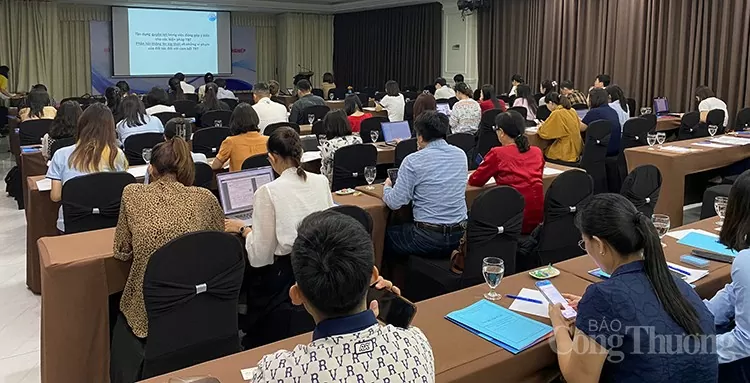 |
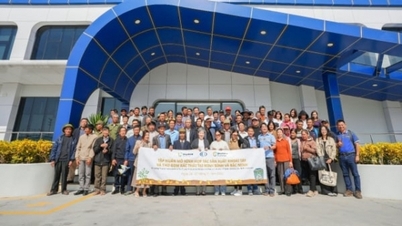
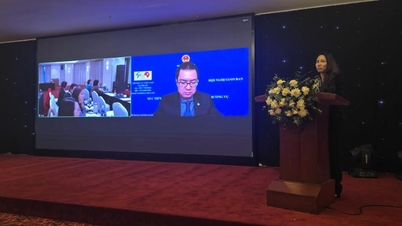
| Overview of the training session |
However, this can also be a tool to neutralize tariff preferences and may lead to the application of measures to suspend preferential treatment, not only for a single exporting company or a specific product, but for the entire industry and all companies producing goods under the relevant HS code when exporting to the partner country. These are quite strict regulations in some new-generation FTAs. Businesses should also be aware of this issue.
"When they discover involvement in fraud and the business cannot provide proof, or the Vietnamese authorities cannot provide proof, they will take measures to temporarily suspend preferential treatment for a series of goods sharing the same HS code or for a series of businesses exporting the same goods to the partner market," Ms. Hien emphasized.
On the other hand, there are cases where some businesses exporting goods to Japan, Australia, or New Zealand are still accustomed to using the AANZ Certificate of Origin (CO) within the framework of the ASEAN-Australia-New Zealand Free Trade Agreement; or using the AJ or VJ Certificates of Origin within the framework of the Vietnam-Japan Economic Partnership Agreement (VJEPA) and the ASEAN-Japan Comprehensive Economic Partnership Agreement (AJCEP). However, upon being informed of the emergence of new agreements such as the CPTPP and RCEP, these businesses immediately shift their approach and adopt the new agreements.
However, the tariffs in the new agreement may not necessarily be as favorable as those in the old agreement, because the tariffs in the new agreement are at the peak of their reduction trajectory, while those in the old agreements were already at the bottom. The appropriate application depends on the specific goods, markets, and tariffs at the time of export.
“For agricultural products exported to Japan, the tariff rate under the CPTPP might be 0%, but under the AJCEP and VJEPA it could be 8% or 5%. While the CPTPP is a newly signed agreement, the AJCEP and VJEPA have been in place for a long time,” Ms. Hien cited as an example. These are points that businesses need to pay attention to, related to the HS code of the exported goods, the export market, and the agreements to which those countries are members.
"Within the CPTPP agreement , seven countries are already trading partners in other FTAs. Only Canada, Mexico, and Peru are three countries that do not have any FTAs or tariff preferences with Vietnam. Therefore, businesses operating in import and export with these markets can take advantage of the tariff preferences from the CPTPP, while for other markets, businesses can choose FTAs that suit their production processes or offer more tariff preferences," Ms. Hien advised.
Source: https://congthuong.vn/xuat-khau-hang-cong-nghiep-cach-nao-tan-dung-hieu-qua-nhat-loi-the-tu-cac-fta-345029.html

![[Image] Leaked images ahead of the 2025 Community Action Awards gala.](/_next/image?url=https%3A%2F%2Fvphoto.vietnam.vn%2Fthumb%2F1200x675%2Fvietnam%2Fresource%2FIMAGE%2F2025%2F12%2F16%2F1765882828720_ndo_br_thiet-ke-chua-co-ten-45-png.webp&w=3840&q=75)
![[Live] 2025 Community Action Awards Gala](/_next/image?url=https%3A%2F%2Fvphoto.vietnam.vn%2Fthumb%2F1200x675%2Fvietnam%2Fresource%2FIMAGE%2F2025%2F12%2F16%2F1765899631650_ndo_tr_z7334013144784-9f9fe10a6d63584c85aff40f2957c250-jpg.webp&w=3840&q=75)

![[Photo] Prime Minister Pham Minh Chinh receives the Governor of Tochigi Province (Japan)](/_next/image?url=https%3A%2F%2Fvphoto.vietnam.vn%2Fthumb%2F1200x675%2Fvietnam%2Fresource%2FIMAGE%2F2025%2F12%2F16%2F1765892133176_dsc-8082-6425-jpg.webp&w=3840&q=75)
![[Photo] Prime Minister Pham Minh Chinh receives Lao Minister of Education and Sports Thongsalith Mangnormek](/_next/image?url=https%3A%2F%2Fvphoto.vietnam.vn%2Fthumb%2F1200x675%2Fvietnam%2Fresource%2FIMAGE%2F2025%2F12%2F16%2F1765876834721_dsc-7519-jpg.webp&w=3840&q=75)



















































Comment (0)