

At the close of trading on July 29, the Vietnamese stock market surprised everyone with the VN-Index falling sharply by 64.01 points (4.11%) to 1,493 points; the HNX Index also lost 3.2% to 255.36 points, while the Upcom Index retreated to 106.07 points.
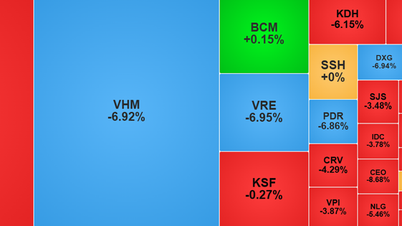
Stocks plummeted to their lower limit across the board.
Not only did the market experience significant fluctuations in points, but it also recorded a trading session with record liquidity, with the trading value on the HOSE exchange alone exceeding 71,700 billion VND - the highest ever. A series of stocks unexpectedly hit their lower limit, surprising investors - after the market had just seen strong gains and some stocks reaching their upper limit in previous trading sessions.
Across various investment forums and groups, many investors who had just bought shares at the ceiling price 1-2 days earlier, before the money even reached their accounts, have now seen the price plummet to the floor, resulting in heavy losses.
Ms. Bich Van (an investor in Ho Chi Minh City) said that she was busy with work today, and when she opened the stock ticker in the afternoon, she was shocked to see the market had "plunged" by more than 64 points, with stocks in her portfolio hitting the floor limit before she could take profits.
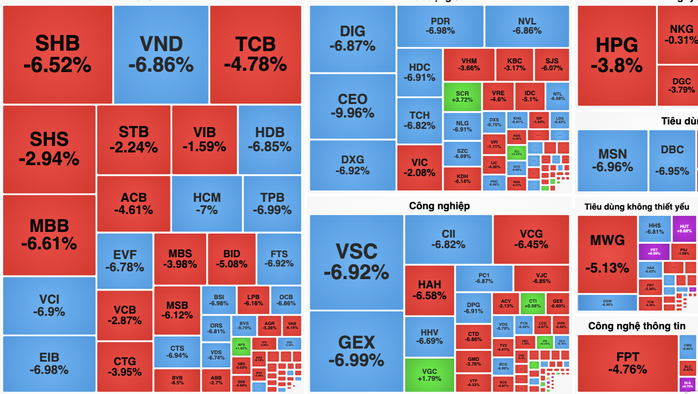
Stocks plummeted to their lower limit in today's sharp decline.
According to Vietnam Construction Securities Company (CSI), under strong profit-taking pressure, a series of stocks hit their lower limit, trading sentiment showed signs of panic, and demand was weak. On the HOSE exchange, as many as 314 stocks declined, completely overwhelming the only 41 stocks that increased in price. Trading volume was the highest since the stock market began operating, surpassing even the decline on the day the reciprocal tax announcement was made and nearly double the average of the past 20 sessions.
"This was an unexpected decline in both magnitude and liquidity. The upward trend has reversed after today's sharp drop. However, the VN-Index is likely to rebound after these unexpected sharp declines, before returning to a correction phase. This rebound is an opportunity for investors to continue selling off some of their stock holdings and avoid bottom-fishing at the present time. It is expected that after the rebound, the VN-Index will correct to the support zone around 1,420 points, at which point new buying positions will begin to be activated," – a CSI securities expert predicted.
Record liquidity is a good sign.
Speaking with a reporter from Nguoi Lao Dong Newspaper, Mr. Truong Hien Phuong, Senior Director of KIS Vietnam Securities Company, said that in the current market context, this is an inevitable correction in an upward cycle. These corrections are necessary to bring stock prices and the market to a more reasonable price range.
"This is a normal phenomenon, creating opportunities for investors who are currently on the sidelines to disburse funds and buy shares. This will support a stronger and more sustainable market rally. When the VN-Index rose from around 1,200 points to over 1,550 points, equivalent to an increase of more than 300 points, many stocks have achieved good returns, making investors want to take profits," analyzed Mr. Truong Hien Phuong.
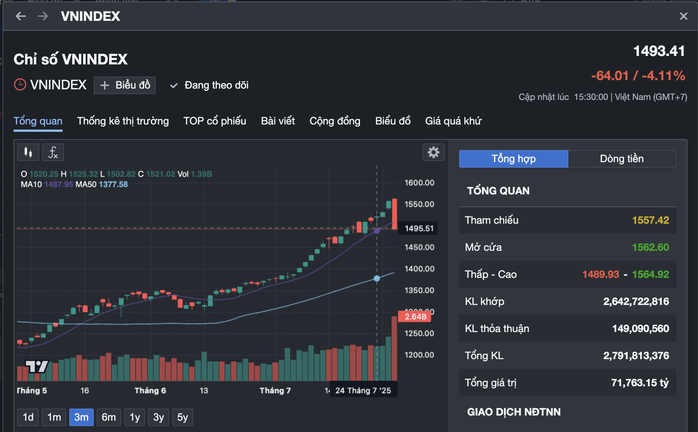
The VN-Index has now fallen below the 1,500-point mark.
Regarding the market's record-breaking liquidity, experts at KIS Vietnam Securities believe that the 2.8 billion shares traded, valued at over 71,700 billion VND, represent the highest volume ever recorded in the stock market. While this figure is surprising, it's not entirely unexpected. This liquidity isn't simply a reflection of new capital flows from buyers and sellers, but rather the speed of capital turnover among investors.
In the short term, the market may experience further downward corrections, but the medium- and long-term outlook remains positive, especially as tariff issues are gradually being resolved, particularly between major markets such as the US, EU, Japan, and Vietnam. Geopolitical tensions are also easing, and the market expects the US Federal Reserve (FED) to potentially lower interest rates in the near future.
Source: https://nld.com.vn/chuyen-gia-noi-gi-ve-phien-boc-hoi-dot-ngot-64-diem-cua-vn-index-196250729173409324.htm

![[Photo] Prime Minister Pham Minh Chinh receives the Governor of Tochigi Province (Japan)](/_next/image?url=https%3A%2F%2Fvphoto.vietnam.vn%2Fthumb%2F1200x675%2Fvietnam%2Fresource%2FIMAGE%2F2025%2F12%2F16%2F1765892133176_dsc-8082-6425-jpg.webp&w=3840&q=75)
![[Live] 2025 Community Action Awards Gala](/_next/image?url=https%3A%2F%2Fvphoto.vietnam.vn%2Fthumb%2F1200x675%2Fvietnam%2Fresource%2FIMAGE%2F2025%2F12%2F16%2F1765899631650_ndo_tr_z7334013144784-9f9fe10a6d63584c85aff40f2957c250-jpg.webp&w=3840&q=75)
![[Image] Leaked images ahead of the 2025 Community Action Awards gala.](/_next/image?url=https%3A%2F%2Fvphoto.vietnam.vn%2Fthumb%2F1200x675%2Fvietnam%2Fresource%2FIMAGE%2F2025%2F12%2F16%2F1765882828720_ndo_br_thiet-ke-chua-co-ten-45-png.webp&w=3840&q=75)
![[Photo] Prime Minister Pham Minh Chinh receives Lao Minister of Education and Sports Thongsalith Mangnormek](/_next/image?url=https%3A%2F%2Fvphoto.vietnam.vn%2Fthumb%2F1200x675%2Fvietnam%2Fresource%2FIMAGE%2F2025%2F12%2F16%2F1765876834721_dsc-7519-jpg.webp&w=3840&q=75)





























































































Comment (0)