

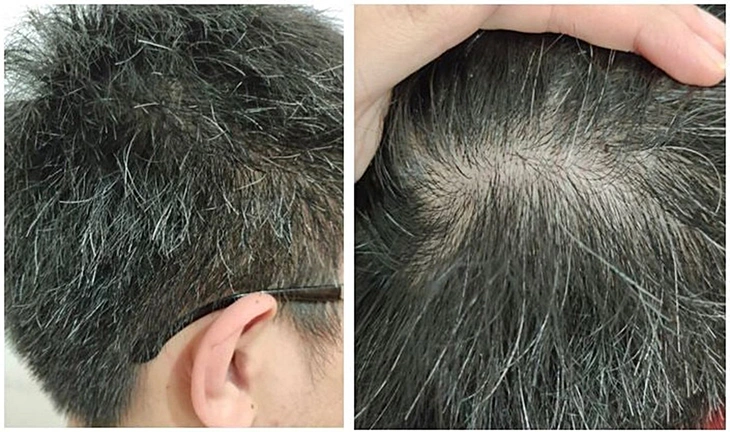
Premature graying of hair in a 20-year-old male - Photo: Provided by the Central Dermatology Hospital
Is there a link between gray hair and cancer?
Discussing this issue, Dr. Nguyen Thi Ha Vinh, Deputy Head of the Day Inpatient Treatment Department at the Central Dermatology Hospital, said that there are currently many studies on gray hair and related factors.
However, it is "too early to conclude" that gray hair is a sign of increased cancer risk.
"Having a lot of gray hair does not necessarily mean a higher risk of cancer. To date, there is no strong enough medical evidence to confirm this," Dr. Vinh emphasized.
According to Dr. Vinh, one reason for people's concern is the image of cancer patients, especially those undergoing chemotherapy, often experiencing hair loss or graying. This creates the association that gray hair is related to malignancy.
However, in reality, changes in hair color in cancer patients are mainly due to the effects of medication or debilitation, which is completely different from the natural graying of hair.
Experts advise people to be cautious about information circulating online and to access official medical sources to protect their health.
Why do many young people get gray hair prematurely?
According to Dr. Vinh, premature graying of hair is defined differently depending on ethnicity. For Caucasians, it's before age 20; for Asians (including Vietnamese) it's before age 25; and for Black people it's before age 30. When gray hair appears before these milestones, it's considered premature graying.
In Vietnam, the incidence of premature graying of hair before the age of 25 is increasing. Gray hair is essentially a sign of the aging process, similar to the appearance of wrinkles and discoloration in the skin. As hair ages, the pigment in the hair follicles decreases, causing the hair strands to turn gray or white.
It is noteworthy that during examinations, doctors have encountered cases of children as young as 6 years old with completely white hair. After testing, many patients were found to have a genetic predisposition from their parents, a cause that current medicine cannot completely address.
Premature graying of hair can be caused by many factors, including unchangeable elements such as genetics or individual predisposition. However, modern lifestyles also contribute to faster hair aging.
A diet deficient in micronutrients such as vitamin B12, iron, zinc, and vitamin D can cause premature graying of hair.
Poor nutrition, consuming high-calorie foods that lack essential micronutrients, overuse of fast food, or prolonged meal skipping all affect hair pigmentation.
In addition, prolonged stress is one of the factors that cause premature graying of hair. Stress and pressure cause the body to increase the production of free radicals, affecting many organs. In the case of hair, this contributes to hair loss, weakening, and premature graying.
Several medical conditions are also associated with premature graying of hair, such as obesity, metabolic disorders, thyroid disease, and autoimmune diseases. If gray hair is accompanied by the aforementioned chronic conditions, fatigue, excessive hair loss, or unusual skin changes, the patient should see a doctor to determine the exact cause.
Doctor Vinh advises people not to believe advertisements for quick gray hair treatments. Gray hair is a part of the physiological process; it can be partially controlled but is difficult to completely reverse.
To minimize premature graying of hair, experts recommend maintaining a nutritious diet, getting enough sleep, managing stress, and consulting a specialist if any unusual symptoms appear. For young children with gray hair, parents should have them undergo a general health check-up to rule out any underlying medical conditions and assess genetic factors.
Source: https://tuoitre.vn/co-phai-toc-bac-nhieu-la-dau-hieu-cua-ung-thu-2025121612271052.htm
![[Image] Leaked images ahead of the 2025 Community Action Awards gala.](/_next/image?url=https%3A%2F%2Fvphoto.vietnam.vn%2Fthumb%2F1200x675%2Fvietnam%2Fresource%2FIMAGE%2F2025%2F12%2F16%2F1765882828720_ndo_br_thiet-ke-chua-co-ten-45-png.webp&w=3840&q=75)
![[Photo] Prime Minister Pham Minh Chinh receives Lao Minister of Education and Sports Thongsalith Mangnormek](/_next/image?url=https%3A%2F%2Fvphoto.vietnam.vn%2Fthumb%2F1200x675%2Fvietnam%2Fresource%2FIMAGE%2F2025%2F12%2F16%2F1765876834721_dsc-7519-jpg.webp&w=3840&q=75)
![[Live] 2025 Community Action Awards Gala](/_next/image?url=https%3A%2F%2Fvphoto.vietnam.vn%2Fthumb%2F1200x675%2Fvietnam%2Fresource%2FIMAGE%2F2025%2F12%2F16%2F1765899631650_ndo_tr_z7334013144784-9f9fe10a6d63584c85aff40f2957c250-jpg.webp&w=3840&q=75)
![[Photo] Prime Minister Pham Minh Chinh receives the Governor of Tochigi Province (Japan)](/_next/image?url=https%3A%2F%2Fvphoto.vietnam.vn%2Fthumb%2F1200x675%2Fvietnam%2Fresource%2FIMAGE%2F2025%2F12%2F16%2F1765892133176_dsc-8082-6425-jpg.webp&w=3840&q=75)





































![[Photo] Prime Minister Pham Minh Chinh attends the Vietnam Economic Forum 2025](https://vphoto.vietnam.vn/thumb/402x226/vietnam/resource/IMAGE/2025/12/16/1765893035503_ndo_br_dsc-8043-jpg.webp)























Comment (0)