

At the workshop “Advanced materials, energy technology and healthcare in the era of artificial intelligence” within the VinFuture 2025 Science and Technology Week, Professor Dang Van Chi presented research showing that circadian rhythms and cell metabolism play a key role in determining the effectiveness of immunotherapy and targeted drugs.
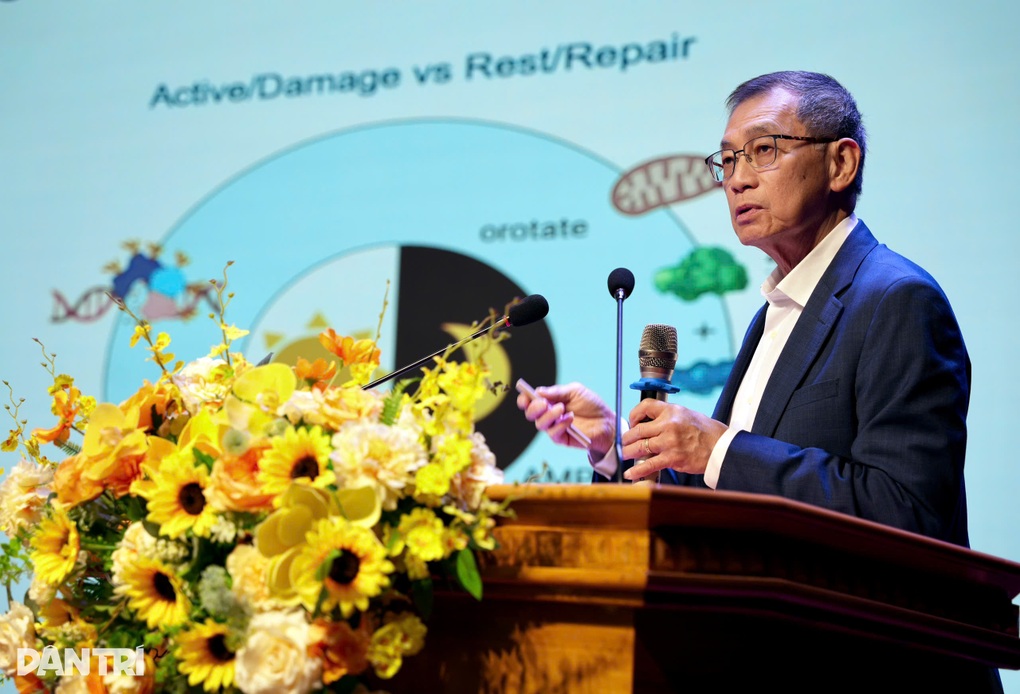
Professor Dang Van Chi shares about "Biological rhythms, cancer metabolism and immunotherapy" (Photo: Hai Yen).
Circadian rhythms play a pivotal role in cancer cell control
Circadian rhythm is considered one of the most important regulatory systems of the human body. This mechanism operates through a gene network that operates in a 24-hour cycle. In which BMAL1 and CLOCK are two central factors that help regulate sleep, energy metabolism, hormones and homeostasis.
When the biological clock works rhythmically, cells have clear working and resting times. When this rhythm is out of phase, the ability to repair DNA is reduced, many life processes become disordered.
Analyses published in Cell Metabolism and Nature Reviews Cancer show that circadian rhythm disruption not only affects sleep and metabolism, but also weakens the immune system. When immune cells are activated at the wrong time, the body has a harder time detecting and eliminating abnormal cells that can become the seeds of cancer.
To better understand this mechanism, scientists often use animal models. This is the standard method in biomedical research because it can control genes, living environment and cell activity, which is not possible in human studies. In many experiments, mice are chosen because their genetics and biological mechanisms are similar to humans.
When researchers removed the BMAL1 gene in mice, the animals showed a range of signs of disorders such as premature aging, metabolic imbalance and faster-than-normal tumor formation.
These results suggest that when the circadian clock is disabled, cells lose their ability to divide in a controlled manner and are more susceptible to a state of abnormal proliferation.
Explaining this mechanism, Professor Dang Van Chi said: “The biological clock is like a command center. It decides when cells should be active and when they need to rest to repair themselves. When this mechanism is broken, the cell division process becomes chaotic and creates conditions for cancer cells to appear.”
Circadian rhythms also influence the activity of the immune system. Many international studies have shown that T cells and macrophages are most active in the morning.
This is believed to be the reason why patients tend to respond better to immunotherapy when treated at this time. A biological timing-based treatment approach is expected to bring higher efficacy and reduce unnecessary toxicity.
Metabolic reprogramming sets the stage for uncontrolled proliferation
In his presentation on the molecular mechanism of cancer, Professor Chi emphasized the central role of the MYC gene. This is one of the most influential cancer genes and appears in most common cancers.
This gene not only promotes cell division but also disrupts the cell's circadian rhythm. When the molecular rhythm is disrupted, cancer cells escape natural control mechanisms and continue to proliferate.
During his time at the University of California San Francisco, Professor Chi first showed the link between overactivity of MYC and profound changes in the way cells produce energy.
When MYC is strongly activated, the cell becomes more dependent on glycolysis and lactate production. This cascade of reactions is controlled by the enzyme Lactate Dehydrogenase A.
Published studies at the Wistar Institute and Johns Hopkins show that MYC promotes hyperactivation of LDH A, causing cells to enter an abnormal metabolic state known as the Warburg Effect.
In the Warburg Effect, cancer cells consume glucose at a very high rate and produce a lot of lactic acid even when there is enough oxygen. This process provides a quick source of energy for the cells to continuously proliferate. The lactic acid accumulates, making the environment around the tumor acidic.
This hampers immune cell activity because many T cells cannot function effectively in an acidic environment. This is one of the ways cancer cells create a safe zone that helps them avoid attack.
Professor Chi asserts that metabolism is the foundation of growth. If we can hit the energy supply, we weaken the tumor's core advantage.
Based on this principle, his laboratory developed a group of molecules that can inhibit LDH. Experiments in mouse models showed that LDH inhibitors reduced tumor growth rate and significantly improved the microenvironment.
When lactic acid levels are reduced, immune cells can enter and function more effectively. Notably, when LDH inhibitors are combined with PD1 antibodies, many models have recorded complete tumor disappearance.
However, this approach still faces a significant challenge. Red blood cells are completely dependent on glycolysis for energy. When LDH is inhibited, they are vulnerable to damage and hemolysis.
This is why the research team is continuing to develop more selective molecules that target cancer cells while limiting the impact on healthy cells.
Diet and gut microbiota modulate immune response
In recent years, the gut microbiome has been considered one of the most influential areas in cancer treatment.
Published studies in Nature Medicine and Cell show that gut bacteria not only aid digestion but also participate in immune regulation.
Several research groups have found that patients with different microbiomes respond differently to immunotherapy. Some bacteria boost T-cell activity, while others make it harder for the immune system to recognize cancer cells.
In investigating this connection, scientists focused on choline, a nutrient commonly found in meat and seafood.
Once in the intestine, choline is broken down by certain bacteria into TMA. The liver then converts TMA into TMAO.
Several independent studies by the Ludwig Cancer Institute and Johns Hopkins University have shown that TMAO levels in the blood of liver cancer patients are closely associated with treatment effectiveness. Patients with high TMAO levels often respond poorly to anti-PD1 therapy and have a shorter survival time.
To test this mechanism, the research teams conducted experiments on mouse models. When mice were fed a choline-rich diet, TMAO levels increased dramatically.
As a result, immunotherapy becomes less effective even when the drug is given at the right dose and at the right time. Conversely, when the bacterial enzyme responsible for creating TMA is inhibited, TMAO levels are significantly reduced and the immune system becomes more active. The ability to respond to anti-PD1 drugs is restored.
According to Professor Chi, the future of cancer treatment will likely combine metabolic-targeted drugs, immunotherapy, circadian-controlled nutrition, and continuous monitoring using artificial intelligence. This combination creates a comprehensive and personalized treatment model.
The research he has pursued for 30 years has proven that cancer is not only a disease of gene mutation but also a disease of biological clock disorder, metabolic imbalance and immune imbalance.
Only by understanding the totality of these regulatory layers can medicine design truly effective treatments.
Source: https://dantri.com.vn/suc-khoe/nghien-cuu-moi-co-the-thay-doi-cach-y-hoc-dieu-tri-ung-thu-trong-thoi-ai-20251204183852856.htm


![[Photo] 60th Anniversary of the Founding of the Vietnam Association of Photographic Artists](/_next/image?url=https%3A%2F%2Fvphoto.vietnam.vn%2Fthumb%2F1200x675%2Fvietnam%2Fresource%2FIMAGE%2F2025%2F12%2F05%2F1764935864512_a1-bnd-0841-9740-jpg.webp&w=3840&q=75)
![[Photo] National Assembly Chairman Tran Thanh Man attends the VinFuture 2025 Award Ceremony](/_next/image?url=https%3A%2F%2Fvphoto.vietnam.vn%2Fthumb%2F1200x675%2Fvietnam%2Fresource%2FIMAGE%2F2025%2F12%2F05%2F1764951162416_2628509768338816493-6995-jpg.webp&w=3840&q=75)

























































































Comment (0)