

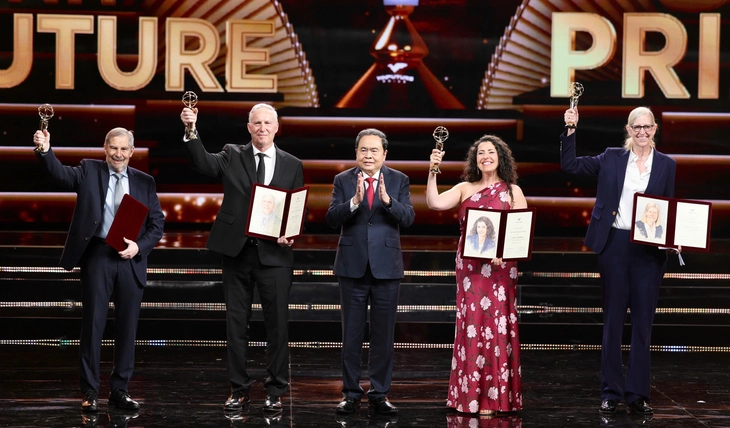
National Assembly Chairman Tran Thanh Man presents the VinFuture 2025 main prize worth 3 million USD to a group of American scientists - Photo: NGUYEN KHANH
The four winners of the VinFuture 2025 Main Prize were announced on the evening of December 5 in Hanoi for their contributions to a future free of HPV-related cancers.
Tuoi Tre had a private interview with Dr. Aimée R. Kreimer and Dr. John T. Schiller - two of the four winners of the VinFuture 2025 Main Prize.
Spread the message about the importance of HPV vaccination
* How did you feel when you were announced as the winners of the VinFuture 2025 Main Prize?
- Dr. Aimée R. Kreimer: I am extremely honored to be one of the four winners of the VinFuture 2025 Main Prize. Their approach and my lifelong goal are very similar: to bring scientific discoveries to many people, for a better future.
I hope that in the future, through this award, I can amplify the message about the importance of HPV vaccination to prevent cancer and increase access globally.
- Dr. John T. Schiller: There are two things that I find wonderful about this prize. First, it is awarded to all fields of science, not just in the fields of public health or biomedicine.
Prevention is often overlooked in favour of treatment, so receiving this award sends the message that cancer prevention research is just as important.
Vietnam is looking to introduce the HPV vaccine into its national immunisation programme, so I think it is great that by receiving this award we are contributing to spreading the message about the importance of HPV vaccination.
* The current price of HPV vaccine is still high. How can it be reduced to increase accessibility?
- Dr. John T. Schiller: Issues related to vaccine prices include production costs and the number of injections required. Production costs will decrease if many other costs are reduced, including transportation and production locations. Countries like China and India are producing HPV vaccines, and I hope Vietnam can produce this vaccine itself.
The second is the number of doses. Dr. Aimée has spent 20 years studying this, proving that one dose of HPV vaccine is as effective as two or three doses. Obviously, one dose is cheaper than two or three doses, and so is the cost of transportation.
Furthermore, the single dose may be more attractive to people without the hassle of multiple vaccinations. In fact, the WHO estimates that since they introduced the single dose recommendation according to Dr. Aimée’s protocol, an additional 30 million girls have been vaccinated.
- Dr. Aimée R. Kreimer: The latest data we have collected over the past 10 years shows that one dose of HPV vaccine provides equivalent protection to two doses.
It's not like we're creating a new HPV vaccine or anything, we're not adding anything to the vial, it's just that instead of two doses, now we're giving one dose and the person gets the same protection as if they had two doses. That's the important aspect that drives down costs and increases coverage.

Dr. Aimée R. Kreimer (left) and Dr. John T. Schiller - two of the four winners of the VinFuture 2025 Main Prize - Photo: NGUYEN KHÁNH
Eliminate prejudice, create gender balance
* According to your calculations, how many people does Vietnam need to vaccinate against HPV to achieve herd immunity?
- Dr. Aimée R. Kreimer: A very good question. The most important target group is girls, so we want to vaccinate girls first, then the reproductive age population.
If a country manages to vaccinate 80% of its reproductive-age population, it will stop transmission in the community. So, 80% of those vaccinated will actually start to protect the remaining 20%.
For example, in the US, when the vaccination rate was around 60%, the HPV infection rate in unvaccinated girls decreased by more than 85%. This 80% figure must be achieved at the national level, not just in a region or province, to have community immunity.
* Many people still think that HPV vaccination is for girls and women, while men are also at risk. How can we eliminate gender bias in HPV vaccination?
- Dr. Aimée R. Kreimer: Yes, HPV can still cause throat and anal cancer in men, so it cannot be said that HPV vaccination is only for girls or women.
Cervical cancer is the most common cancer caused by HPV, which is why many countries have considered this HPV vaccine program for girls only. However, we have to consider HPV as a cause of cancer that can occur in both men and women. So vaccination has a direct benefit for men, for boys.
Second, the virus is clearly transmitted between men and women, so men can contribute to reducing the incidence of HPV-related cancers by demonstrating responsibility by breaking the cycle of transmission.
* What do you think about the next generation of HPV vaccines?
- Dr. John T. Schiller: We can already give one dose of HPV vaccine, obviously we can't reduce it to zero doses (laughs). So what we will do and should do is expand the number of cancer-causing HPV strains that the vaccine can protect against.
Merck in the US has produced a vaccine that can prevent 9 strains of HPV. Inovax in China has also just launched a vaccine that can prevent 9 strains, up from the original 2 strains.
- Dr. Aimée R. Kreimer: If we want to protect about 70% of the population from cervical cancer, I think we need to get a vaccine against HPV strains 16 and 18, then gradually move to vaccines against other strains.
Don't wait until there is a vaccine that can prevent all 9 strains, start now with one that prevents 2 strains to completely eliminate cervical cancer.
National Assembly Chairman Tran Thanh Man:
Promote cooperation in research on common issues of humanity
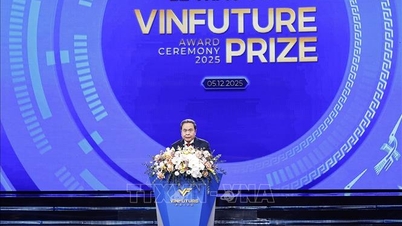
Speaking at the VinFuture 2025 award ceremony on the evening of December 5, National Assembly Chairman Tran Thanh Man affirmed that the VinFuture award is one of the largest science and technology awards in the world in terms of scale initiated by Vietnamese people.
VinFuture not only honors outstanding scientific works but also creates valuable dialogues and forums between scientists, businesses and policy makers. From there, new ideas, new approaches, new cooperation models are opened and widely spread.
According to Mr. Man, the world is facing many complex changes. Climate change, epidemics, energy security, food security, economic fluctuations and even unknown risks from science, technology, new technologies... require each country to find a suitable path of development. Science can only truly develop strongly when there is extensive, equal and sustainable international cooperation.
"Vietnam wishes to work with the world's scientific community to promote cooperation in researching common issues of humanity, promote academic exchanges, train high-quality human resources, cooperate in technology transfer and implement green development models and inclusive development.
We are ready to accompany countries, organizations, and research institutes in the spirit of openness, responsibility, and mutual respect. Vietnam will continue to be a reliable and attractive destination for scientists so that creative values can be shared and spread strongly to the international community," Mr. Man affirmed.
VinFuture Prize 2025 winners
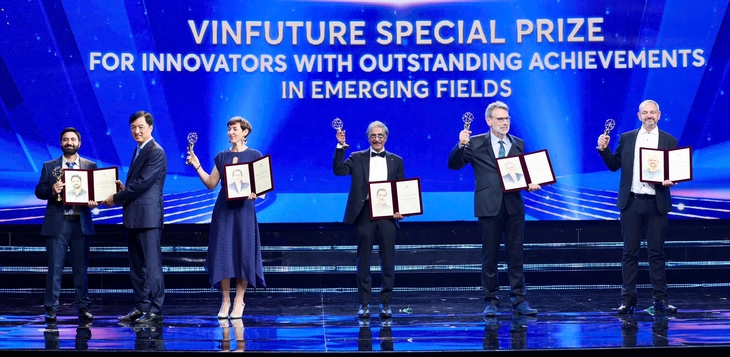
Hanoi Party Secretary Nguyen Duy Ngoc presents the VinFuture 2025 Special Prize to Scientists researching new fields - Photo: NGUYEN KHANH
The main VinFuture 2025 prize worth 3 million USD was awarded to Dr. Douglas R. Lowy, Dr. John T. Schiller, Dr. Aimée R. Kreimer and Professor Maura L. Gillison (USA) for their discoveries and development of HPV vaccines to prevent tumors caused by human papillomavirus (HPV).
The VinFuture 2025 Special Prize for Scientists from Developing Countries honored Professor María Esperanza Martínez-Romero (Mexico) for her advances in research on microbial ecology and symbiotic nitrogen fixation mechanisms in tropical ecosystems.
The VinFuture 2025 Special Prize for Female Scientists was awarded to Professor Mary-Claire King (USA) for her discovery of the BRCA1 gene related to the risk of breast and ovarian cancer, laying the foundation for genetic testing, screening programs and personalized treatment.
The VinFuture 2025 Special Prize for Scientists researching new fields honored five scientists: Professor Venkatesan Sundaresan (USA), Professor Raphaël Mercier (Germany), Dr. Emmanuel Guiderdoni (France), Dr. Imtiyaz Khanday (USA) and Dr. Delphine Mieulet (France) for their innovations in developing hybrid crops capable of self-propagating.
Source: https://tuoitre.vn/hai-nha-khoa-hoc-gianh-giai-chinh-vinfuture-2025-viet-nam-co-co-hoi-giam-manh-ung-thu-do-hpv-20251206092448694.htm


![[Photo] National Assembly Chairman Tran Thanh Man attends the VinFuture 2025 Award Ceremony](/_next/image?url=https%3A%2F%2Fvphoto.vietnam.vn%2Fthumb%2F1200x675%2Fvietnam%2Fresource%2FIMAGE%2F2025%2F12%2F05%2F1764951162416_2628509768338816493-6995-jpg.webp&w=3840&q=75)


![[Photo] 60th Anniversary of the Founding of the Vietnam Association of Photographic Artists](/_next/image?url=https%3A%2F%2Fvphoto.vietnam.vn%2Fthumb%2F1200x675%2Fvietnam%2Fresource%2FIMAGE%2F2025%2F12%2F05%2F1764935864512_a1-bnd-0841-9740-jpg.webp&w=3840&q=75)
















































































Comment (0)