

So, according to current legal regulations, what kind of benefits are civil servants and public employees entitled to when they leave their jobs, and are they eligible for unemployment benefits?
Implementing streamlining of the administrative apparatus and downsizing of personnel in accordance with Resolution 18 of the Central Committee will result in a significant number of state employees leaving their jobs. Many people are asking, according to current legal regulations, what benefits will civil servants and public employees receive upon leaving their jobs, and what will their unemployment benefits be?
Unemployment benefits are only available to those who have contributed to the program.
Unemployment benefits are paid on a contribution-based principle, as stipulated in the 2013 Employment Law regarding mandatory unemployment insurance participation for those working under labor contracts or employment agreements.
According to the 2008 Law on Cadres and Civil Servants, as amended by Clause 1, Article 1 of the 2019 Law on Cadres and Civil Servants and the Law on Public Employees, a civil servant is a Vietnamese citizen recruited and appointed to a rank, position, or title corresponding to a job position in agencies of the Party, State, and socio-political organizations at the central, provincial, and district levels; in agencies and units of the People's Army that are not officers, professional soldiers, or defense workers; and in agencies and units of the People's Public Security that are not officers, non-commissioned officers serving under the professional regime, or public security workers, and who are on the payroll and receive salaries from the state budget.
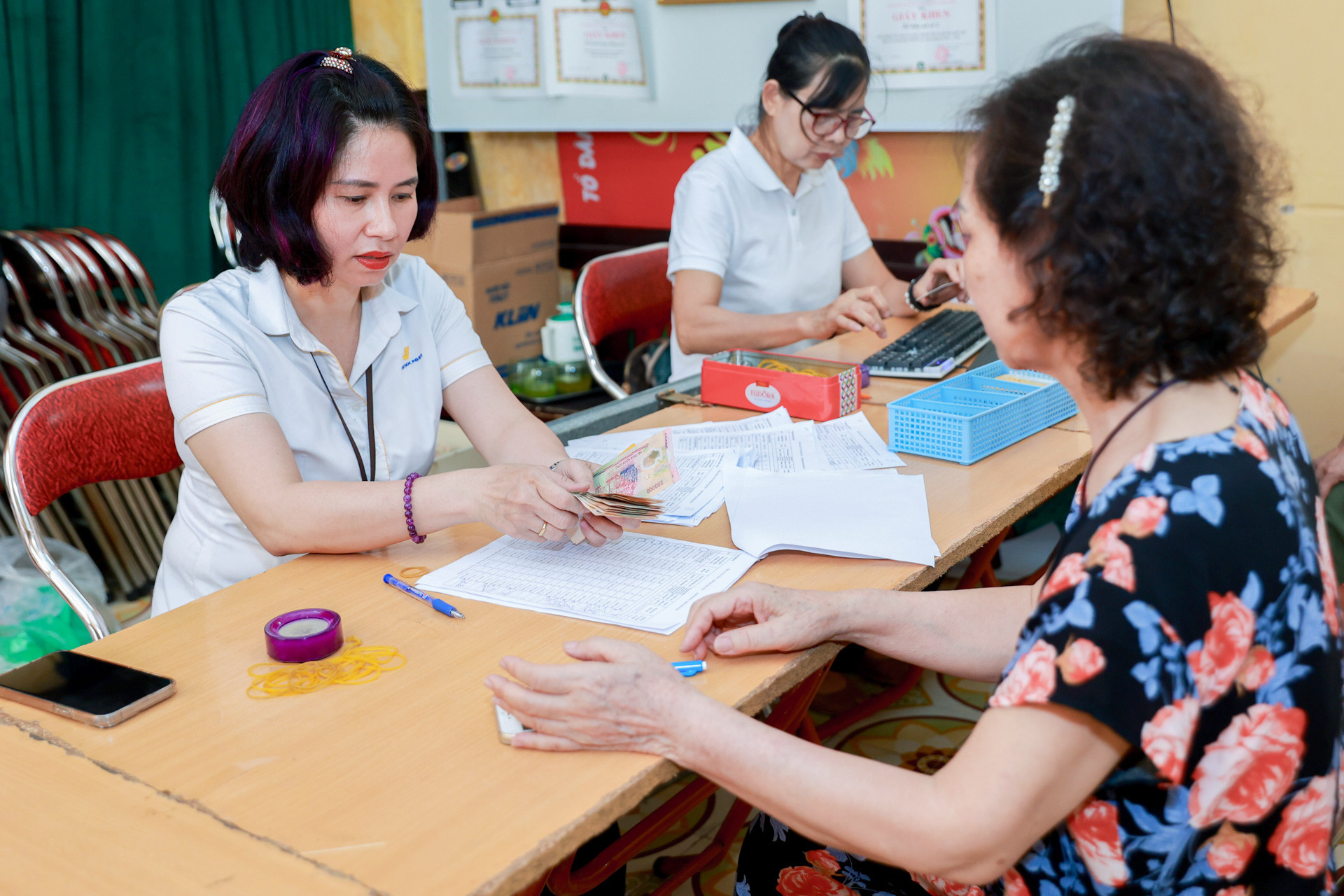
Therefore, civil servants are not eligible for unemployment insurance because they work on the payroll and receive salaries from the state budget, not under labor contracts. Consequently, they will not receive unemployment benefits upon leaving their jobs.
Although not entitled to unemployment benefits, upon leaving their jobs, civil servants will receive severance pay and social insurance benefits as stipulated in Government Decree 46/2010 on termination of employment and retirement procedures for civil servants.
Although not eligible for unemployment benefits, civil servants who leave their jobs may be entitled to the following benefits:
Entitled to severance pay. The amount is calculated as 1/2 of the current monthly salary for each year of service, including: salary according to rank and grade, leadership position allowance; seniority allowance exceeding the standard rate; professional seniority allowance; and retained salary differential coefficient (if any).
The minimum severance pay is equal to one month's current salary.
If they do not continue to participate in voluntary social insurance, civil servants will be entitled to a lump-sum social insurance payment if they fall into one of the following categories: reaching the retirement age as prescribed but not having contributed to social insurance for 20 years; after one year of leaving their job but not having contributed to social insurance for 20 years; emigrating abroad; or suffering from one of the life-threatening diseases as prescribed by the Ministry of Health .
The lump-sum social insurance benefit is equal to 1.5 months of the salary used for social insurance contributions multiplied by the number of years of social insurance contributions.
Officials are entitled to unemployment benefits.
Article 2 of the 2010 Law on Public Employees clearly states that a public employee is a Vietnamese citizen recruited for a specific job position, working at a public service unit under a labor contract, and receiving a salary from the public service unit's salary fund as prescribed by law.
Therefore, according to the above regulations, civil servants are still eligible to participate in unemployment insurance, and upon leaving their jobs, they will receive unemployment benefits.
According to Article 50 of the Employment Law, the monthly unemployment benefit is stipulated as follows: Workers are entitled to 60% of the average monthly salary on which unemployment insurance contributions were paid during the six consecutive months prior to unemployment.
In this case, the maximum monthly benefit shall not exceed 5 times the basic salary at the time of contract termination for employees subject to the salary regime regulated by the State.
The maximum monthly benefit shall not exceed five times the regional minimum wage at the time of termination of the employment contract for employees whose salaries are determined by the employer.
Furthermore, the Employment Law stipulates that employees can receive unemployment benefits starting from the 16th day after submitting all necessary documents for unemployment benefits.
According to a labor and employment expert, for civil servants and public employees, downsizing is handled according to the downsizing regulations. These regulations are defined for each stage, period, and specific civil servant or public employee. However, public employees who are granted early retirement benefits under the retirement policy will not receive unemployment benefits.
Source: https://vietnamnet.vn/cong-chuc-vien-chuc-nghi-viec-co-duoc-nhan-tro-cap-that-nghiep-2351833.html


![[Photo] Prime Minister Pham Minh Chinh receives the Governor of Tochigi Province (Japan)](/_next/image?url=https%3A%2F%2Fvphoto.vietnam.vn%2Fthumb%2F1200x675%2Fvietnam%2Fresource%2FIMAGE%2F2025%2F12%2F16%2F1765892133176_dsc-8082-6425-jpg.webp&w=3840&q=75)
![[Live] 2025 Community Action Awards Gala](/_next/image?url=https%3A%2F%2Fvphoto.vietnam.vn%2Fthumb%2F1200x675%2Fvietnam%2Fresource%2FIMAGE%2F2025%2F12%2F16%2F1765899631650_ndo_tr_z7334013144784-9f9fe10a6d63584c85aff40f2957c250-jpg.webp&w=3840&q=75)
![[Image] Leaked images ahead of the 2025 Community Action Awards gala.](/_next/image?url=https%3A%2F%2Fvphoto.vietnam.vn%2Fthumb%2F1200x675%2Fvietnam%2Fresource%2FIMAGE%2F2025%2F12%2F16%2F1765882828720_ndo_br_thiet-ke-chua-co-ten-45-png.webp&w=3840&q=75)
![[Photo] Prime Minister Pham Minh Chinh receives Lao Minister of Education and Sports Thongsalith Mangnormek](/_next/image?url=https%3A%2F%2Fvphoto.vietnam.vn%2Fthumb%2F1200x675%2Fvietnam%2Fresource%2FIMAGE%2F2025%2F12%2F16%2F1765876834721_dsc-7519-jpg.webp&w=3840&q=75)




































































Comment (0)