

Everyone in the countryside loves cassava. Cassava grated and used to make bánh ít (a type of Vietnamese cake) is simply delicious. But boiled cassava remains the "national dish."
Back then, during cassava season, my grandmother's kitchen always had a basket full of them. Whenever she had free time in the afternoon, she would sit in the backyard peeling the cassava roots. The roots had a simple brown outer layer. Their gentle appearance suggested that the inside was pure white. Peeling the cassava root was very easy. Unlike the peels of other roots, peeling a cassava root was as easy as peeling tree bark. As a playful child, I would trail behind my grandmother to join in the peeling.
Grandma split the cassava tubers into small pieces, then took them to the well to wash them thoroughly. Back in the kitchen, she lit a fire and put an earthenware pot on to boil the tubers. I don't know if boiling is the easiest and most leisurely way to prepare cassava, but it's very easy. Just pour water into the pot, add the tubers, and wait for the water to drain.
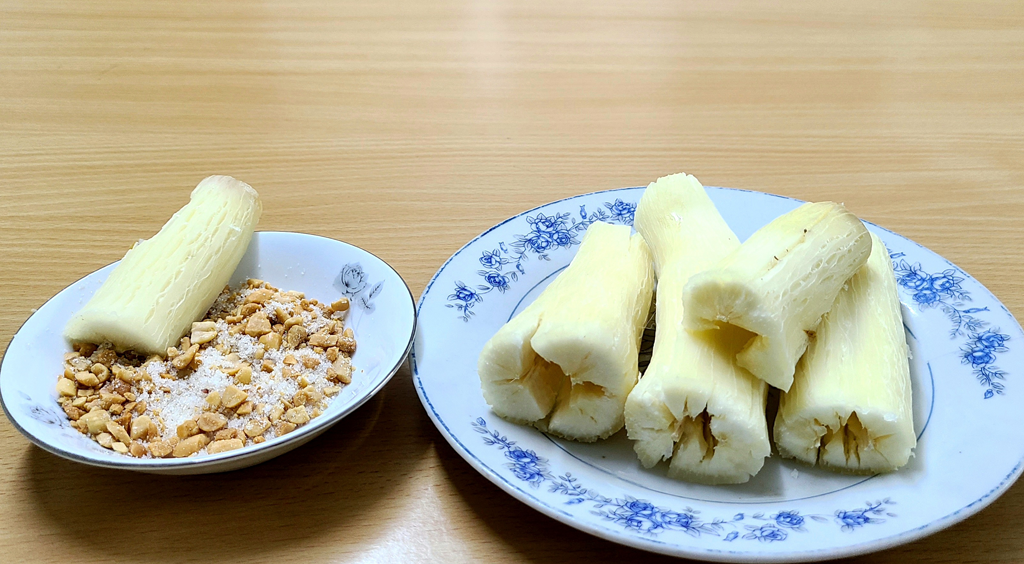
Cassava eaten with salted peanuts
When cooked, the pot of cassava will automatically signal with its fragrant aroma. The aroma of cooked cassava is incredibly strong. The fragrance fills the kitchen, layering throughout the house. Grandma lifts the pot, and steam rises in thick plumes. The freshly cooked cassava is piping hot. I take a piece. Then, hand to hand. Cassava can't be broken in half like sweet potatoes. To eat it, you have to cut it in half lengthwise. The cassava is so hot, I feel like my tongue is going to fall off. But the nutty flavor makes it impossible to stop. Cassava is delicious on its own, but when combined with peanut salt, it becomes even more flavorful. I dip a piece of cassava in peanut salt and savor it. The nutty cassava, the fragrant peanut salt, along with the salty taste of the salt and the sweetness of the sugar, "cooperate" with each other. Without anyone saying anything, seeing the pot completely empty, everyone silently understands whether they are praising or criticizing the dish.
My grandmother's unique trick was to boil cassava, then sauté it in oil until fragrant. Afterward, she'd add the cassava and stir-fry a few times. She'd add a pinch of salt, a little MSG, and a bit of sugar to settle. Whether she knew it was delicious, or perhaps she knew children were drawn to "novelty," she made it that way. It was a dish whose name I never gave, but its lingering taste remains to this day.
Growing up, my hometown remained behind. I ventured into the city. The local delicacies followed me into urban life. It was truly a blessing. However, a few times when I stopped to buy cassava, I happily told the vendor, "This dish originates from my hometown, doesn't it?" She looked up at me, smiled softly, her eyes welling up with tears.
Source link

















![[Photo] Reception to welcome General Secretary and President To Lam and his wife on their State visit to the Philippines](https://vphoto.vietnam.vn/thumb/1200x675/vietnam/resource/IMAGE/2026/06/01/1780295488620_vna-potal-chieu-dai-chao-mung-tong-bi-thu-chu-tich-nuoc-to-lam-va-phu-nhan-tham-cap-nha-nuoc-toi-philippines-8798060-7855-jpg.webp)























































Comment (0)