

It seems even the wild trees are no longer resilient to the unpredictable weather of recent years. As the rainy season arrives, snack lovers and wild fruit hunters flock to the Bay Nui region, but they miss out on the perfect time to see the ripe wild plums. Locals say that this year the plums are bearing fruit later and unevenly. Some trees have almost all been harvested, while others only have tiny green fruits. A few trees are stunted, with damaged or misshapen fruit… requiring thorny bamboo fences to prevent children from climbing and picking them. However, the price of wild plums this season is quite high, over 100,000 VND/kg, yet the supply still falls short of demand.
Many people wonder why this fruit, once eaten so casually that people didn't even bother picking it, leaving the tree trunk covered in black fallen fruit, is now so expensive? Actually, the trâm tree grows naturally throughout the lowlands; no one cultivates or cares for it. When in season, it produces an abundance of black fruit. The trâm fruit is large and round, turning a deep purple when ripe, with a glossy, plump skin that looks very appealing, primarily for snacking. The trâm in mountainous areas is similar, even smaller, with sweetness varying depending on the season and weather… yet many people insist on buying "mountain trâm" to enjoy it. The common explanation is that eating wild fruit offers a more special and enjoyable experience.
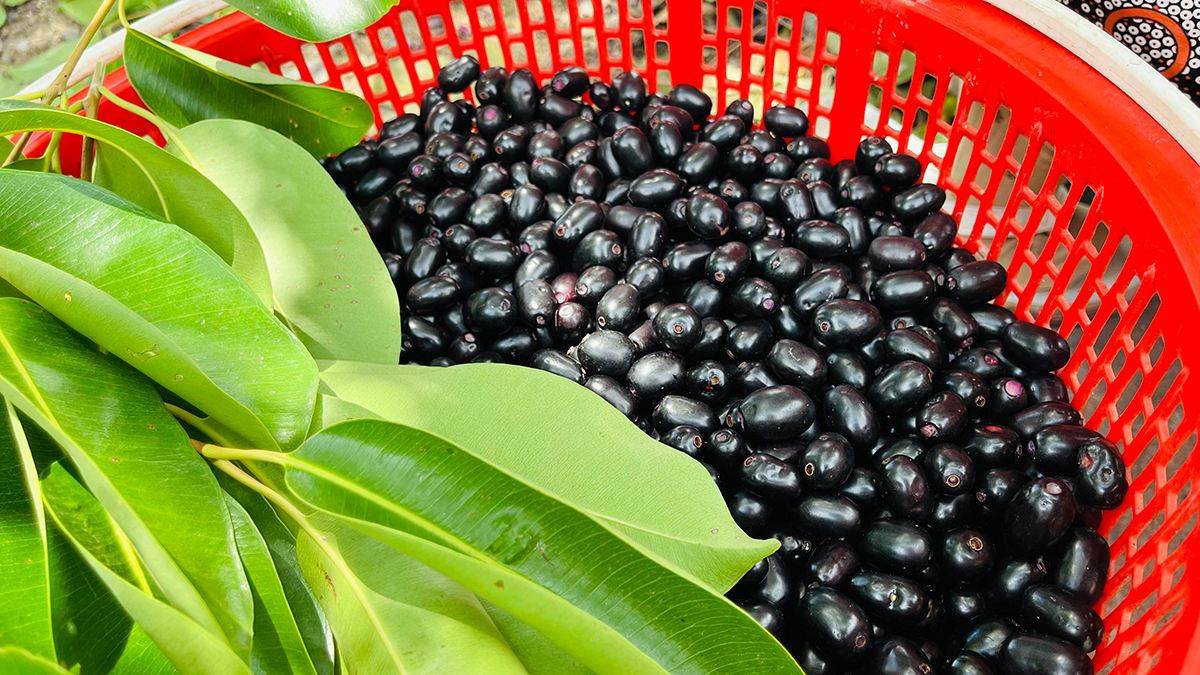
Mr. Nguyen Thanh Nghe (from Cho Moi district) often invites friends to the mountains to stroll, take photos, admire the beautiful scenery, and relax after stressful days at work. In his opinion, the mountain rose apples have a fragrant aroma and a consistent sweetness. Perhaps it's not just because they're called "natural fruit," but because the Khmer ethnic minority people carefully select the best ones before selling them. They only keep the best ones to display, discarding any that aren't ripe enough. This meticulousness and honesty in their business practices endears them to buyers. Supporting this snack also helps the local people earn extra income for a few short months.
Along Provincial Road 948, passing through Nui To commune (Tri Ton district), there are dozens of roadside stalls selling fruits and wild vegetables. The striking purple color of the rambutan always catches the eye of tourists the fastest. Ms. Neang Sang displays two trays full of large rambutans, with several baskets behind her waiting for customers to pick them up. “This season, the price of rambutan has dropped to 50,000 VND/kg. Every day I sell about 20kg of rambutan retail to passersby, not including the amount I sell wholesale to traders at varying prices. It’s great that many people buy it, and it brings in extra income for my family,” Ms. Sang shared.
Tri Ton District has thousands of rose apple trees, concentrated mainly in Nui To commune and Co To town. From the age of 7, the trees begin to bear fruit, with mature trees yielding an average of 50kg per season. This annual gift to the people of the mountainous region is very popular with tourists. Recognizing this demand, locals set up stalls along the roadside, eagerly inviting anyone who stops to look to sample the fruit, saying, "These are mountain rose apples, from our own trees, they're delicious and sweet!" Some even transport the fruit on bicycles around the commune, tourist spots, markets, and residential areas to sell to more customers.
The money people earn from this "gift from nature" is only the tip of the iceberg, because the work of climbing and picking the rose apples is very hard and dangerous. Young people go to work to earn money, children go to school, and only the elderly go out to pick and transport the rose apples to sell... The price of rose apples fluctuates sharply at the beginning and end of the season, partly because the work of picking and gathering enough to meet the demand is quite laborious. Ms. Neang Khol recounted: "Customers become regulars, so when the season comes, people take advantage of the opportunity to pick as much as possible, having to wake up early or late in the afternoon to have rose apples ready for sale the next day. For trees that are too tall, they have to use ladders to climb to the upper branches. The time spent selecting ripe, delicious fruits is also quite long..."
The Terminalia catappa tree has been closely associated with the working lives of the Khmer ethnic minority for a very long time. Growing scattered across fields, along roadsides, in front of houses, and behind verandas, it provides shade for people to rest and is a gathering place for children to play. No longer just a casual fruit or a traditional local delicacy, it has now become a natural specialty from the mountainous region, available in even the most remote towns and cities, bringing in considerable income.
The season for the rose apple tree lasts from the end of March to the end of June according to the lunar calendar. Besides selling ripe fruit, in recent years some households have started making rose apple wine, and engineers have researched processing rose apple seeds into instant tea. In Nui To commune, a teacher has even successfully experimented with making rose apple wine, packaging it neatly like industrial products. This innovative approach is supported by the local community, who provide feedback to help improve it further. The hope is that this will create a new brand for the locality and improve the lives of the people.
MY HANH
Source: https://baoangiang.com.vn/dac-san-tram-bay-nui-a420846.html


![[Photo] President Luong Cuong presides over the welcoming ceremony for the President of the European Council, Antonio Costa.](/_next/image?url=https%3A%2F%2Fvphoto.vietnam.vn%2Fthumb%2F1200x675%2Fvietnam%2Fresource%2FIMAGE%2F2026%2F01%2F29%2F1769662707713_ndo_br_1-jpg.webp&w=3840&q=75)


![OCOP during Tet season: [Article 4] Elevating local products](/_next/image?url=https%3A%2F%2Fvphoto.vietnam.vn%2Fthumb%2F402x226%2Fvietnam%2Fresource%2FIMAGE%2F2026%2F01%2F29%2F1769652810578_2935-z6982071462129_649e82db06fb2f2ea701388b1f5f5b0b-173322_176-185229-202804_457.jpeg&w=3840&q=75)


![OCOP during Tet season: [Part 3] Ultra-thin rice paper takes off.](/_next/image?url=https%3A%2F%2Fvphoto.vietnam.vn%2Fthumb%2F402x226%2Fvietnam%2Fresource%2FIMAGE%2F2026%2F01%2F28%2F1769562783429_004-194121_651-081010.jpeg&w=3840&q=75)

![OCOP during Tet season: [Part 2] Hoa Thanh incense village glows red.](/_next/image?url=https%3A%2F%2Fvphoto.vietnam.vn%2Fthumb%2F402x226%2Fvietnam%2Fresource%2FIMAGE%2F2026%2F01%2F27%2F1769480573807_505139049_683408031333867_2820052735775418136_n-180643_808-092229.jpeg&w=3840&q=75)


Comment (0)