


The Vietnam Commodity Exchange (MXV) reported that the global raw materials market experienced relatively volatile trading in the first trading session of the week (April 21). With six out of seven commodities simultaneously declining in price, the agricultural market attracted significant attention yesterday. In addition, the metals sector showed clear divergence amidst conflicting supply and demand dynamics.
In the agricultural market, according to MXV, soybean prices recorded a slight decrease of 0.68% to 378 USD/ton in the first trading session of the week. The market failed to maintain its early gains, with prices quickly weakening in line with the general trend of other agricultural commodities.
Weather conditions in the US have not had a significant impact on the market. Heavy rains over the weekend in Texas, Oklahoma, and Missouri have improved soil moisture in drought-prone areas, supporting planting progress in the Midwest. While some areas may experience delays due to the rain, the market views this as a short-term risk and not a cause for concern at this time.
According to data from China's General Administration of Customs, the country imported 2.44 million tons of US soybeans in March, a 12% increase year-on-year, bringing total imports for the first quarter to 11.6 million tons, 62% higher than the previous year.
Nevertheless, experts predict that Brazilian soybeans will dominate the market in the coming months as the harvest season in that country reaches its peak. In addition, China's domestic soybean production is expected to increase by 2.5% this year, indicating a long-term trend of reduced reliance on imports. This factor has contributed to putting pressure on prices.
Meanwhile, some positive trade news has emerged, but it hasn't been strong enough to reverse the market trend. This includes a bilateral trade agreement between the US and India, and a proposal to impose fees on Chinese ships under the amended Section 301, which excludes agricultural products and reduces risks for soybean exports. Japan is also reportedly considering increasing soybean imports from the US, but no specific details have been released.
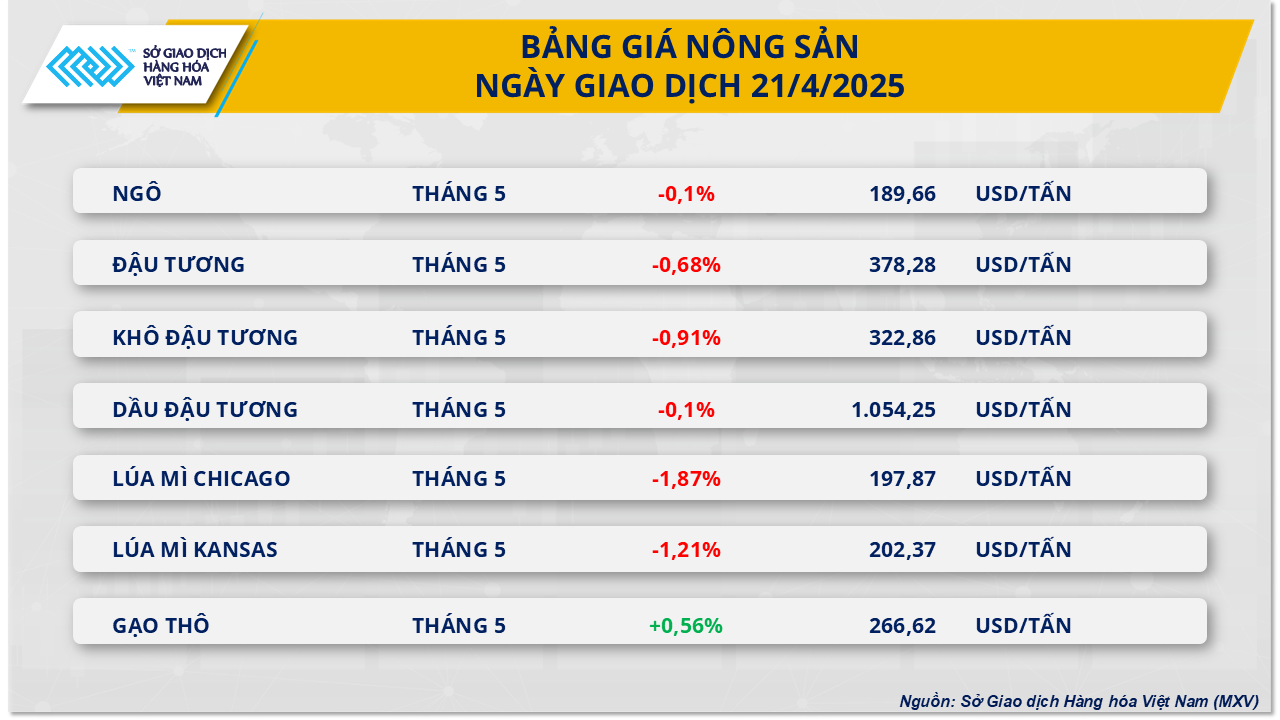
Similar to soybeans, both soybean meal and soybean oil weakened. Soybean oil prices fell slightly by an insignificant 0.1%, indicating that sellers have returned to the market after five consecutive sessions of gains. The lack of clarity regarding policies supporting biofuels in the US continues to weaken expectations for soybean oil consumption in the country, putting pressure on prices.
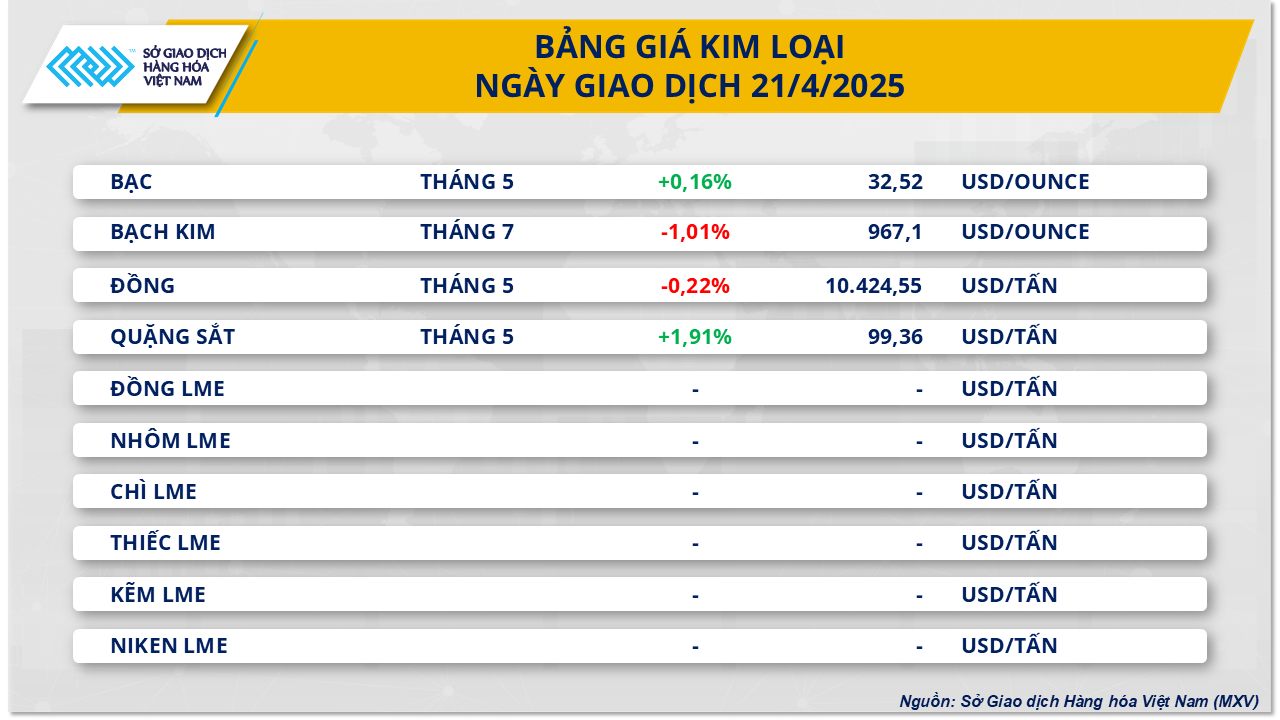
For the metals group, the first trading session of the week saw a clear divergence in trends across the metal market. In the precious metals market, silver closed slightly higher, up 0.16% to $32.52 per ounce. Meanwhile, platinum reversed course and weakened by 1.01% to $967.1 per ounce.
The demand for financial hedging from investors drew money into the precious metals market, including silver, during yesterday's trading session. Recently, China took new steps in trade to counter the US in the global commodities market by reducing crude oil imports from the US by 90%, while simultaneously purchasing record amounts of oil from Canada and increasing soybean imports from Brazil. In addition, the Dollar Index fell below 100 points – its lowest level in over three years. At the same time, the yield on 10-year US Treasury bonds remained high above 4.4%. These factors benefited precious metals, including silver.
Conversely, platinum prices are under pressure as the outlook for US auto sales becomes less positive, potentially reducing demand for platinum in the automotive catalytic converter manufacturing sector. According to Cloud Theory, a US auto price tracker, new car prices have surpassed $50,000 and are expected to continue rising. The sharp increase in car prices is making consumers more cautious in their purchasing decisions. Meanwhile, since February, many automakers and dealerships have proactively cut back on incentives and promotions, weakening purchasing power in the auto market.
For base metals, COMEX copper prices reversed course and fell 0.22% to $10,424 per ton. Meanwhile, iron ore continued its upward trend, gaining 1.91% to reach $99.36 per ton.
Copper prices are under downward pressure as supply in China surged in March. According to data from the National Bureau of Statistics of China (NBS), refined copper production in March reached 1.25 million tons, an 8.6% increase year-on-year, surpassing the previous record of 1.24 million tons recorded in December last year. The increase in production was mainly driven by higher prices of by-products such as gold and sulfuric acid, which improved profit margins that had been under significant pressure, allowing mills to increase capacity.
Source: https://baodaknong.vn/thi-truong-hang-hoa-22-4-dien-bien-tuong-doi-giang-co-250199.html


















































































![[Photo] The rapeseed flower season heralds the arrival of spring on the summit of Suoi Giang.](https://vphoto.vietnam.vn/thumb/402x226/vietnam/resource/IMAGE/2026/02/12/1770911320984_baolaocai-br_chuyen-muc00-00-38-10still068-jpg.webp)














Comment (0)