

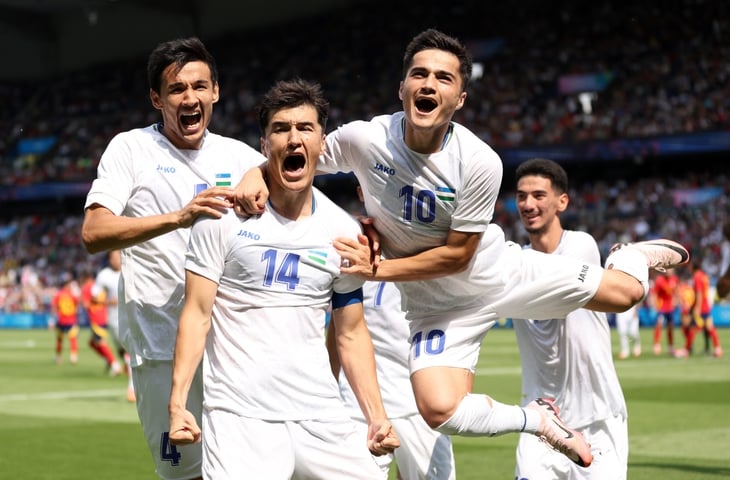
Uzbekistan demonstrates strength that rivals that of leading Asian powerhouses - Photo: REUTERS
Poor in economics , but strong in sports science.
For the first time in history, Uzbekistan has qualified for the World Cup. This is the result of a 10-year continuous effort to promote youth football, demonstrated by a series of impressive titles.
At the youth level, Uzbekistan has amassed an impressive string of championships across all age groups. In 2018, they won the U23 Asian Championship, before reaching the final of the tournament two more times in 2022 and 2024.
In 2023, Uzbekistan won the U20 Asian Championship again. And most recently, the Uzbekistan U17 team won the Asian Championship after defeating Saudi Arabia in the final while playing with 9 men against 11.
The current powerful Uzbekistan team is a reflection of those successes at the youth football level. From Khusanov and Ashurmatov to Fayzullaev and Shomurodov, the current Uzbekistan team boasts many talented players who have competed in Europe.
Youth development is obviously the formula for success. But how did football from a country with limited economic resources manage to experience such a boom in football training, and more broadly, in sports training?
The answer may lie in the laboratories of Russia – once the nerve center of Soviet sports. And Uzbekistan is a part of that.
Uzbekistan gained independence in 1991 after separating from the former Soviet Union. However, the ties between this Central Asian nation and the Russians remain clearly evident.
Uzbeks share a common ethnic background with the Tatars and Bashkirs, major ethnic communities within Russia. Similarities in appearance and culture are easily seen between Uzbeks and Chechens or Dagestans, federal entities in southern Russia.
Russian support
In sports, in particular, Russians and Uzbeks have an extremely close relationship.
On June 5th and 8th, while the Uzbekistan national team was competing in the World Cup qualifiers, their U23 team hosted the Russian U23 team in Fergana.
These are not simply training matches. According to Aleksei Fomin, head of the Russian U23 team's technical delegation, the Russian players brought along a mobile data analysis system. This helps monitor the performance, heart rate, speed, and recovery capabilities of the home team's players.
"We're not just competing; we're also bringing equipment and tactical analysis software to share. Uzbek coaches are very interested in applying scientific data in training," Fomin told Izvestia .
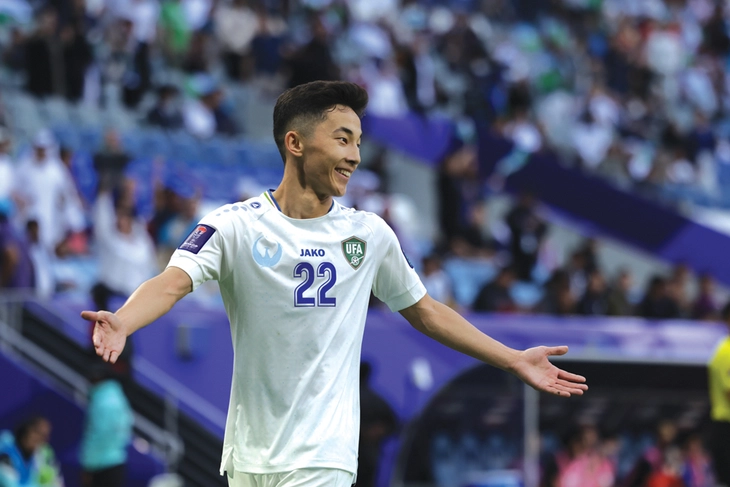
Fayzullaev, the star currently playing for CSKA Moscow - Photo: REUTERS
This is part of a long-standing cooperation between the two countries in the field of sports - especially football - which has been promoted for many years through training programs, technology transfer, and kinesiology research.
Uzbekistan currently has at least three football academies affiliated with prestigious Russian sports schools. A notable collaboration is with the Russian University of Physical Education (GTSOLIFK). Here, young Uzbek players have access to 3D tactical simulation software, modern training programs, and a biometric testing system that helps determine optimal playing positions.
Since 2023, a major project called "Transfer of the Russian-Uzbekistan School Sports Model" has been implemented in Tashkent, aiming to build a system for selecting football talent from the secondary school level. This model is similar to how Russia develops talents for clubs like Spartak Moscow or CSKA Moscow.
Not only young players, but also some stars like Jaloliddin Masharipov and Rustam Ashurmatov were sent to sports centers in Kazan and Moscow for injury rehabilitation, movement analysis, and technical refinement.
They became role models for the next generation. As part of the project to build a "smart sports city" in Tashkent, Uzbekistan imported athlete management software from NaukaSport (Russia).
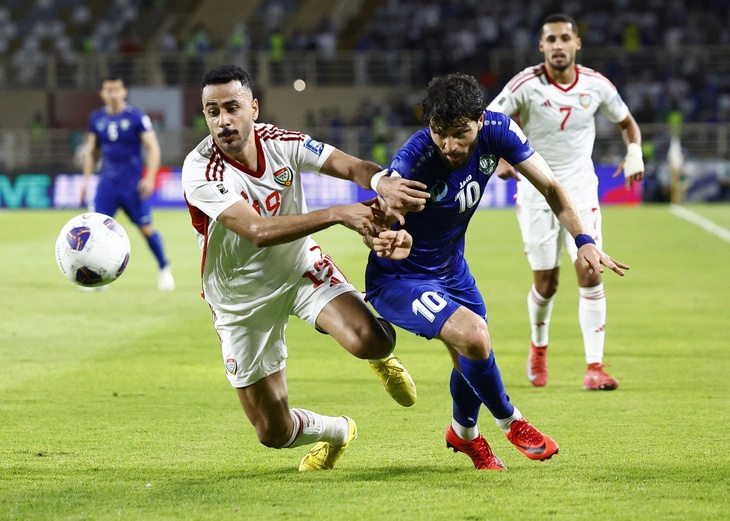
Uzbekistan (in blue) surpassed powerhouses like UAE and Qatar to qualify for the World Cup - Photo: REUTERS
At Bunyodkor's new stadium, each player is fitted with a bio-tracking device that connects directly to the coach's control panel, allowing for real-time tactical adjustments.
"Uzbekistan is taking a path that not many Central Asian countries dare to take: using data science to build a systematic approach to football," assessed expert Andrea Olsson from the Goethe Institute (Sweden). And the influence of the Russians is extremely clear.
Even the gene screening technology implemented by sports science research laboratories in Uzbekistan 12 years ago is considered to be linked to Russia.
There will certainly be many Eastern European teams at the 2026 World Cup. But for Croatia, Serbia, and Poland, they have long had their own distinct and powerful sporting traditions, keeping pace with the development of science and the economy.
As for Uzbekistan, the football world might see a glimpse of a "black-haired" Russian team (*) at the 2026 World Cup.
(*) "Black-haired" Russians is a colloquial term referring to Russians who are not of Slavic origin, mostly of Turkic or Caucasian descent.
Source: https://tuoitre.vn/fifa-cam-nga-nhung-da-co-uzbekistan-20250606194827735.htm
![[Image] Expediting land clearance at Alley 310 Nghi Tam to facilitate the construction of Tu Lien Bridge](https://vphoto.vietnam.vn/thumb/1200x675/vietnam/resource/IMAGE/2026/04/14/1776160406551_ndo_br_z7724148990408-9e5d4777e3c4504998b4286178b2e66e-jpg.webp)
![[Photo] General Secretary and President To Lam visits and delivers a policy speech at Tsinghua University.](https://vphoto.vietnam.vn/thumb/1200x675/vietnam/resource/IMAGE/2026/04/14/1776164592318_vna-potal-tong-bi-thu-chu-tich-nuoc-tham-va-phat-bieu-chinh-sach-tai-dai-hoc-thanh-hoa-trung-quoc-8700658-5437-jpg.webp)
![[Photo] General Secretary and President To Lam and his wife begin their state visit to China.](https://vphoto.vietnam.vn/thumb/1200x675/vietnam/resource/IMAGE/2026/04/14/1776133794926_z7723148772587-ffefa3c4b1e54e100de1554593a862c6-jpg.webp)







![[Photo] General Secretary and President To Lam receives Slovak Prime Minister Robert Fico](https://vphoto.vietnam.vn/thumb/1200x675/vietnam/resource/IMAGE/2026/04/13/1776080592076_a1-bnd-8227-6002-jpg.webp)

































Comment (0)