

“Liberating the South, we are determined to march forward together / Destroying American imperialism, crushing the traitorous clique /... Here is the majestic Mekong River, here is the glorious Truong Son Mountains / Urging our troops to charge forward and kill the enemy.”
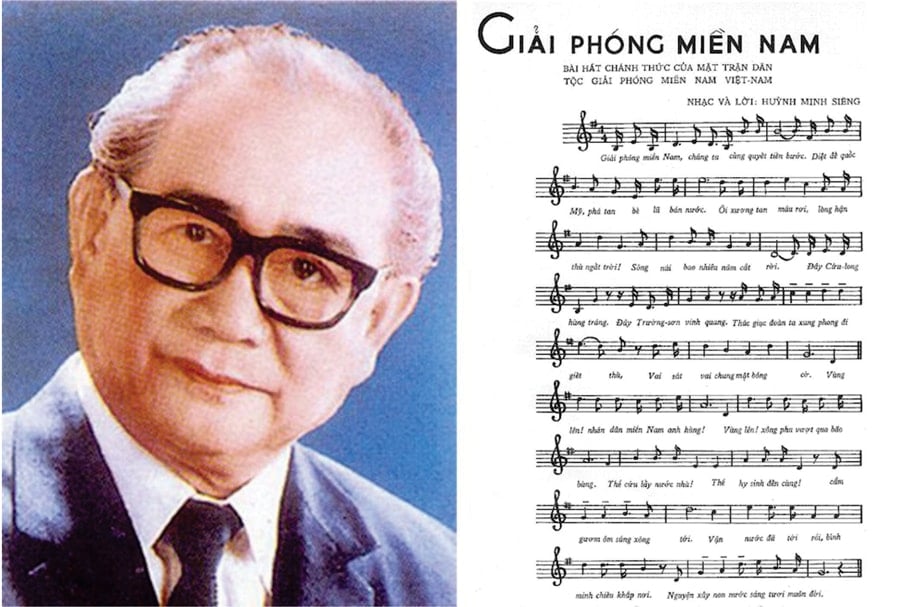
Composer Lưu Hữu Phước.
In December 1960, the National Liberation Front of South Vietnam was established, creating a need for an official anthem that would both outline the revolutionary line and call on the people to rise up and drive out the invaders and liberate their homeland. In early 1961, this task was assigned to three comrades: Huynh Van Tieng, Mai Van Bo, and Luu Huu Phuoc (referred to as the Hoang Mai Luu group). The group unanimously agreed to have Luu Huu Phuoc compose the song, while the group would provide feedback and make revisions. Within a week, the song "Liberating South Vietnam" was completed.
The song closely adhered to the principle of armed struggle, calling on the entire nation to fight under the Party's banner: "Shoulder to shoulder under one flag/...Swear to save the country! Swear to sacrifice to the end/Holding swords, embracing guns, charging forward/The nation's destiny has arrived. Dawn shines everywhere/Building a bright and prosperous nation for generations to come."
After listening to the song, Comrade Pham Hung, then a high-ranking official of the National Liberation Front of South Vietnam, said: "Excellent, very good!... Absolutely wonderful! Welcome and thank you, comrades." The song quickly became widely popular through the airwaves of the Liberation Radio, the Voice of Vietnam Radio , and various performing arts troupes.
There's an interesting detail: When listing the authors, the group initially used Huỳnh Minh Liêng (instead of Huỳnh, Mai, Lưu) to maintain secrecy. However, when published in the Nhân Dân newspaper, for some unknown reason, it was printed as Huỳnh Minh Siêng. Later, the author didn't correct it because the word "Siêng" also has a positive connotation.
Professor and musician Lưu Hữu Phước (1921 - 1989, from Can Tho) was famous for his patriotic songs closely associated with the history of the national revolution. He served as Minister of Information and Culture of the Provisional Revolutionary Government of the Republic of South Vietnam; Chairman of the Culture and Education Committee of the National Assembly; and Vice President of the Central Committee of the Vietnam Union of Literature and Arts. He was awarded the First Class Independence Medal and the Ho Chi Minh Prize for Literature and Arts. In his hometown of Can Tho, the city's central park and the high school are proudly named after musician Lưu Hữu Phước.
Source: https://hanoimoi.vn/giai-phong-mien-nam-699890.html




























































Comment (0)