

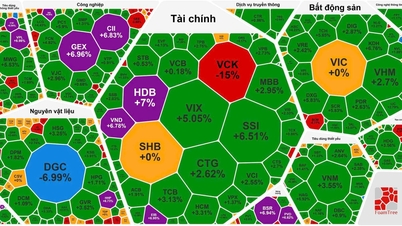
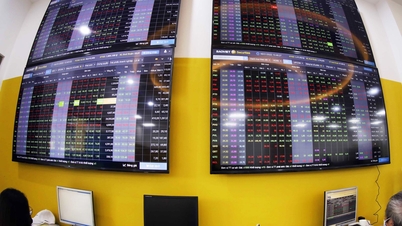
The VN-Index just experienced its most volatile trading week in history, with a sharp drop of 95 points in one session. In subsequent sessions, the market attempted to recover, but strong divergence is occurring between industry groups and even among stocks within the same industry.
Thanks to large-cap stocks supporting the index, the VN-Index has returned to near the 1,700 mark. After two consecutive weeks of correction, securities companies have released their assessments of the market outlook for the coming week.
VCBS: Closely monitor the market to restructure your portfolio.
The VN-Index traded within a wide range last weekend, closing at 1,683.18 points, down 3.88 points, or 0.23%. On the hourly chart, the VN-Index gradually narrowed its range, with the MACD and RSI indicators showing an upward trend, suggesting that the recovery may continue in the short term.
On the daily chart, after a sharp bearish maruzobu candlestick at the beginning of the week, the VN-Index has had three consecutive doji candlesticks, indicating significant tug-of-war between buyers and sellers. The general index has not yet confirmed a complete bottom, continuing to move around the 1,660 support level and heading towards the 1,700 point region.
The VN-Index attempted a recovery week after a record 95-point drop at the beginning of the week. While capital flows showed a divergence across the Real Estate, Retail, and Oil & Gas sectors, financial sectors such as Banking and Securities continued their downward trend.
Accordingly, VCBS recommends that investors continue to closely monitor market developments in the coming sessions and take advantage of intraday rallies to restructure their portfolios, by eliminating weak stocks and those that have broken their upward trend, and gradually shifting their holdings to stocks that are beginning to show good recovery momentum in the final sessions of the week.
SHS: Focus on stocks with strong fundamentals.
The VN-Index continued its recovery, retesting the 1,700-point range after a strong rebound in the 1,620-1,630 point support zone, the lowest point in September 2025. The next strong resistance level is 1,730 points, the highest price of the sharp decline on October 20, 2025. Under the influence of leading stocks in the VN30 index, the VN-Index is consolidating after a period of strong price increases.
Selling pressure at high prices is increasing as the VN-Index recovers and retests the 1,700-point level for many highly speculative stocks. In the short term, the VN-Index is ending a strong growth phase that lasted from April 2025 to the present. This leads to a market divergence in two directions: On one side, there is strong selling pressure on stocks that experienced strong growth and have high leverage ratios... On the other side, there is a good recovery, cash flow, and an improving trend for stocks and groups of stocks that underwent a prolonged correction, with prices returning to the April-May 2025 levels, a period of sharp declines due to tax imposition and positive business results.
Given these developments, SHS cautiously assesses and proposes new investment opportunities, based on the reasonable valuation range of the businesses and strong Q3/2025 business results. Investors should maintain a reasonable portfolio allocation. Investment targets should be directed towards stocks with strong fundamentals, leading in strategic sectors, and those with outstanding economic growth potential.
Yuanta Vietnam: Positive outlook on the medium-term portfolio.
Yuanta believes the market may recover in the first trading session of the week. At the same time, the market is still in a short-term consolidation phase, so the VN-Index may continue to trade sideways around the 20-day moving average (i.e., 1,698 points). If the VN-Index surpasses 1,721 points, the short-term trend could be more positive.
Additionally, the sideways movement of short-term sentiment indicators suggests that investors remain cautious about current market developments.
For short-term strategies (less than 1 month), the overall market trend remains downward. Therefore, investors can maintain a stock allocation of 20-40% of their portfolio and should only consider making small new purchases to gauge the short-term trend.
With a medium-term strategy (1-5 months), the overall market trend remains UP. Simultaneously, the market is still in a medium-term accumulation phase, indicating a technical correction and trading near the medium-term support level of 1,605 points. Therefore, investors can continue to buy and hold a high proportion of stocks in their medium-term portfolios.
TPS: Observe the demand carefully.
In subsequent trading sessions, if demand continues to weaken, the market's rebound is likely to end, and the VN-Index may return to a correction phase. However, the 1,600 - 1,620 point range is a reliable support zone in case the VN-Index corrects.
The HNX-Index's performance at the end of the week was hesitant, although liquidity improved somewhat and exceeded the 20-day average, but the index did not change significantly. On the other hand, the HNX-Index is still trading below the 10-day and 20-day moving averages, indicating a short-term trend leaning towards correction. The ~265-point level will act as support to determine the next trend. In case the HNX-Index breaks through this support, investors need to make appropriate risk management decisions.
PHS: Expectations for a breakout in the index.
The VN-Index closed the week with a Doji candlestick pattern, continuing to show a tug-of-war in search of equilibrium. Overall, the movement remained within the 1,620-1,690 point range, exhibiting a consolidation phase. A positive sign is that stocks that had previously experienced sharp declines are beginning to stabilize and recover from their lows. The upward momentum is expected to resume when the index breaks through and consolidates above 1,710 points, while support is near the 1,640-1,650 point level.
For the HNX-Index, trading returned to a sideways movement, with the index changing little around the reference point. The movement may continue to consolidate in the 262-268 range to accumulate further momentum. Resistance in the recovery phase is around the 272-276 level.
For investors, after bringing their accounts to a safe level, remaining positions should be held. Investors need to monitor the market's reaction while searching for an equilibrium point. Avoid chasing prices or averaging down before clear signs of a rebound or stoppage are established.
Source: https://baodautu.vn/goc-nhin-ttck-tuan-2710---3110-tam-ly-than-trong-thi-truong-van-dang-tich-luy-d422942.html
![[Photo] Prime Minister Pham Minh Chinh receives the Governor of Tochigi Province (Japan)](/_next/image?url=https%3A%2F%2Fvphoto.vietnam.vn%2Fthumb%2F1200x675%2Fvietnam%2Fresource%2FIMAGE%2F2025%2F12%2F16%2F1765892133176_dsc-8082-6425-jpg.webp&w=3840&q=75)

![[Photo] Prime Minister Pham Minh Chinh receives Lao Minister of Education and Sports Thongsalith Mangnormek](/_next/image?url=https%3A%2F%2Fvphoto.vietnam.vn%2Fthumb%2F1200x675%2Fvietnam%2Fresource%2FIMAGE%2F2025%2F12%2F16%2F1765876834721_dsc-7519-jpg.webp&w=3840&q=75)

![[Image] Leaked images ahead of the 2025 Community Action Awards gala.](/_next/image?url=https%3A%2F%2Fvphoto.vietnam.vn%2Fthumb%2F1200x675%2Fvietnam%2Fresource%2FIMAGE%2F2025%2F12%2F16%2F1765882828720_ndo_br_thiet-ke-chua-co-ten-45-png.webp&w=3840&q=75)
![[Live] 2025 Community Action Awards Gala](/_next/image?url=https%3A%2F%2Fvphoto.vietnam.vn%2Fthumb%2F1200x675%2Fvietnam%2Fresource%2FIMAGE%2F2025%2F12%2F16%2F1765899631650_ndo_tr_z7334013144784-9f9fe10a6d63584c85aff40f2957c250-jpg.webp&w=3840&q=75)






















































![[Photo] Prime Minister Pham Minh Chinh attends the Vietnam Economic Forum 2025](https://vphoto.vietnam.vn/thumb/402x226/vietnam/resource/IMAGE/2025/12/16/1765893035503_ndo_br_dsc-8043-jpg.webp)





































Comment (0)