

Meanwhile, Hanoi Medical University (HMU) continues to be ranked in both Clinical Medicine and Public Health , although its ranking has decreased compared to 2024, from 151-200 to 301-400 for Public Health and from 301-400 to 401-500 for Clinical Medicine.
While most other universities are experiencing a decline in rankings for their existing academic programs, the University of Economics Ho Chi Minh City (UEH) has even improved its ranking in Business Administration, rising from 301-400 globally in 2024 to 201-300 in 2025. UEH's Finance program is also ranking quite highly, at 76-100 globally, while its Economics program is at 301-400.
Duy Tan University (DTU) continues to be the university with the most ranked majors, with 14 majors, mainly in Technology and Engineering fields such as Computer Science and Engineering, Electrical and Electronics Engineering, Telecommunications, Mechanical Engineering, Construction, Environment, Chemical Technology, etc., and one major in the Health Sciences field, Public Health . However, six of the university's majors have dropped in ranking compared to the previous year. Duy Tan University is also no longer ranked in Biotechnology, while it has been ranked for the first time in Artificial Intelligence (AI) .
Ton Duc Thang University (TDTU) also saw a drop in ranking in 5 academic disciplines while maintaining its position in 2 others. The university has relatively high rankings globally in several Science and Engineering fields such as Civil Engineering (151-200), Mathematics (201-300), Mechanical Engineering (201-300), Instrumentation Engineering (201-300), and Water Resources Engineering (201-300). TDTU will no longer be ranked in Computer Science & Engineering in 2025.
This year, the two National Universities each have only one major ranked on the GRAS 2025: Biotechnology (301-400) at the National University of Ho Chi Minh City and Economics (401-500) at the National University of Hanoi. Last year, the National University of Ho Chi Minh City was still ranked in Computer Science & Engineering, Civil Engineering, and Chemical Engineering.
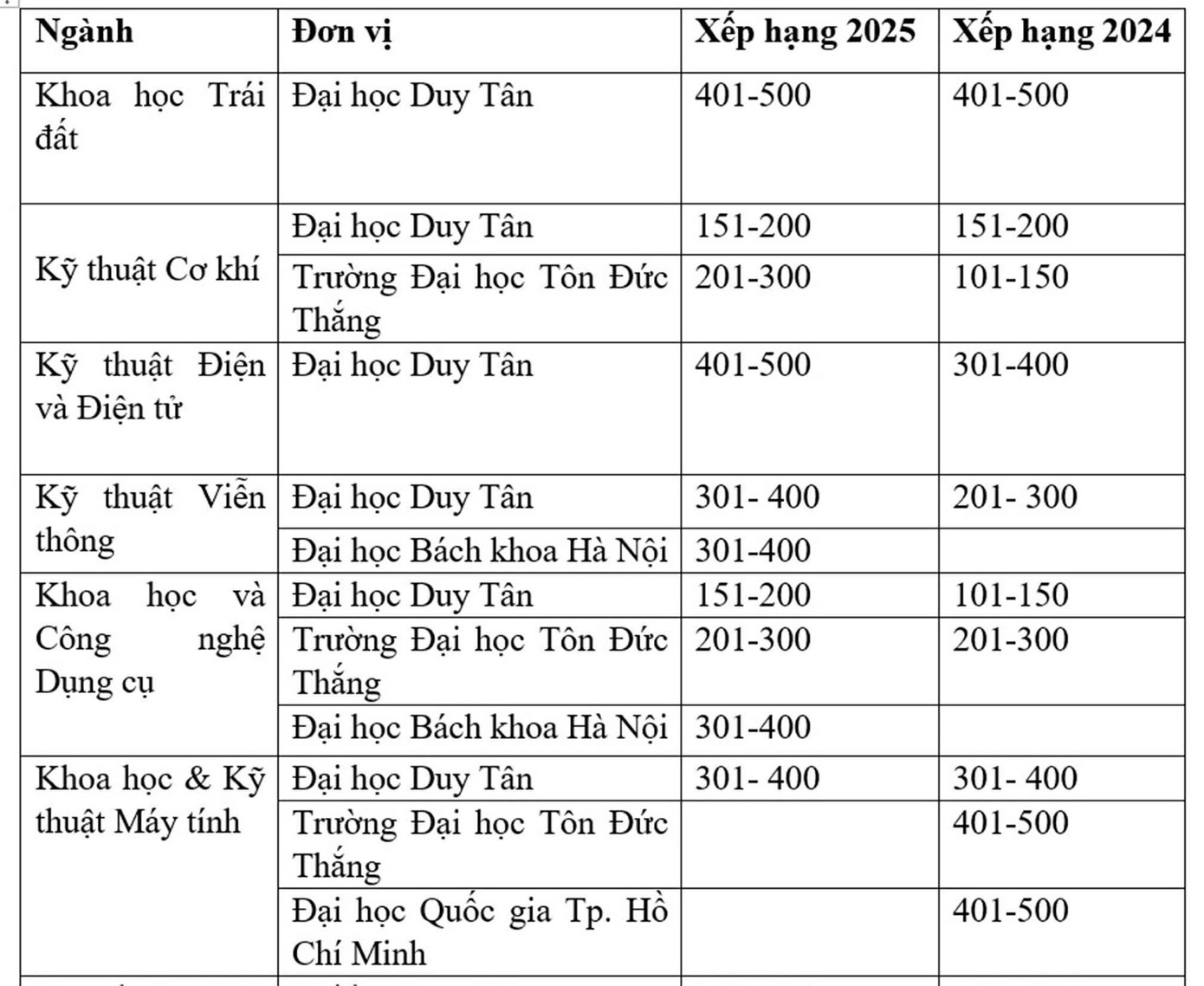
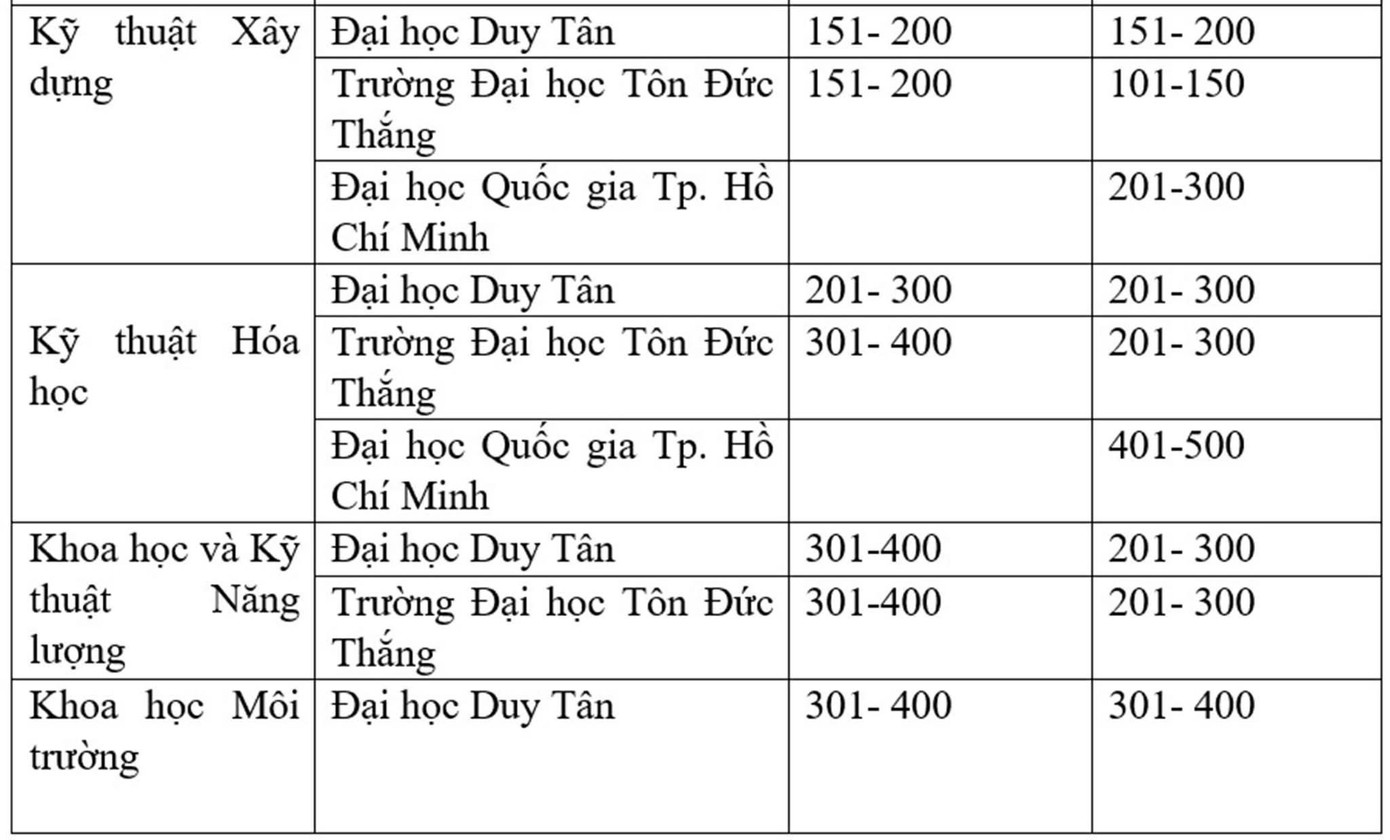
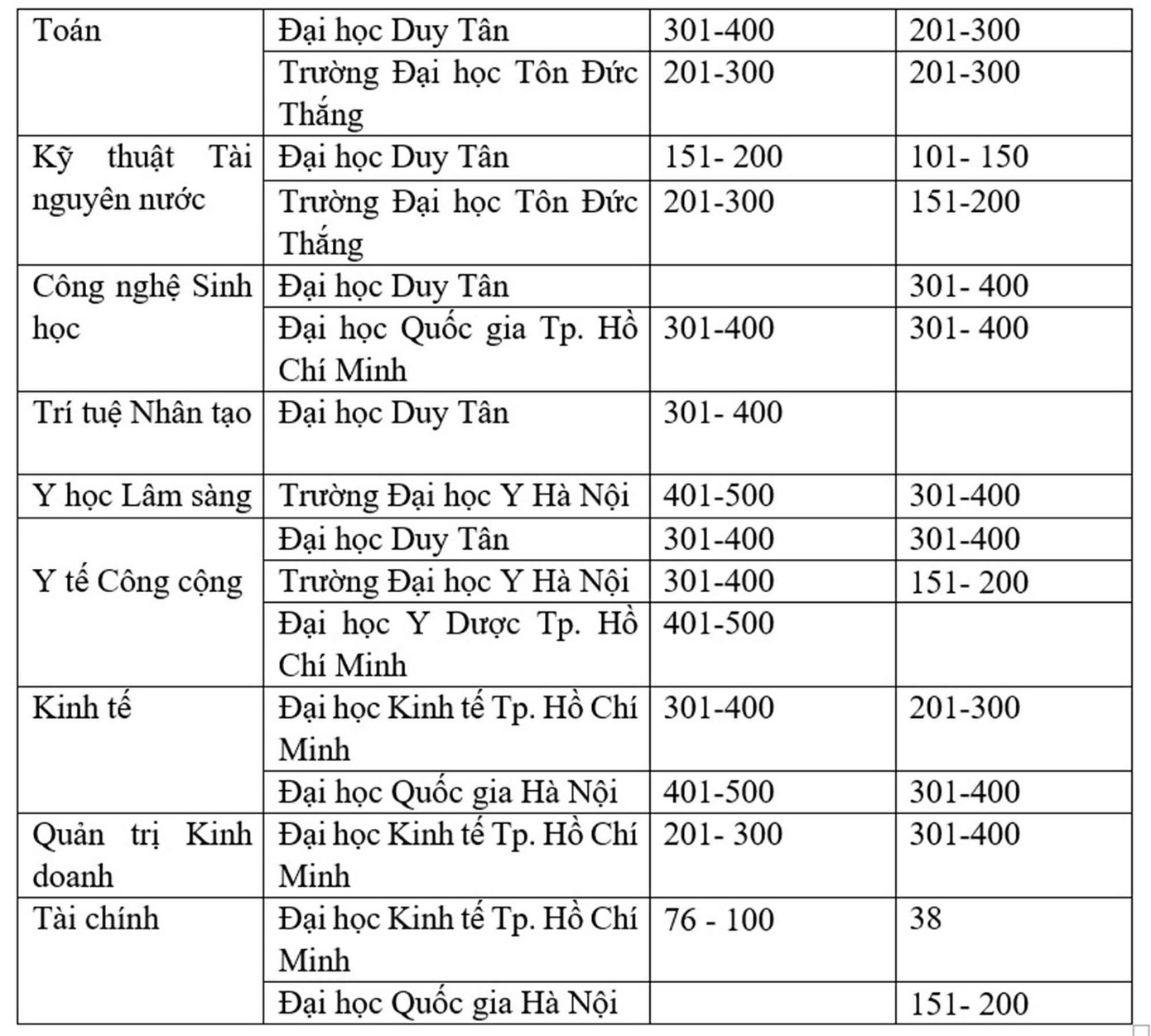
Ranking of majors in Vietnamese universities in 2025 and 2024 according to GRAS 2025
The Shanghai Ranking by Subject Area at Universities (GRAS) is considered one of the most rigorous rankings currently available due to its very high research quality requirements across all disciplines. According to the GRAS criteria, each discipline is only considered if it meets a minimum publication threshold, ranging from 25 to 300 articles depending on the field. Each discipline has specific regulations regarding the number of publications, with exceptionally high entry requirements (a large number of articles) or lower requirements (still needing 25 to 100 articles depending on the discipline), such as:
- In the Natural Sciences field: Physics requires 300 assignments or Chemistry 200, while many other disciplines such as Mathematics, Geography, or Ecology must also achieve a minimum of 100 assignments.
- Engineering fields: Materials Science & Engineering, Energy, or Environmental Science & Engineering require 200 papers; fields such as Electrical and Electronic Engineering, Computer Science, and Automotive Engineering have a threshold of 100 to 150 papers.
- Life Sciences and Medicine: Biology requires 200 papers and Clinical Medicine up to 300 papers, or even the Social Sciences (which usually have lower thresholds) still require between 25 and 100 papers depending on the field.
Meanwhile, the continuous increase in Vietnam's Scopus/ISI journal publications over the past years—from 18,376 articles in 2022 to 19,181 in 2023 and 22,046 in 2024 ( according to the Scopus database )—shows a disparity between the increase in quantity and quality (level) of Vietnam's international publications. At the same time, although many universities have shifted from single-discipline to multi-disciplinary universities, the rankings still show that the strength of Vietnamese universities remains primarily in their core academic disciplines.
GRAS currently uses five sets of indicators to evaluate universities by subject area, including:
• World-Class Faculty : This includes individuals who have received international academic awards (Laureates), are highly cited researchers (HCR), serve as principal editors of international journals (Editors), or hold international academic leadership positions (Leadersship).
• Outstanding Academic Achievements ( World-Class Output ): considering publications in leading international journals (TJ), international academic awards (Awards);
• High - Quality Research : refers to the number of articles published in journals classified as Q1 (highest) according to international journal classification;
• Research Impact : This refers to the standardized citation index (CNCI), meaning that research should not only be published frequently but also have a substantial impact, being cited by the global academic community; and
• International Collaboration : Considering the proportion of international collaboration in research, it is clear that GRAS prioritizes research with an international scope, not simply "internal" research.
With its high publication thresholds, high publication quality, and clear stratification across fields, GRAS only considers institutions with truly outstanding research capabilities. This creates a high degree of selectivity and is why the GRAS ranking is recognized by the international academic community as a rigorous measure of the research capabilities of universities worldwide.
Source: https://tienphong.vn/gras-2025-ghi-nhan-cac-thay-doi-ve-chat-luong-nghien-cuu-cua-viet-nam-post1804088.tpo


![[Photo] Two flights successfully landed and took off at Long Thanh Airport.](/_next/image?url=https%3A%2F%2Fvphoto.vietnam.vn%2Fthumb%2F1200x675%2Fvietnam%2Fresource%2FIMAGE%2F2025%2F12%2F15%2F1765808718882_ndo_br_img-8897-resize-5807-jpg.webp&w=3840&q=75)











































































Comment (0)