

Is it reasonable for universities to not accept IELTS certificates and require students to take English language programs organized by the university?
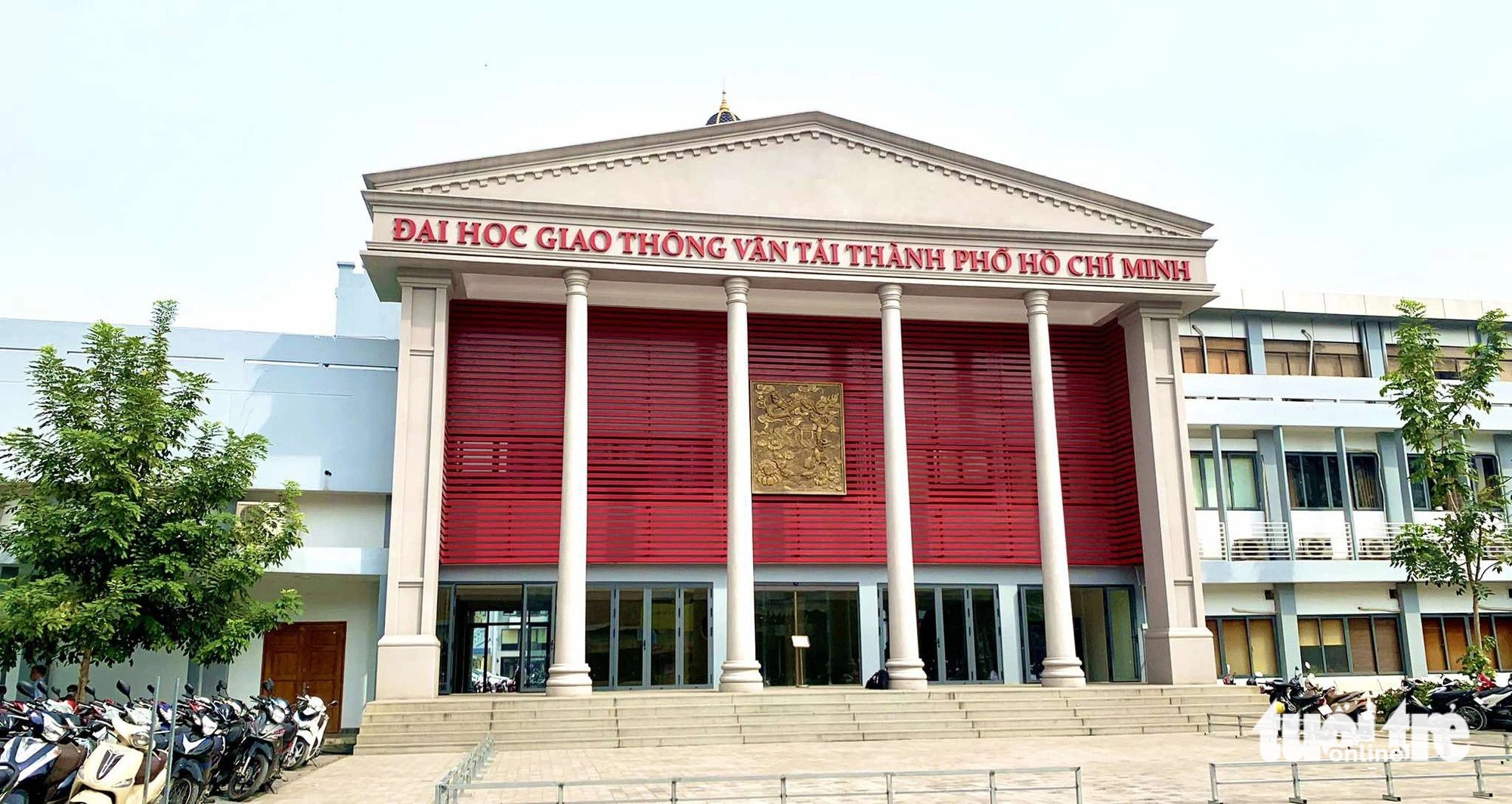
Ho Chi Minh City University of Transport does not accept exemptions from the English course for students with IELTS certificates - Photo: TRAN HUYNH
As reported by Tuoi Tre Online , many parents and students of Ho Chi Minh City University of Transport are upset that students who already have international language certificates such as IELTS are not accepted by the university, and are forced to take an English exam and pay for English courses at the school.
The incident attracted widespread attention from readers, with many conflicting opinions.
An IELTS score of 7.0 doesn't necessarily mean you understand technical English; you might need to study more.
According to reader Tu, in reality, Ho Chi Minh City University of Transport still allows students from cohort 22 and earlier to submit international English certificates to be exempted from the English course. However, from cohort 23 onwards, the university requires students to pay tens of millions of VND to take the university's English course.
"In fact, those with an IELTS score of 7.0 or higher are quite good at communicating and even researching in English, so they will do well in their professional fields. Learning English at school is like studying high school material, focusing only on grammar and vocabulary. If you can't listen and speak, how can you get a job?"
Regarding English for Specific Purposes, I think the school should stipulate that students can register for courses if they want to, or study on their own outside of school. Is it really necessary to spend 6 million VND on English for Specific Purposes if it's just vocabulary learning?", one reader wondered.
Reader Tinh commented: "Clearly, according to the school's announcement, most classes are general English, with only the last class possibly being specialized English."
Students with high IELTS scores who still have to retake English courses at school are wasting time and money.
Once students have a good level of English, they can learn additional specialized vocabulary on their own, as a course at school alone won't solve anything."
Reader Huynh Chuong asks: Has the General English program at Ho Chi Minh City University of Transport been accredited by the Ministry of Education and Training ? Is the English UTH certificate issued by the university legally valid? Does the Ministry allow the university to issue this certificate independently?
Meanwhile, school leaders explained that "teaching the English program at the school aims to ensure quality and prevent students from being scammed by external groups into receiving fake certificates."
Regarding this opinion, reader Xuan Phuong commented: "Whether it's a genuine scam or not depends on the management. Do all the lecturers at the school have IELTS 7.5 scores that they would force students to do something like that?"
Learning specialized English makes sense.
However, many readers also believe that it is reasonable for the school to organize specialized English courses within the school.
Reader Minh Khang commented: "I support English for specific purposes for students in universities. We are integrating very deeply with the world , so it is necessary."
In fact, IELTS certificates are general in nature and not specialized in any narrow field. If students do not study English for their specific major, they will have difficulty accessing specialized materials during their studies and research."
Sharing the same viewpoint, reader Gia Bao believes that learning specialized English will be very helpful for future employment. In an environment where people communicate using specialized terminology and language, accurately understanding what the other person is conveying is crucial.
"English taught at school is specialized English, and it's reasonable for students to be required to learn it. For example, 'Bridge' means a bridge, a connecting bridge, but in maritime studies, it refers to the ship's wheelhouse."
"If you don't study English for specific purposes, you'll face many difficulties communicating professionally after graduation," reader Johny commented.
Reader Hoang Dan also affirmed: "Those with an IELTS score of 7.0 are not necessarily knowledgeable and proficient in technical terminology, especially in the language of specialized machinery."
However, reader Migu commented: "You're studying English for specific purposes, but the school doesn't differentiate English for specific purposes for each major. I'm studying automation, but I still have to study English for logistics. After graduation, that specific English won't be useful in my job."
The English tuition fees at the school are too high.
Identifying himself as a student of Ho Chi Minh City University of Transport, reader Hoai Nam commented: "Honestly, the quality of English lecturers at the university is average. The tuition fee is 5 million VND per level, but I only received 4-5 in-person classes, the rest were online, and the course only lasted a month."
According to reader Vy: "The school teaches a total of five levels of English, but only one level is English for Specific Purposes. We don't object to English for Specific Purposes because every school has it. And we also don't object to the school teaching basic English."
The issue we disagree with is the English tuition fee. 6 million VND for specialized English might be acceptable, but for basic English, this fee is too high.
We even had to study online and e-learning (self-study - teachers assign homework for students to research and complete on their own, or not). More importantly, e-learning took up a significant amount of time, and it was even counted as a class period."
Source: https://tuoitre.vn/ielts-7-5-van-hoc-lai-tieng-anh-o-truong-can-thiet-hay-lang-phi-2024120710242137.htm



![[Image] Pleasant weather helps students enter the 10th grade entrance exam with confidence.](https://vphoto.vietnam.vn/thumb/1200x675/vietnam/resource/IMAGE/2026/05/29/1780034401612_ngay-1-thi-lop-10-minh-duy-8-5009-jpg.webp)
![[Photo] Ba Lang An Lighthouse - the "eye of the sea" amidst the "rock museum" of Quang Ngai province.](https://vphoto.vietnam.vn/thumb/1200x675/vietnam/resource/IMAGE/2026/05/29/1780038698840_anh-man-hinh-2026-05-29-luc-14-10-42.png)





























































































Comment (0)