

This information was announced by the Deputy Minister of Science and Technology , Pham Duc Long, at Internet Day 2025, held on December 17, 2025 in Hanoi, with the theme "Creating a Reliable Digital Space – The Internet Must Be Safer".
The event was organized by the Vietnam Internet Association (VIA) in collaboration with the Vietnam Internet Center, the Ministry of Science and Technology, and technology companies.

Deputy Minister of Science and Technology Pham Duc Long visits theFPT booth.

Deputy Minister of Science and Technology Pham Duc Long and former Permanent Deputy Minister of Post and Telecommunications Mai Liem Truc listen to a report at the Viettel IDC booth.

Deputy Minister of Science and Technology Pham Duc Long visits the Digital Brand Presence booth at Internet Day 2025.
After nearly three decades of development, the Internet has become an inseparable part of Vietnam's socio-economic life. Internet infrastructure is increasingly modern, with widespread coverage; the participation of citizens and businesses in the digital environment is growing deeper and broader; and the quality of connectivity is constantly improving, approaching that of developed countries.
However, according to Deputy Minister Pham Duc Long, as we enter a new phase of development, the challenge is no longer about expanding scale or increasing speed, but rather about orienting Internet development in depth , ensuring the effective utilization of achievements already made, and serving the goal of rapid, sustainable, and inclusive development.
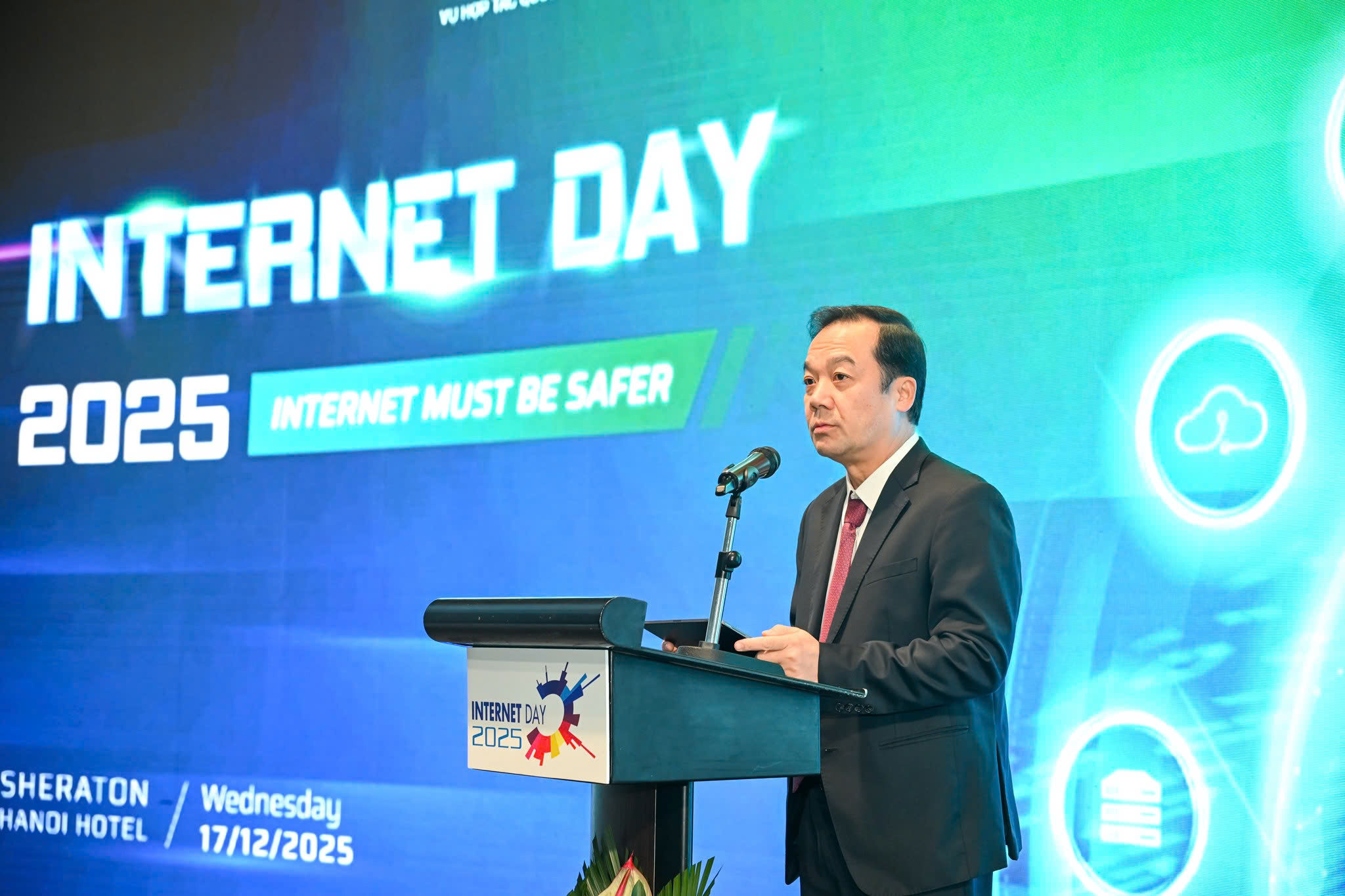
Deputy Minister Pham Duc Long speaks at Internet Day 2025.
Resolution No. 57-NQ/TW dated December 22, 2024, of the Politburo identified science, technology, innovation, and digital transformation as key pillars of national development. In this context, the Internet is not merely a technical infrastructure, but has become a development space where scientific and technological activities, data, digital platforms, and innovation are connected and transformed into practical value.
Deputy Minister Pham Duc Long emphasized that Vietnam's Internet is shifting from a connectivity infrastructure role to a digital infrastructure for the digital economy , encompassing connectivity, computing power, data, platforms, and information security. This is a key factor determining the productivity, competitiveness, and self-reliance of Vietnam's digital economy in the future.
According to Deputy Minister Pham Duc Long, for the Internet to develop sustainably, it must first be built on a foundation of trust: trust between people in the digital environment and trust within the entire digital ecosystem, where technology platforms, data, and communities work together to create value.
"Trust doesn't form naturally; it needs to be built intentionally through institutions, standards, and the coordinated efforts of the State, businesses, and society," Deputy Minister Pham Duc Long affirmed.
Sharing the same view, Mr. Vu Hoang Lien, Chairman of the Vietnam Internet Association, believes that the biggest challenge facing the Internet today is no longer transmission speed or coverage, but rather building a safe and reliable digital space .
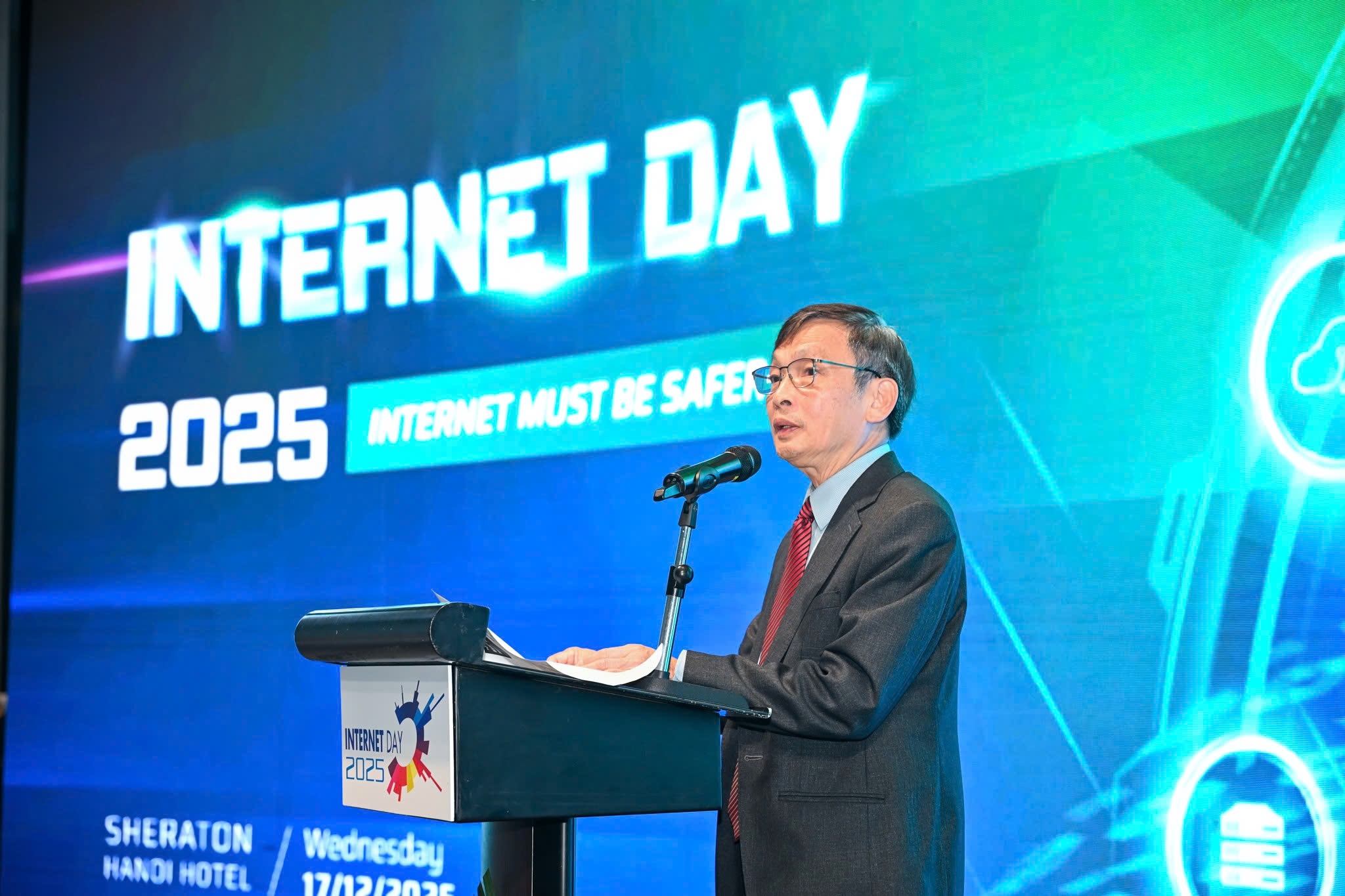
Mr. Vu Hoang Lien, Chairman of the Vietnam Internet Association, speaking at Internet Day 2025.
The downside of the explosion of new technologies such as artificial intelligence and big data is that they are being exploited for online fraud, psychological manipulation, and profiteering with increasing sophistication. Among nearly 80 million internet users in Vietnam, a significant number have become victims of cyber violations.
Mr. Vu Hoang Lien shared that when trust is damaged, users become hesitant to click; businesses falter in digital transformation due to concerns about data security.
According to Nguyen Truong Giang, Acting Director of the Vietnam Internet Center ( VNNIC) , Internet security risks exist at every network layer. At the physical infrastructure, risks include cable breaks, power outages, and equipment failures. At the connectivity infrastructure, risks include cyberattacks such as DDoS and phishing, along with reliance on international transmission lines. At the core infrastructure, the biggest risk lies in routing security – the root element of the Internet.
However, after detecting the threat, VNNIC collaborated with businesses to implement routing security solutions. Thanks to the early implementation of these measures since 2020, the protection rate of Vietnam's Internet address ranges has now reached 97%. In addition, 14,000 domain names are protected, ensuring the security of digital identities.
From a regional perspective, Filip Graovac, representative of the Asia Foundation, argues that digital trust is the foundation of the digital economy. The increasing internet penetration rate has changed consumer behavior, especially in large cities. On average, 3 out of 5 Asian users regularly shop online, with about 60% of transactions conducted through digital payments. Therefore, digital economic growth can only be generated when people and businesses truly trust the digital environment.
According to international rankings, as of October, Vietnam's fixed broadband internet speed ranked 10th in the world, and mobile broadband internet ranked 15th. Vietnam's digital infrastructure is currently ranked 67th out of 193 countries, an increase of 7 places compared to 2022.
Vietnam currently has 7 international undersea fiber optic cables; its data infrastructure is expanding rapidly with 45 data centers. Approximately 85% of households use fiber optic internet. After nearly a year of commercialization, 5G network coverage reaches 59% of the population, creating an important foundation for the development of the digital economy, digital government, and digital society. According to the Telecommunications Authority, mobile network coverage is widespread throughout the country, with affordable service prices suitable for the majority of the population.
Source: https://mst.gov.vn/internet-day-2025-khong-gian-so-tin-cay-trong-ky-nguyen-ai-bung-no-197251217143045625.htm
![[Image] The tenacious fighting spirit of Vietnamese women's football](/_next/image?url=https%3A%2F%2Fvphoto.vietnam.vn%2Fthumb%2F1200x675%2Fvietnam%2Fresource%2FIMAGE%2F2025%2F12%2F17%2F1765990260956_ndo_br_4224760955870434771-copy-jpg.webp&w=3840&q=75)
![[Live] 2025 Community Action Awards Gala](/_next/image?url=https%3A%2F%2Fvphoto.vietnam.vn%2Fthumb%2F1200x675%2Fvietnam%2Fresource%2FIMAGE%2F2025%2F12%2F16%2F1765899631650_ndo_tr_z7334013144784-9f9fe10a6d63584c85aff40f2957c250-jpg.webp&w=3840&q=75)
![[Photo] Prime Minister Pham Minh Chinh receives the Governor of Tochigi Province (Japan)](/_next/image?url=https%3A%2F%2Fvphoto.vietnam.vn%2Fthumb%2F1200x675%2Fvietnam%2Fresource%2FIMAGE%2F2025%2F12%2F16%2F1765892133176_dsc-8082-6425-jpg.webp&w=3840&q=75)
![[Image] Leaked images ahead of the 2025 Community Action Awards gala.](/_next/image?url=https%3A%2F%2Fvphoto.vietnam.vn%2Fthumb%2F1200x675%2Fvietnam%2Fresource%2FIMAGE%2F2025%2F12%2F16%2F1765882828720_ndo_br_thiet-ke-chua-co-ten-45-png.webp&w=3840&q=75)
![[Photo] Prime Minister Pham Minh Chinh receives Lao Minister of Education and Sports Thongsalith Mangnormek](/_next/image?url=https%3A%2F%2Fvphoto.vietnam.vn%2Fthumb%2F1200x675%2Fvietnam%2Fresource%2FIMAGE%2F2025%2F12%2F16%2F1765876834721_dsc-7519-jpg.webp&w=3840&q=75)









![[Live] Closing Ceremony and Award Presentation for the "Impressive Vietnam Tourism" Video/Clip Creation Contest 2025](https://vphoto.vietnam.vn/thumb/402x226/vietnam/resource/IMAGE/2025/12/17/1765974650260_z7273498850699-00d2fd6b0972cb39494cfa2559bf85ac-1765959338756946072104-627-0-1338-1138-crop-1765959347256801551121.jpeg)













































































Comment (0)