

Vietnam is building a modern, secure, and interconnected national data system.
Attending the workshop were: Ms. Nguyen Thi Thanh, Vice Chairwoman of the National Assembly; Mr. Bui Hoang Phuong, Deputy Minister of Science and Technology; Major General Nguyen Ngoc Cuong, Director of the National Data Center, Ministry of Public Security , and Vice President of the National Data Association; representatives from central and local ministries and agencies; international organizations; and a large number of domestic and international scientists and experts.
In his opening remarks at the workshop, Major General Nguyen Ngoc Cuong, Director of the National Data Center and Vice President of the National Data Association, affirmed: A new development order is emerging. If the 20th century was driven by oil and heavy industry, the 21st century is driven by data, knowledge, and analytical capabilities. In the data age, data has become a factor of production on par with land, labor, and capital; it is valued, traded, and exploited to enhance productivity, forming the foundation for innovation and artificial intelligence, and contributing directly to GDP in many OECD and European economies .
According to Major General Nguyen Ngoc Cuong, the nation that manages data better and exploits it more intelligently will have a significant advantage in global competition. Vietnam has chosen to enter the data era by building a modern, secure, and interconnected national data system and by assigning a leading role to an agency with sufficient capacity, infrastructure, and responsibility. This is also the reason why the Government has assigned the Ministry of Public Security as the national focal point for data.
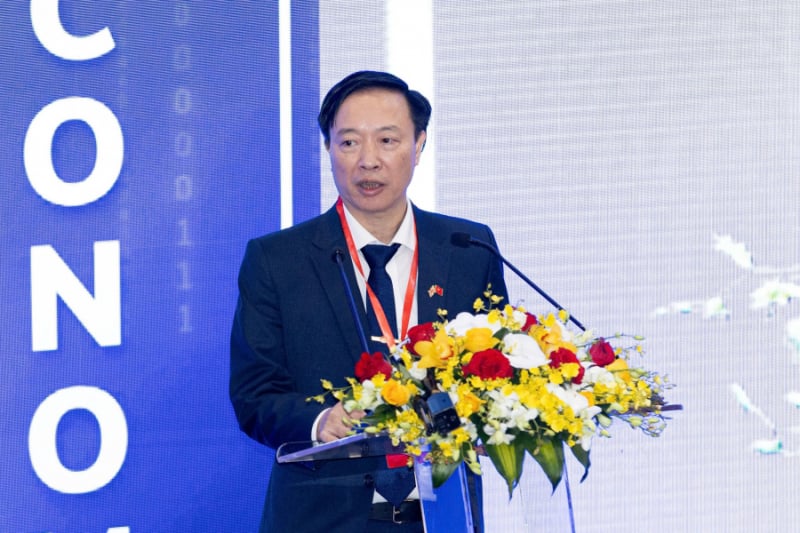
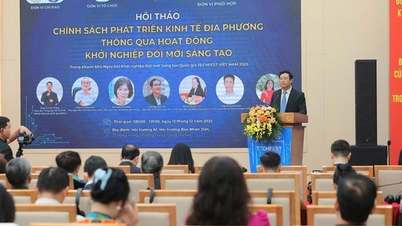
Major General Nguyen Ngoc Cuong, Director of the National Data Center and Vice President of the National Data Association, delivered a speech at the conference.
Major General Nguyen Ngoc Cuong stated that, over the years, the Ministry of Public Security has built and operated many core data platforms: the National Population Database, the electronic identification and authentication system, the national data connection and sharing system, and especially the deployment of the National Data Center, the largest and most far-reaching data infrastructure project, laying the foundation for the formation of a data market and the development of the data economy in Vietnam.
The National Data Center will create a trusted data layer for the digital government; provide infrastructure for AI and digital services; standardize nationwide data connectivity, contributing to ensuring data security, safety, and sovereignty, while opening up a modern data architecture for regional and international integration. In other words, the Ministry of Public Security not only manages data, but is also the force that creates the infrastructure, standards, and operational order of the national data ecosystem, a particularly important role in the data era.
This conference is not just for academic exchange. It is a forum that lays the groundwork for regional and international cooperation on the data economy, where Vietnam hopes to connect more deeply with leading universities worldwide, policy-making bodies, international research organizations, global technology companies, and networks of data and AI experts.
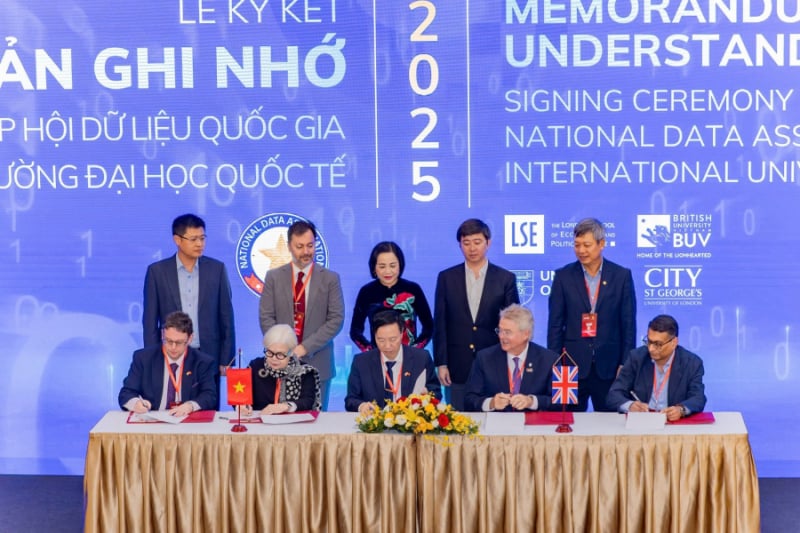
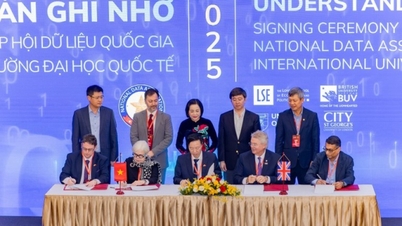
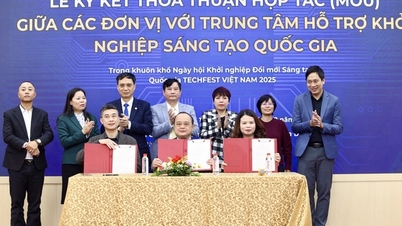
The National Data Association and international universities signed a memorandum of understanding in the presence of National Assembly Vice Chairwoman Nguyen Thi Thanh and other delegates.
Major General Nguyen Ngoc Cuong shared that the Vietnamese Ministry of Public Security is honored to host the International Conference on Data Economy and expects this event to open up three avenues for long-term cooperation.
Firstly, there should be collaborative research on data economics and data value measurement, particularly models based on OECD, EU, UK, and Australian standards, to develop a set of data economics indicators for Vietnam.
Secondly, cooperation in data governance and data security includes data standards, data sharing, data rights, and the protection of national data sovereignty.
Thirdly, cooperation in training high-quality human resources between Vietnam and international research centers is needed to build capacity in data analytics, data economics, and artificial intelligence.
This is not just about collaboration between institutions, universities, and experts, but about building an international network on Data Economy, with Vietnam as a connecting point for the Southeast Asian region.
Professor Raymond Gordon, Rector of BUV University, believes that the data economy is a crucial driver of productivity growth, but it's not simply a matter of technology. The core lies in governance, developing talented human resources, and strategic thinking to achieve sustainable growth. Vietnam has recognized the role of data early on through the development of digital development frameworks. Data not only serves academic research but has become a strategic element, shaping new development thinking.
BUV University is proud to be a bridge in international cooperation, striving towards global standards based on trust, transparency, and integrity. In the context of AI driving the smart economy, data economy is a key focus of BUV's training, aiming to develop a high-quality workforce and apply technology and innovation to policy, infrastructure, and economic development.
BUV University is committed to long-term cooperation with a clear, measurable, and verifiable vision, not only investing in facilities but also building a solid educational foundation, accompanying Vietnam in developing the data economy, training a high-class workforce, and opening up new opportunities in the data era.
Which data-driven economic model is suitable for Vietnam?
According to delegates at the conference, the data economy is no longer just a technological trend but has become a new infrastructure architecture shaping the productivity, innovation, and competitiveness of nations in the next decade. Data is the "lifeblood" of innovation, the foundation for new productivity, and the common language of all modern decision-making. Viewing the future through the lens of data is how advanced nations are designing the next generation of growth models.
To enter the new economic structure, Vietnam needs a comprehensive data infrastructure plan, a common data standard, a secure and transparent data sharing mechanism, a modern legal framework for data, and especially a competent central authority to lead the national data sector.
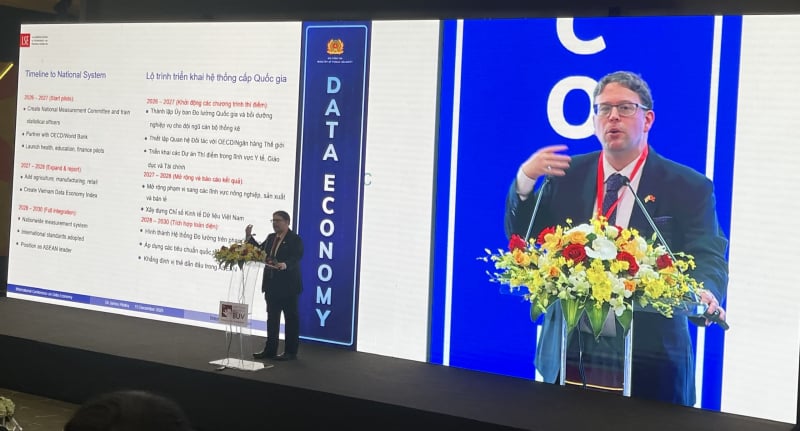
Associate Professor James Abdey, Deputy Academic Director for International Programs at the London School of Economics and Political Science (LSE), shared information at the workshop.
Professor Muttukrishnan Rajarajan, Department of Security Engineering & Director of the Institute for Cyber Security, City University of St George, University College London, analyzed the overall picture of the transition from a knowledge-based economy to a digital economy and then to a data-based economy, a model that is reshaping the competitiveness of nations.
According to Professor Muttukrishnan Rajarajan, data has now become a strategic economic asset, determining the operational efficiency, innovation capabilities, and growth of businesses and nations. With strong transformation drivers and evolving policies, Vietnam has a great opportunity to participate deeply in the global data value chain if it prioritizes investment in digital infrastructure, standardizes data governance, and promotes inter-sectoral cooperation.
Associate Professor Ali Al-Dulaimi, Head of the Faculty of Technology & Computer Science at BUV University, believes that with its young population, rapid digital transformation, and flexibility in policy planning, Vietnam has the conditions to build a "hybrid" model, combining state direction, the innovation capacity of the private sector, and policies to protect its citizens.
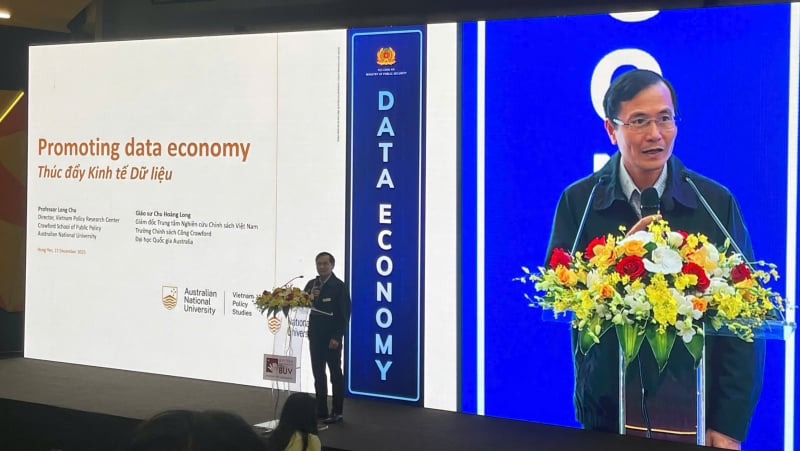
Professor Chu Hoang Long, Director of the Vietnam Policy Research Center, Crawford School of Public Policy, Australian National University, shared information at the conference.
Associate Professor James Abdey, Deputy Academic Director for International Programs at the London School of Economics and Political Science (LSE), emphasized that data has become a core intangible asset that fuels the competitiveness of modern economies, even surpassing the value of traditional assets in many areas.
However, the lack of a comprehensive measurement system means that much of the economic value derived from the data is not reflected in GDP, leading to a systematic underestimation of productivity and the scale of economic activity. This makes policy planning, monitoring digital transformation progress, and attracting investment more difficult.
Drawing on the experiences of the UK, the OECD, and the World Bank, he proposed that Vietnam develop a measurement framework that combines international standards with a practical approach, starting with pilot programs in three data-intensive sectors – health, education, and finance – to quickly demonstrate economic value before scaling up nationwide.
Professor Chu Hoang Long, Director of the Vietnam Policy Research Center at the Crawford School of Public Policy, Australian National University, emphasized that to promote a healthy data economy, Vietnam needs to simultaneously measure three groups of factors: data exploitation, data provision, and the policy and business environment. In particular, data policy development should be based on ethics, transparency, and the leading role of the Government through the digitalization of public services and enhanced public-private partnerships.
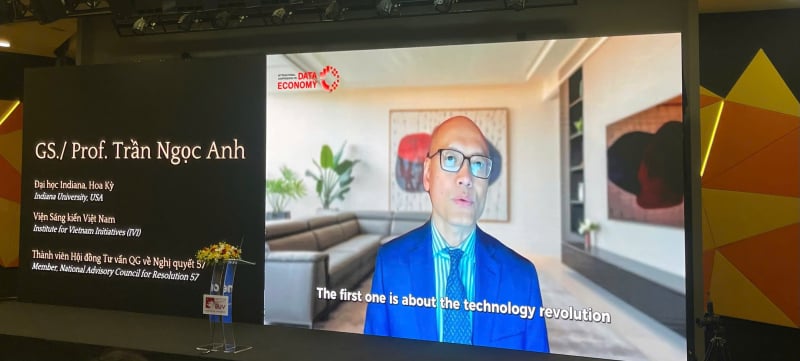
Professor Tran Ngoc Anh, Indiana University, President of the Vietnam Initiative Institute, shared information at the workshop from Indiana University.
Professor Tran Ngoc Anh, Indiana University, President of the Vietnam Institute for Innovation, and a member of the Advisory Group for Resolution 57 on breakthroughs in national science, technology, innovation, and digital transformation, also affirmed that data is becoming a strategic resource of the 21st century, determining the competitiveness and development position of the nation.
International cooperation on the data economy is a prerequisite for Vietnam to "move fast, move correctly, and move far." Currently, Vietnam is proactive, positive, and responsible in international integration with three attractive values: a young population, rapid digitalization, and a developing national data system.
To achieve the goal of becoming Asia's leading "Data Powerhouse" by 2045, the data economy needs to be built on three key pillars: Digital infrastructure (5G/6G, data centers, cloud computing, IoT); digital workforce (data science, AI, cybersecurity, digital skills); and digital institutions (personal data protection, open data sharing, cybersecurity, policy sandbox). These pillars will foster innovation and generate new wealth for the economy.
In his concluding remarks at the workshop, Major General Nguyen Ngoc Cuong, Director of the National Data Center and Vice President of the National Data Association, stated that the Vietnamese Government will continue to improve institutions, standardize and share data responsibly, develop a transparent data market, build a data and AI workforce, and expand international cooperation—all for the goal of data serving humanity, promoting innovation, improving the quality of life, and elevating the nation.
Source: https://mst.gov.vn/kinh-te-du-lieu-tru-cot-tang-truong-moi-cua-viet-nam-trong-thap-ky-toi-19725121401510167.htm























































































Comment (0)