

The model is applied uniformly and consistently throughout the entire political system.
The overall objective of the Regulation is to create a unified national digital space to fundamentally and comprehensively restructure the operational methods of the political system, shifting from traditional governance to modern, efficient national governance based on data and digital technology . This will change mindsets and governance methods, forming the basis for building a comprehensive national digital architecture framework, aiming for a transparent, efficient governance system that is people- and business-centered.

Regarding specific objectives: The model aims to establish a synchronized national digital interconnection system based on shared infrastructure, data, digital platforms, and applications to eliminate information fragmentation and investment disparities, create a shared national digital resource, and utilize data, digital technology, and artificial intelligence as drivers of socio -economic development, national defense, and security. The implementation of this model aims for concrete, measurable results (KPIs) in terms of increased transparency and accuracy, reduced compliance time and costs, and enhanced analytical, forecasting, and policy-making capabilities.
This model is applied uniformly and synchronously throughout the entire political system, including agencies and organizations of the Party, State, Vietnam Fatherland Front, and socio-political organizations from the central to local levels. Its application in localities with particularly difficult socio-economic conditions will follow a suitable roadmap guided by the Central Steering Committee.
7 core principles of the Model
The construction, implementation, operation, and evaluation of the Model must strictly adhere to 7 core principles, shifting from an "administrative management" mindset to a "development management" mindset, including: Results-based governance; Data-driven leadership, direction, and operation in real time; Intelligent and automated operation with a priority on the application of Artificial Intelligence (AI First); Strong decentralization and delegation of authority on a digital platform; User-centric approach with a unified service ecosystem; Ensuring information security and cybersecurity as a prerequisite and overarching requirement; Promoting the development of open data, enhancing transparency, accountability, and innovation.
The principles of the Model are closely interconnected and mutually supportive, forming a unified whole. In this model, ensuring cybersecurity (Principle 6) is the foundation upon which the remaining principles can be reliably and sustainably implemented. On this secure foundation, data-driven leadership, guidance, and management (Principle 2) are only feasible when there is an intelligent, automated data collection system (Principle 3). The collected data allows the central government to effectively monitor and, consequently, decentralize power to local authorities (Principle 4). The effectiveness of decentralization and the entire model is measured by tangible results (Principle 1), aiming for satisfaction for citizens and businesses through a unified, user-centric ecosystem (Principle 5). User trust in the ecosystem is further strengthened by the assurance of cybersecurity (Principle 6). Based on this, the public disclosure, sharing, and openness of data (Principle 7) not only enhances transparency and accountability but also promotes innovation, maximizes the value derived from data, creating a closed and continuously improving cycle.
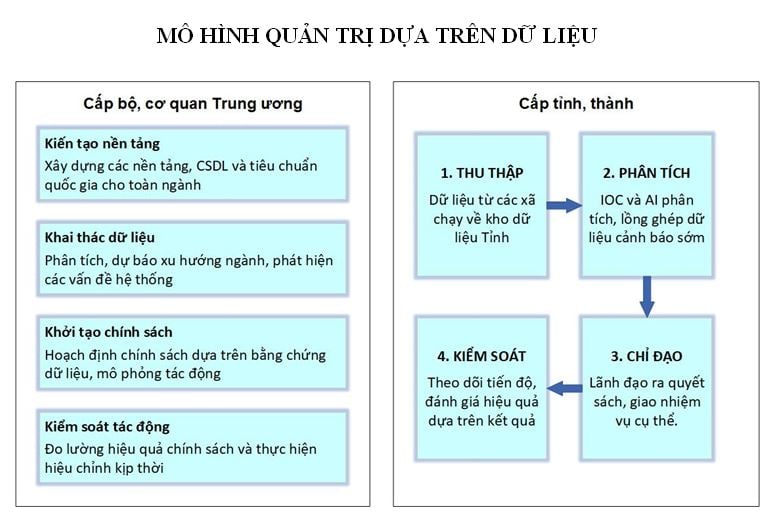
The overall 4-layer architecture of the Model
The model is built according to a 4-layer overall architecture, ensuring consistency, scalability, safety, and network security, including (1) Shared Digital Infrastructure and Network Security Layer, (2) Data and Core Platform Layer, (3) Shared Application and Business Layer, and (4) Interaction Channel and Performance Measurement Layer, with data and artificial intelligence playing a central role, connecting and operating throughout the entire system.
This layering helps to clearly define the roles and responsibilities of agencies and ensures that components can be developed independently but remain compatible and closely interconnected; in which data and artificial intelligence play a central role, connecting and operating throughout the entire system.
Level 1. Shared digital infrastructure and cybersecurity. This is the physical and logical foundation, providing basic resources and secure connections for the entire political system, including: the National Data Center and the cloud computing platform within the National Data Center, built and operated under the leadership of the Ministry of Public Security; the Party's wide-area information network; the dedicated data transmission network for Party and State agencies; the dedicated digital signature authentication system for public service, managed by the Government Cipher Committee; the National Cybersecurity Monitoring Center, managed by the Ministry of Public Security; specific connections for remote areas and areas with special geographical conditions; and infrastructure ensuring end-to-end data security and safety.
Layer 2. Data and Core Platform. This is the central layer, playing a crucial role in the Model, where data is created, stored, shared, and processed into knowledge. Data in databases must be standardized, ensuring the principles of "accuracy, completeness, cleanliness, and viability," including: National and specialized databases: Including national databases (Population, Land, Enterprises, etc.) and specialized databases built by ministries and agencies, including specific databases (data on ethnic minorities, border management, etc.); the national aggregate database at the National Data Center and the data sharing and coordination platform of the National Data Center, chaired by the Ministry of Public Security; the national data integration and sharing platform; the electronic identification and authentication platform; the national digital map and postal code system; and the shared big data analytics and artificial intelligence platform (AI platform).
Layer 3. Common Applications and Operations . This layer includes application systems and digital platforms serving common operations throughout the entire political system, built on the principle of shared use to avoid duplication and waste, such as: - The National Public Service Portal, the National Document Interconnection System, the Information System for Government and Prime Minister's Guidance and Management, the National Reporting Information System (including the Government Reporting Information System and the Reporting Information Systems of ministries, agencies, and localities), the Unified Official Email System, the National Online Meeting Platform, the National Platform for Managing Cadres, Civil Servants, and Public Employees, and specialized platforms and applications serving propaganda, mass mobilization, border management, disaster warning, and other tasks of agencies within the political system.
Grade 4. Interaction channels and effectiveness measurement. This is the interface layer, where users (officials, civil servants, citizens, businesses) interact with the system and where the effectiveness of the entire model is measured, including: Main interactive interface: National Public Service Portal (for web interface) and VNeID application (for mobile); Guidance and management tools (Dashboards for monitoring and managing national, sectoral, field, and local operations); Monitoring and measurement framework (KPIs).
This architecture creates a closed loop: Data from databases (Layer 2) is processed by the AI Platform (Layer 2) into information and knowledge. This knowledge is visualized on dashboards (Layer 4) for leadership guidance and management. The effectiveness of these guidance is measured by the KPI framework (Layer 4), thereby realizing the Principle of Results-Based Management.
The Central Steering Committee on Science, Technology Development, Innovation, and Digital Transformation assigns tasks to ministries, central agencies, and localities to implement tasks according to their functions, ensuring effective information and reporting; at the same time, it requires that the development and implementation of the Model be considered a key political task, demanding a revolutionary change in thinking and methods of leadership, direction, and management at all levels and sectors. This is an urgent requirement to implement Plan No. 02-KH/BCĐTW and effectively serve the two-tiered local government model, enhancing national governance capacity.
The implementation of this model goes hand in hand with perfecting the legal framework for connecting, sharing, exploiting, using, and protecting data. The model must be designed with an open, flexible architecture that is easy to update and integrate with new technologies.
Source: https://mst.gov.vn/kien-tao-khong-gian-so-quoc-gia-thong-nhat-dong-bo-dua-tren-du-lieu-va-tri-tue-nhan-tao-197250910085529951.htm

![[Image] Leaked images ahead of the 2025 Community Action Awards gala.](/_next/image?url=https%3A%2F%2Fvphoto.vietnam.vn%2Fthumb%2F1200x675%2Fvietnam%2Fresource%2FIMAGE%2F2025%2F12%2F16%2F1765882828720_ndo_br_thiet-ke-chua-co-ten-45-png.webp&w=3840&q=75)
![[Photo] Prime Minister Pham Minh Chinh receives Lao Minister of Education and Sports Thongsalith Mangnormek](/_next/image?url=https%3A%2F%2Fvphoto.vietnam.vn%2Fthumb%2F1200x675%2Fvietnam%2Fresource%2FIMAGE%2F2025%2F12%2F16%2F1765876834721_dsc-7519-jpg.webp&w=3840&q=75)
































































































Comment (0)