

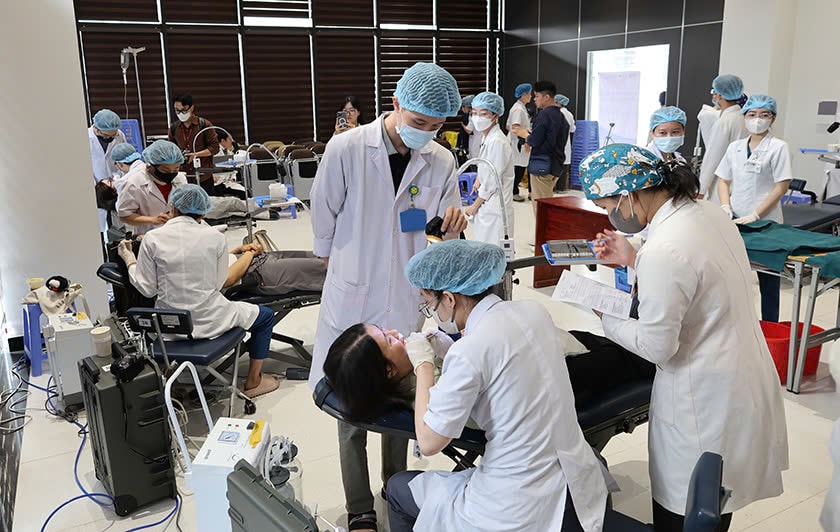
The labor market is changing as technology shifts the demand for labor from medium-level skills to high-level skills, requiring complex analytical and management skills. However, schools and training centers still face many limitations, as the curriculum update cycle is only two years, while technology and the market change very rapidly, and job structures change, requiring training to be updated and adapted in a timely manner.
Associate Professor Dr. Nguyen Gia Nhu, Rector of the School of Technology and Engineering, Duy Tan University, stated that universities are facing many major challenges in the face of AI development.
To adapt to the impact of AI, according to Mr. Nguyen Gia Nhu, universities need to implement many synchronized solutions. First, training programs need to be updated in the direction of AI by incorporating courses on machine learning, natural language processing, computer vision, and data science into the curriculum, while integrating interdisciplinary skills such as combining technology with economics , healthcare, education, etc., so that students understand how to apply AI in practice.
Another approach is to strengthen cooperation with businesses to allow students to intern in real-world AI projects, invite experts from businesses to teach, organize workshops, or guide final-year projects, helping students not only learn theory but also grasp real-world needs, reducing the risk of unemployment.
According to Nguyen Hong Hai, Vice Rector of the University of Technology, Da Nang University, applying science and technology to teaching and educational management helps improve the quality of learning and training. AI not only helps students learn faster but also helps develop soft skills such as creativity, critical thinking, and problem-solving – key elements for future success.
At the University of Economics, Da Nang University, accounting is one of the majors frequently discussed due to the risk of AI replacing humans. However, Associate Professor Dr. Le Van Huy, the university's Rector, affirms that AI simplifies processes but cannot replace humans. "The university applies various teaching methods, thereby helping students adapt quickly and effectively to technological trends and modern skills, solving difficult and complex tasks in the work process, so there is no fear of being replaced by AI," Dr. Le Van Huy asserted.
Source: https://baodanang.vn/ky-nang-nghe-nghiep-di-doi-voi-ky-nang-so-3308321.html


![[Photo] Closing Ceremony of the 10th Session of the 15th National Assembly](/_next/image?url=https%3A%2F%2Fvphoto.vietnam.vn%2Fthumb%2F1200x675%2Fvietnam%2Fresource%2FIMAGE%2F2025%2F12%2F11%2F1765448959967_image-1437-jpg.webp&w=3840&q=75)

![[Photo] Prime Minister Pham Minh Chinh holds a phone call with the CEO of Russia's Rosatom Corporation.](/_next/image?url=https%3A%2F%2Fvphoto.vietnam.vn%2Fthumb%2F1200x675%2Fvietnam%2Fresource%2FIMAGE%2F2025%2F12%2F11%2F1765464552365_dsc-5295-jpg.webp&w=3840&q=75)











![[Infographic] Preventing students from making their own firecrackers: 7 things parents need to know](https://vphoto.vietnam.vn/thumb/402x226/vietnam/resource/IMAGE/2025/12/11/1765466656703_img_0320_20251211183542.jpeg)






























![[OFFICIAL] MISA GROUP ANNOUNCES ITS PIONEERING BRAND POSITIONING IN BUILDING AGENTIC AI FOR BUSINESSES, HOUSEHOLDS, AND THE GOVERNMENT](https://vphoto.vietnam.vn/thumb/402x226/vietnam/resource/IMAGE/2025/12/11/1765444754256_agentic-ai_postfb-scaled.png)
















































Comment (0)