

According to the draft Law on Teachers submitted to the National Assembly for initial consideration at the 8th Session of the 15th National Assembly, for the first time, the legal status of teachers in non-public schools is fully and comprehensively established as teachers, not just as employees under labor contracts.
The draft Law on Teachers, submitted to the National Assembly for initial consideration at the 8th Session of the 15th National Assembly, consists of 9 Chapters and 50 Articles.
The Law on Teachers applies to teachers in both public and private educational institutions. This helps to fill a legal gap for teachers in private institutions, as the Law on Public Employees only penalizes "Vietnamese citizens recruited and working in public educational institutions."
For the first time, the legal status of teachers in private schools has been fully and comprehensively established as educators, not just as employees under labor contracts.
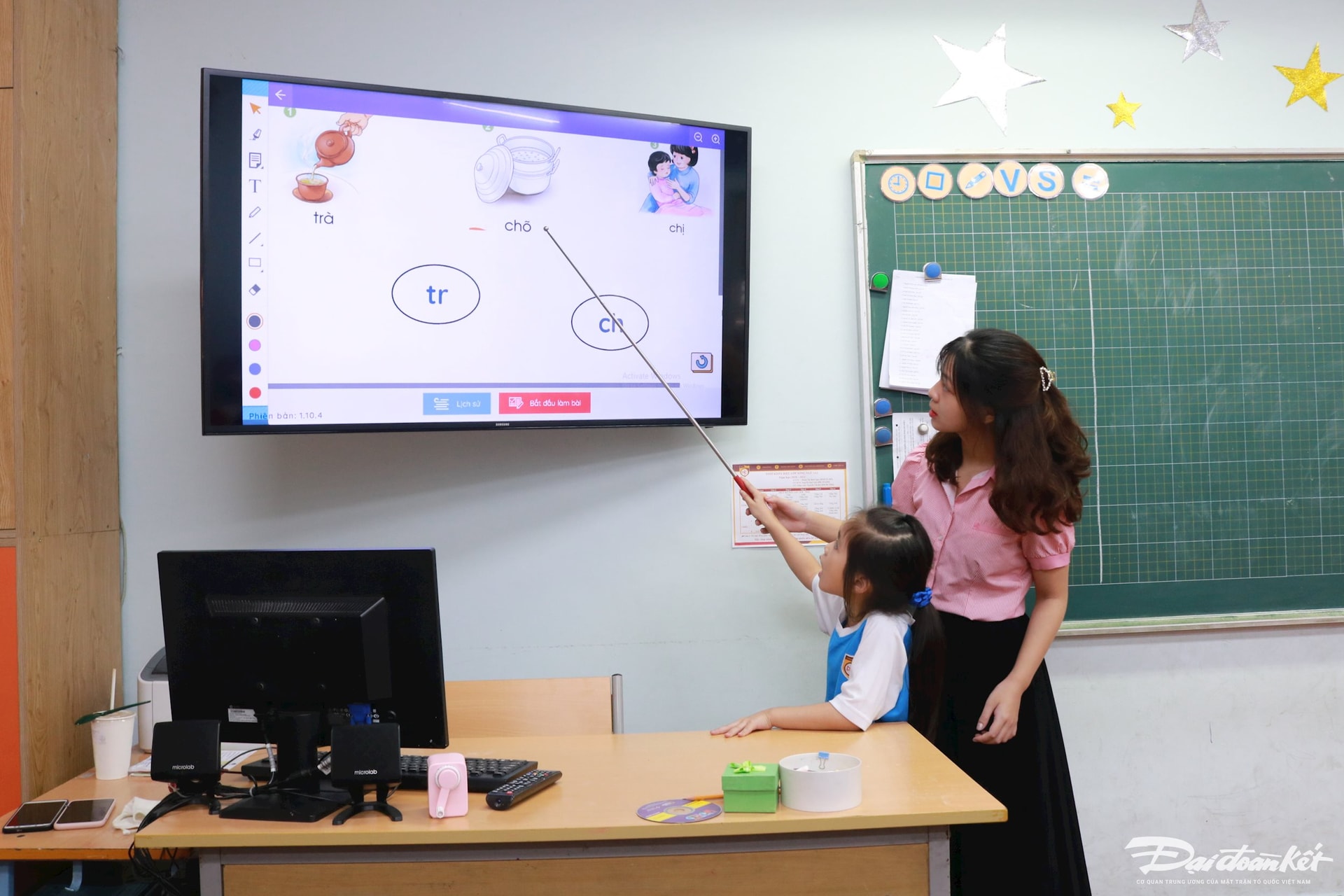
According to statistics, the current teaching staff comprises six groups: civil servants, public employees, workers, military officers, police officers, and those engaged in teaching and education in schools within the system of Party, Front, and mass organization agencies.
The aforementioned groups are linked to specific educational levels and training qualifications, leading to some regulations regarding teachers not being implemented in a synchronized and unified manner. The Law on Teachers standardizes the teaching staff through a system of job titles and professional standards for teachers, with standards closely adhering to professional competency requirements while still ensuring unique elements specific to each educational level and training qualification.
According to the draft Law on Teachers, recruitment and employment policies are regulated in conjunction with the characteristics of the teaching profession. Specifically, the recruitment of teachers must ensure pedagogical practice in order to select individuals with sufficient competence aligned with the professional standards for teachers, meeting the professional requirements of each educational level and training qualification.
Policies regarding the deployment, secondment, transfer, and inter-school/inter-level teaching of teachers in public educational institutions are fully regulated, serving as a basis for assigning teachers appropriately to the characteristics of their professional activities and the requirements of the education sector.
With the draft Law on Teachers, teachers are protected through rights and prohibitions, with the aim of increasing their autonomy, creativity, and protection in their professional activities.
Teachers' salaries are ranked highest in the administrative and public service salary scale; they receive preferential treatment in terms of salary and allowances compared to other teachers, especially preschool teachers; those working in particularly difficult areas inhabited by ethnic minorities, mountainous regions, coastal areas, and islands; special schools and other specialized schools; those implementing inclusive education; ethnic minorities; and teachers in certain specialized professions.
Teachers who are recruited and assigned a salary for the first time will be promoted one salary level in the administrative and public service salary scale system.
The retirement age for teachers is regulated separately to suit the characteristics of their profession. Specifically, teachers in preschools, if they so wish, may retire at a younger age, but not more than 5 years younger than the prescribed age, and their pension will not be reduced due to early retirement.
Over the past period, the Drafting Committee for the Law on Teachers has organized hundreds of workshops, conferences, and discussions to gather opinions…
The Ministry of Education and Training stated that the overarching principle in enacting the Law on Teachers is to promote the development of the teaching staff, attract qualified and dedicated individuals to the profession, and retain the teaching staff, rather than to create a law that establishes institutions for state management.
Source: https://daidoanket.vn/lan-dau-tien-vi-tri-phap-ly-cua-nha-giao-ngoai-cong-lap-duoc-xac-lap-10294068.html
![[Image] Leaked images ahead of the 2025 Community Action Awards gala.](/_next/image?url=https%3A%2F%2Fvphoto.vietnam.vn%2Fthumb%2F1200x675%2Fvietnam%2Fresource%2FIMAGE%2F2025%2F12%2F16%2F1765882828720_ndo_br_thiet-ke-chua-co-ten-45-png.webp&w=3840&q=75)

![[Photo] Prime Minister Pham Minh Chinh receives Lao Minister of Education and Sports Thongsalith Mangnormek](/_next/image?url=https%3A%2F%2Fvphoto.vietnam.vn%2Fthumb%2F1200x675%2Fvietnam%2Fresource%2FIMAGE%2F2025%2F12%2F16%2F1765876834721_dsc-7519-jpg.webp&w=3840&q=75)
![[Photo] Prime Minister Pham Minh Chinh receives the Governor of Tochigi Province (Japan)](/_next/image?url=https%3A%2F%2Fvphoto.vietnam.vn%2Fthumb%2F1200x675%2Fvietnam%2Fresource%2FIMAGE%2F2025%2F12%2F16%2F1765892133176_dsc-8082-6425-jpg.webp&w=3840&q=75)
![[Live] 2025 Community Action Awards Gala](/_next/image?url=https%3A%2F%2Fvphoto.vietnam.vn%2Fthumb%2F1200x675%2Fvietnam%2Fresource%2FIMAGE%2F2025%2F12%2F16%2F1765899631650_ndo_tr_z7334013144784-9f9fe10a6d63584c85aff40f2957c250-jpg.webp&w=3840&q=75)






































![[Photo] Prime Minister Pham Minh Chinh attends the Vietnam Economic Forum 2025](https://vphoto.vietnam.vn/thumb/402x226/vietnam/resource/IMAGE/2025/12/16/1765893035503_ndo_br_dsc-8043-jpg.webp)

























Comment (0)