

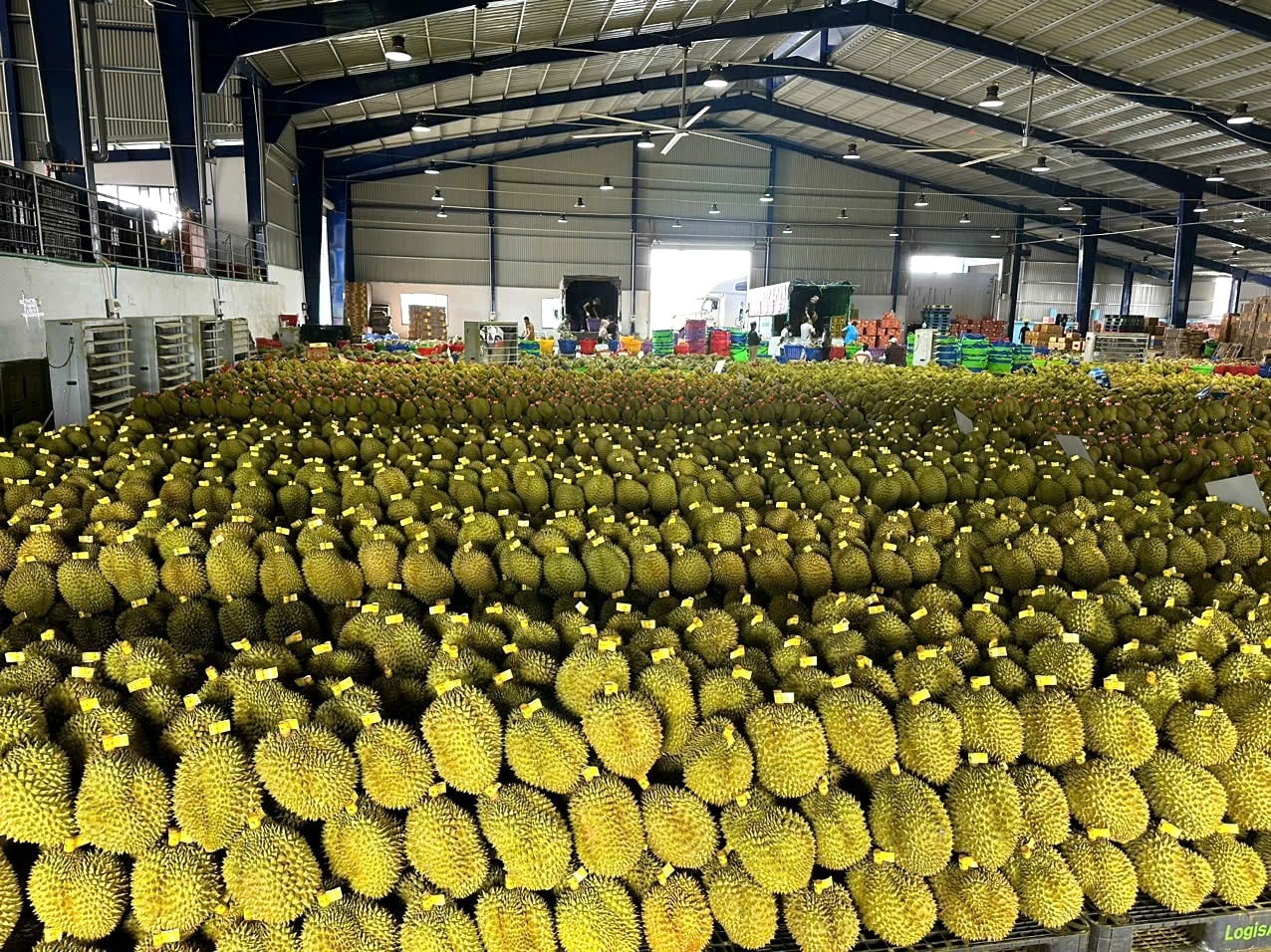
Comply with the regulations of the importing country.
To date, the total durian cultivation area in Lam Dong province is 43,960 hectares, of which 50.2% (22,058 hectares) is under cultivation. The total production for the 2025 crop year is estimated at approximately 266,700 tons. The largest durian cultivation area is in the Lam Dong Thousand Flowers region (26,100 hectares), followed by the Lam Dong Great Forest region (12,217.2 hectares) and the Lam Dong Blue Sea region (4,380 hectares). Specifically, Da Huoai 2 commune in Lam Dong Thousand Flowers has a 300-hectare durian cultivation area recognized for its high-tech application. In addition, over 7,200 hectares of durian cultivation in the province utilize water-saving irrigation systems, and 1,015 hectares are certified safe according to VietGAP standards.
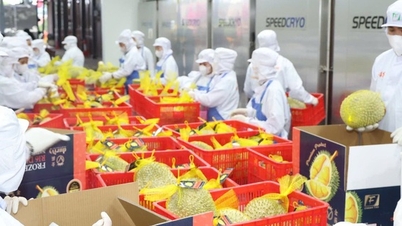
Specifically, the area for planting, preliminary processing, and processing durian for export in the province has been approved by the General Administration of Customs of China (GACC), granting 337 planting area codes (MSVT) covering over 13,127.8 hectares (accounting for 59.5% of the total business area) and 53 packaging facility codes (CSĐG) with 134,971 m2 of factory space.
Specifically, the Lam Dong "thousand flowers" area has 197 durian orchards (8,009.5 ha) and 37 durian processing plants (61,845 m2). The Lam Dong "great forest" area has 113 durian orchards (nearly 3,428.5 ha) and 3 durian processing plants (5,650 m2). The Lam Dong "blue sea" area has 26 durian orchards (over 1,394.7 ha) and 12 durian processing plants (67,476 m2). In the distribution and circulation stage, 133 enterprises and cooperatives purchase 85% of the fresh durian production; 15% of the durian products are processed, peeled, and frozen. Overall, Lam Dong province has 47 linked chains with 1,678 households producing and consuming durian on a total area of 4,504.5 ha.
Over the first nine months of 2025, the Lam Dong Department of Crop Production and Plant Protection collected 234 durian samples for analysis of pesticide residues, heavy metals, lead, and pest identification. The results showed no samples exceeding the lead limit; one sample exceeded the limit for heavy metals (0.074/0.05 mg/kg); and six samples were contaminated with pests that are subject to quarantine regulations in China. “Immediately after receiving the analysis results, the Lam Dong Department of Crop Production and Plant Protection requested the owners of the durian growing areas affected by heavy metal and pest contamination to investigate the causes, implement corrective measures, and ensure compliance with the quality standards of both the importing country and Vietnam.”
"At the same time, we will strengthen strict control over fertilizers and pesticides in the growing areas, ensuring they are on the list of those permitted for use in Vietnam; use pesticides according to the 'four correct' principles (correct pesticide, correct time, correct dosage, correct method) and ensure the quarantine period before harvesting the product...", the Lam Dong Provincial Department of Crop Production and Plant Protection stated.
Regular and unscheduled inspections and monitoring.
During the same period, the Lam Dong Provincial Department of Crop Production and Plant Protection monitored 134 product codes and 12 durian quality control centers exporting to the Chinese market. Simultaneously, together with a Chinese expert team and an inspection team from the Department of Crop Production and Plant Protection, they inspected 12 other durian growing areas and 4 durian quality control centers. In addition, they authorized nearly 40 businesses to monitor 90 product codes and quality control center codes for durian exported throughout the province.
However, businesses authorized to monitor the MSVT (Measurement, Verification, and Quality Control) code for exported durian still face many difficulties, especially those authorized to export outside the province. Some cooperatives and farmers do not keep complete records and updates of durian cultivation logs, leading to difficulties in determining the origin if there are chemical residues on the harvested product. Meanwhile, there is no unit in the province designated by GACC to build and operate a laboratory for analyzing and testing durian quality standards before exporting to the Chinese market.
Therefore, the Plant Protection and Crop Production Sub-Department and the Processing Quality and Market Development Sub-Department under the Lam Dong Department of Agriculture and Environment will further strengthen regular or unscheduled inspections and supervision to ensure that establishments and units granted MSVT and CSĐG comply with Vietnamese law and meet the requirements of the import market.
For durian export shipments that receive food safety warnings, the cause must be assessed and the relevant parties instructed to take timely corrective measures. For growing areas and processing facilities using chemicals not on the list of permitted or prohibited chemicals, strict legal action must be taken…
Source: https://baolamdong.vn/ma-so-vung-trong-sau-rieng-can-tang-cuong-giam-sat-394447.html







































![[Video] Sunset at Lap An Lagoon – Where the sun sets over the fishing nets](https://vphoto.vietnam.vn/thumb/1200x675/vietnam/resource/IMAGE/2026/05/31/1780192137701_beach-landscape-sea-water-nature-grass-745871-pxhere-com.jpeg)
























Comment (0)