

1. The cooperative's nursery was half-submerged, half-above ground, a so-called underground house. It dated back to the "war of destruction" in North Vietnam and hadn't been rebuilt yet. The lower half was dug down and left as is, while the upper half was plastered with earthen walls (filled with straw and mud stretched across square bamboo bars). The childcare workers were selected from among the farmers, sometimes old, sometimes young, depending on the time. The nursery had children of all ages, some still lying on their backs, others already babbling.
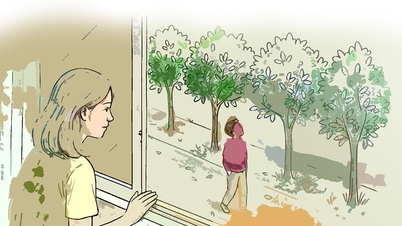
When Ms. Thuan became our teacher, she widened the hole in the mud wall to the size of a window. Initially, Ms. Tam (the previous teacher) had been removing the mud wall to… eat it. She was pregnant, and for some reason, she had a strong craving for… earth, so she removed and ate it, creating a hole about the size of two hands. To block the wind, Ms. Thuan cut dried banana leaves and clamped them together to make a makeshift door; it would collapse when it was windy and be propped open when the weather was nice. Ms. Thuan was a true farmer, having only completed the 6th grade (on a 10-point scale). For some reason, every time she propped open the door, she would say, "Open the door so the fragrance can fly in." That seemingly "inconsistent" phrase stuck with us, to the point that we would repeat it in class, even though the fragrance back then was the scent of the fields, earth, and straw.
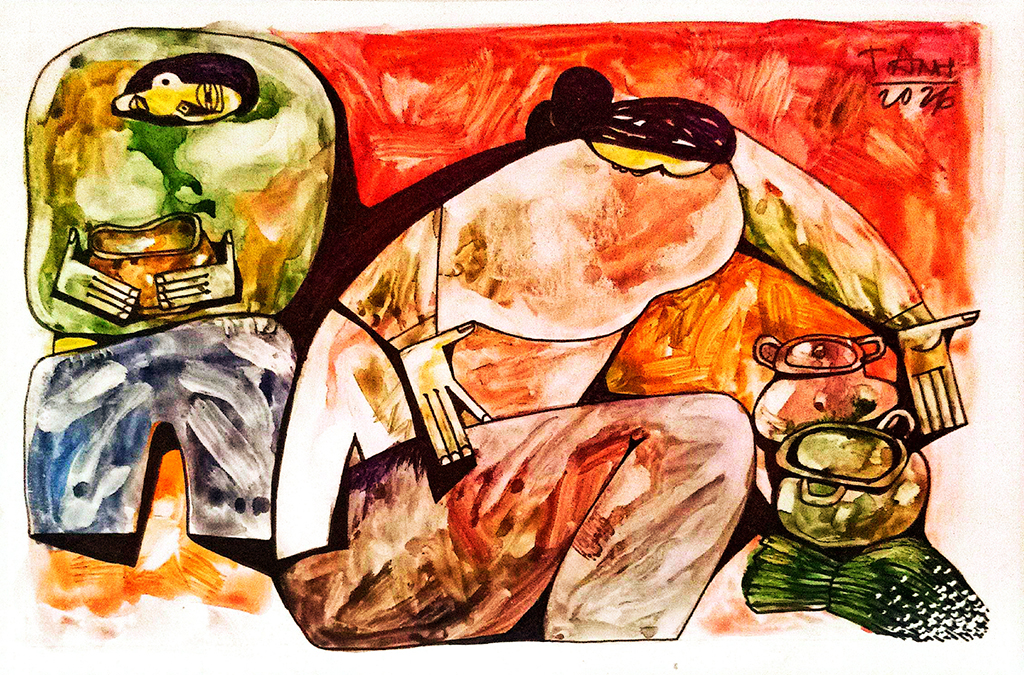
Illustration: Tuan Anh
Occasionally, Ms. Thuan would go around the neighborhood calling out to the elementary school children, "Come here, let me ask you for a favor." The favors she'd ask were things like making windmills and boats from coconut leaves, tying grasshopper shapes, and pretending to make sticky rice cakes... picking wildflowers, tying them together, and hanging them on top of the four-sided cradle for the children to look at while lying on their backs. She'd also take empty milk cans (or butter cans), put pebbles in them, and shake them to make a rattling sound... We saved any leftover colored paper for crafts to make flowers and string them together to hang around the house near Tet (Vietnamese New Year). The children watched with fascination and loved it!
The older I get, the more I think about it, and the more I like the line "Open the door to let the fragrance in," she says it like a poet. More than poetry, it's a philosophy, a philosophy of life.
2. My village used to be very poor. The fields were vast, and during harvest season, the cooperative's yards were full of rice, with boats carrying it to the district's granary. They were graded by points, 10 points per hectare. In good years, each hectare yielded about 3.5 kg of rice, but in bad years, sometimes it was less than a kilogram. We ate cassava mixed with rice.
My hometown, Le Thuy, is a flood-prone area. As the old ladies used to say, "even a toad's urine would cause a flood." During the rainy season, banana tree stumps became the main food source; every house had many plantain trees in its garden. Back then, plantain trees were very large (unlike now, which seem to have degenerated). During the flood season, we would cut down the trees to make rafts – some for pigs and chickens, some for cooking, and some for pushing around the neighborhood when needed. We always dug up the stumps to save. When we ate them, we'd peel them, slice them, soak them in salt water, then boil them, discarding the water to remove the bitterness before cooking. We'd add a little pork fat or MSG if we had some.
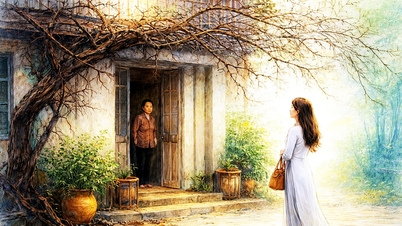
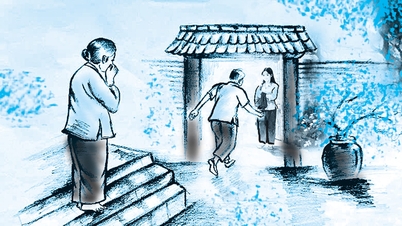
During the off-season, my mother would do some small-scale trading, buying goods wholesale and then reselling them retail. With a little profit, she would buy seafood for us children. Occasionally, after cooking the fish, she would take one, add some of the sauce, and tell my siblings and me to give it to other families. Our aunt's family nearby, who had many children and were even poorer than ours, was the first one my mother thought of.
One day, my mother said, "Go to your aunt's house and ask her for a piece of banana root for me; I saw she just dug it up." I objected because we still had a few roots at home, but my mother insisted I go.
Much later, my mother said, "Our family often gives Auntie's family this or that, even though it's not much, but she feels embarrassed. Occasionally, if you see any garlic or chili peppers in her garden, come and ask for some, so she'll know she has something to give us."
I was momentarily stunned. My mother had also "opened the door to let the incense in."
3. During Tet, no matter what, every family in the countryside makes two dishes: mango cake (also known as "banh thuan" in some places) and ginger jam.
My village is often flooded, so we can't grow ginger; we have to buy it. Even then, we can't buy much because it needs sugar. And sugar is very scarce. We only get to drink sugar water when we're sick.
After buying the mangoes, my siblings and I would peel, slice, and soak them; some would crack eggs and mix them with flour, then use chopsticks to beat them (there were no machines like now), taking turns beating until our palms were red. The final step of making the jam and pouring the mango cakes had to be done by my mother. Therefore, even now, I am still haunted by the image of my mother's back during the days leading up to Tet (Lunar New Year). My mother did one thing after another, turning her back to the kitchen to make jam and cakes, and all my siblings and I could see was... her back.
From then until adulthood, for me, the most beautiful thing about women has always been… their backs. A back that is patient and resilient; a back that exudes the pure scent of worry and hardship. A back we only see when they turn away. Perhaps not at that moment, but sometimes, we only see it much later.
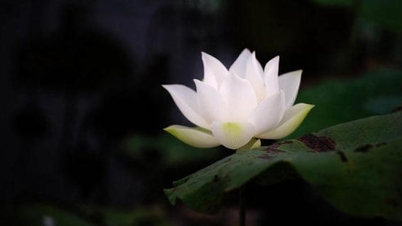
The back is the gateway through which the fragrance emanates.
Source: https://thanhnien.vn/mo-cua-de-huong-bay-185260211175605509.htm

![[Photo] National Assembly Chairman Tran Thanh Man working with the Standing Committee of the Law and Justice Committee](https://vphoto.vietnam.vn/thumb/1200x675/vietnam/resource/IMAGE/2026/05/21/1779378929214_ndo_br_1-4610-jpg.webp)
![[Photo] General Secretary and President To Lam presides over a working session with the Central Policy and Strategy Committee on the development of the materials industry.](https://vphoto.vietnam.vn/thumb/1200x675/vietnam/resource/IMAGE/2026/05/21/1779359935432_a3-bnd-3129-1412-jpg.webp)








![[Infographic] What procedures can citizens perform using VNeID?](https://vphoto.vietnam.vn/thumb/402x226/vietnam/resource/IMAGE/2026/05/22/1779406743893_ang-ky-bien-ong-quyen-su-dung-at-cap-oi-cap-lai-gplx-64102334643904941287555-19074442750124617066629.webp)












































Comment (0)