

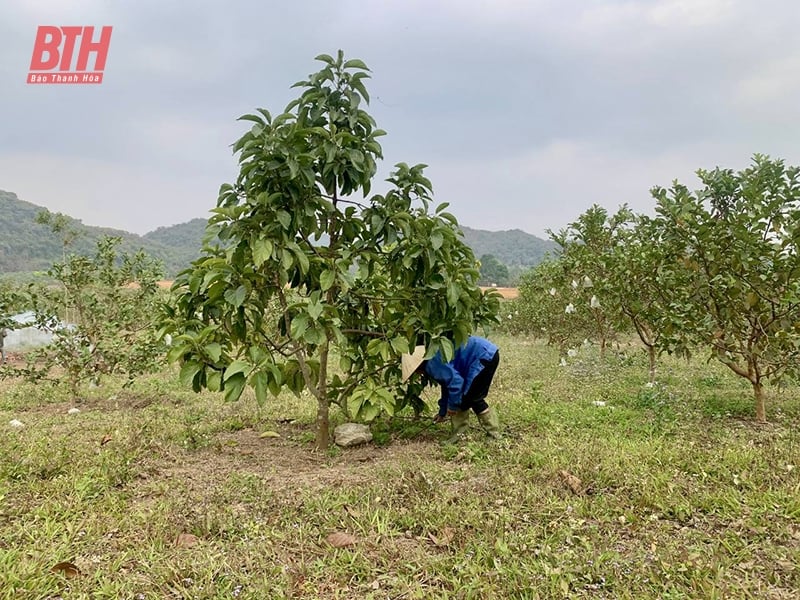
Booth 7 and 034 avocado varieties are grown in Van Du town (Thach Thanh district).
Sowing the seeds of "green gold"
In the 300m2 greenhouse of the Thanh Hoa Agricultural Institute, 210 avocado mother trees of two varieties, Booth 7 and 034, have developed steadily after 3 years of care, growing uniformly, lush green, and with minimal pests and diseases. Currently, the trees are entering their second harvest season, a crucial stage for evaluating fruit quality and yield potential before selecting the mother trees for large-scale seed production.
According to assessments, the quality of the avocados is considered excellent. The flesh is thick and firm; the flavor is fragrant, creamy, and smooth, true to the characteristics of a premium avocado variety. In particular, the fruits are large, uniform in size, and have a low seed ratio – important criteria for serving the consumer and processing markets. Besides the 210 mother trees, the Thanh Hoa Agricultural Institute has implemented a seedling production model with a scale of 1,500 trees/variety/year. The application of technology in greenhouses helps control pests and diseases effectively, improving the grafting success rate and ensuring uniform seedling quality. In 2022 and 2024, the institute produced 9,067 grafted trees, of which 7,283 met the standards for planting (exceeding the target by 121%). These trees have been distributed to many models in Thuong Xuan, Nhu Xuan, Thach Thanh, Ha Trung, and Thanh Hoa City.
Furthermore, maintaining the care of the mother trees for three years demonstrates the determination of the Thanh Hoa Agricultural Institute in building a systematic and scientifically- based plant breeding system. They not only focus on growth indicators such as height, trunk diameter, and canopy, but also carefully monitor and analyze fruit quality, a factor determining commercial value.
However, one of the major obstacles currently is that the mother trees have not yet been recognized as "elite nurseries." This is a necessary legal condition for allowing the harvesting of grafting material for large-scale seed production. Meanwhile, the seed market still depends on imports from southern provinces, posing many risks regarding quality. Therefore, early recognition of elite nurseries will pave the way for a standardized avocado seed production ecosystem right in the area, which is a prerequisite for the sustainable development of specialized avocado cultivation.
Expectations from practice
With a well-established technological foundation, commercial avocado farming models for Booth 7 and 034 varieties quickly came into practice and yielded noticeable results.
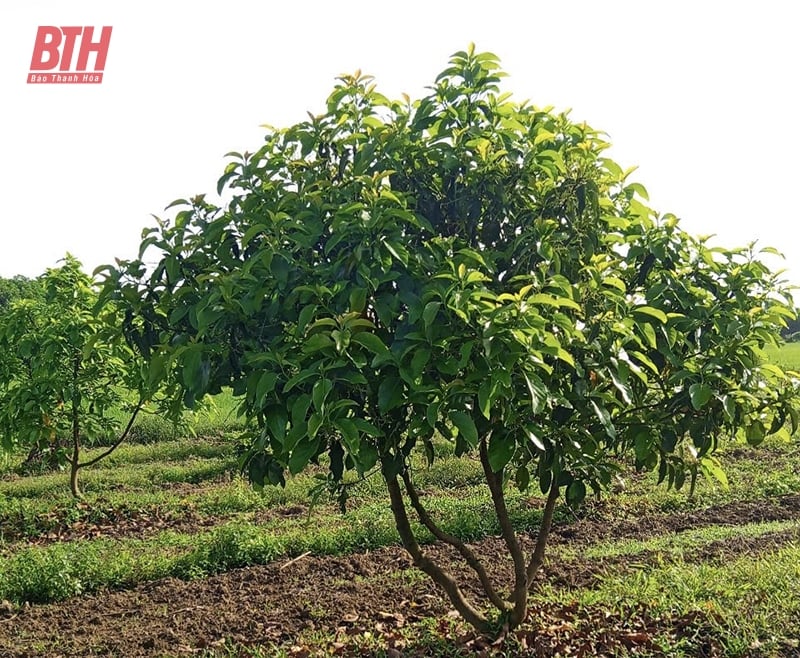
210 mother avocado trees of the Booth 7 and 034 varieties are still being maintained, cared for, evaluated, and monitored at the Thanh Hoa Agricultural Institute.
In Tan Binh commune, Nhu Xuan district, an area with typical hilly terrain and limited arable land, the Booth 7 and 034 avocado cultivation model has been implemented on a total area of 4 hectares. Through field surveys, the project management board selected two exemplary households to implement the model: Mr. Do Trung Ha (Tan Thang village) and Mr. Vi Van Thuong (Tan Lap village). Both households belong to the group of ethnic minority farmers who have shown a proactive and positive spirit in participating in crop conversion.
On this plot of land, two avocado varieties were planted at a ratio of 1:1 (2 hectares of each variety). A total of 2,020 seedlings were provided, of which 1,600 were planted directly and 420 were used for replanting. The planting process was carefully monitored from soil preparation and hole digging to post-planting care and pest control. Currently, after more than 3 years, the trees are developing steadily, are healthy and green, and some trees are showing signs of flowering, promising a first harvest of the expected quality.
Mr. Ha shared: “I used to grow cassava and acacia, but the results weren't very good. When I learned about the avocado cultivation model, and received seedlings and technical training, I was very excited. If the trees develop as instructed, I believe this is a crop that can help the people here change their lives.” Preliminary assessments show that the trees are less susceptible to pests and diseases, quite drought-tolerant, and particularly suitable for sloping land with a thin topsoil layer.
Besides offering hope for income, the model also helps to green barren land, contributing to the protection of the ecosystem in the area bordering the Xuan Lien Nature Reserve, where the project has agreed to expand by an additional 1 hectare to continue monitoring the adaptability of the trees in semi-wild natural forest conditions.
In Thuong Xuan district, the commercial avocado cultivation model is being implemented by Thanh Xuan General Agricultural Service Cooperative (Thanh Xuan commune) on 3 hectares of hilly land. The cooperative received 1,680 seedlings from the project, including 1,200 for official planting and 480 for replanting. The avocado trees are evenly distributed between two varieties: 1.5 hectares of Booth 7 avocado and 1.5 hectares of 034 avocado. Currently, the avocado trees are growing well, branching evenly, with few pests and diseases, and a high survival rate after planting. Some trees have already yielded their first harvest and show clear commercial potential.
Sharing the initial results after more than 3 years of implementing the project, Ms. Pham Thi Ly, the project leader, stated: “We are satisfied with the scientific and practical effectiveness of the project. In the climate and soil conditions of Thanh Hoa's mountainous region, the two avocado varieties, Booth 7 and 034, have adapted well, grown vigorously, produced stable yields, and yielded high-quality fruit. These are very important factors if we want to develop this into a long-term commercial production area.”
According to Ms. Ly, one of the noteworthy points after the project's completion was the sense of responsibility and dedication of the staff at the Thanh Hoa Agricultural Institute. Even though the project has ended and no longer receives state budget funding, the institute continues to maintain, monitor, and comprehensively evaluate the mother tree garden with 210 original seedlings.
"We clearly understand that this is not just a short-term task within the framework of a project, but a foundation for a long-term avocado breeding strategy. Therefore, continued observation of growth, monitoring fruit quality, yield, and adaptability of each variety will be carried out seriously for at least the next three years," Ms. Ly emphasized.
She also added that the data collected during the post-acceptance phase will serve as a scientific basis for selecting superior trees, gradually completing the dossier for recognizing the superior orchard – an important condition for proactively producing high-quality seedlings locally, serving the needs of sustainable development of the avocado growing region of Thanh Hoa.
Although still in its initial stages, the early results of the Booth 7 and 034 avocado projects in Thanh Hoa have laid a solid foundation for a new direction in the development of mountainous agriculture. From well-invested mother trees to dedicated households caring for the trees, confidence in this "green gold" crop is gradually taking shape. With the support of appropriate policies and a long-term development strategy, avocado cultivation will contribute to increasing income, improving livelihoods for the people, and creating sustainable wealth for areas with untapped potential.
Text and photos: Tran Hang
Source: https://baothanhhoa.vn/mo-duong-dua-cay-vang-xanh-ve-dong-dat-xu-thanh-251396.htm


![[Image] Central Party Office summarizes work in 2025](/_next/image?url=https%3A%2F%2Fvphoto.vietnam.vn%2Fthumb%2F1200x675%2Fvietnam%2Fresource%2FIMAGE%2F2025%2F12%2F18%2F1766065572073_vptw-hoi-nghi-tong-ket-89-1204-jpg.webp&w=3840&q=75)

































































Comment (0)