

 |
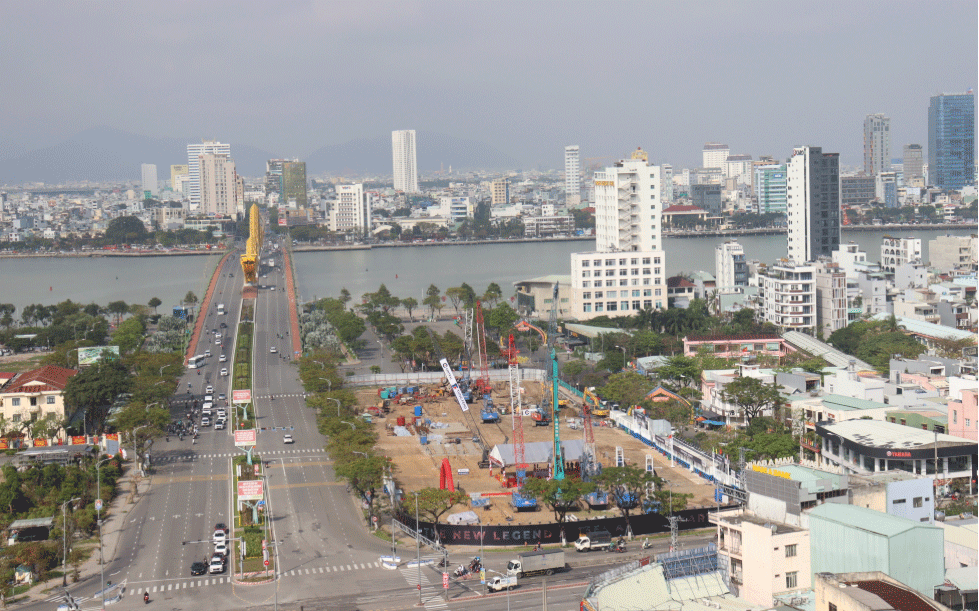
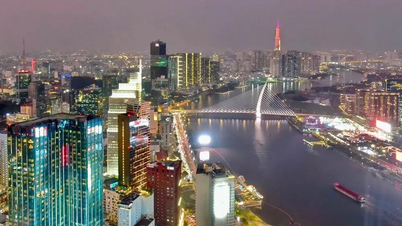
| The urban space of Da Nang city has expanded many times over after 50 years of national reunification. IN THE PHOTO: An urban view of Son Tra and Hai Chau districts. Photo: HOANG HIEP |
Urban area has tripled.
In late 1993, the Prime Minister approved the first master plan, which served as the basis for Da Nang becoming a centrally-governed city on January 1, 1997, with an urban area of approximately 5,600 hectares at that time. This also formed the basis for investment in many urban renovation projects and upgrades to major transportation routes, which were actively implemented in the early 2000s.
In June 2002, the Prime Minister approved the adjustment of the Da Nang City Master Plan until 2020, with a vision to 2030. Subsequently, the Politburo issued Resolution No. 33-NQ/TW on October 16, 2003, on the construction and development of Da Nang City during the period of industrialization and modernization of the country.
These are crucial, strategic foundations for the city to implement a series of projects, transforming Da Nang into a construction site where nearly one-third of the total number of households have given up land to build roads, resettlement areas, residential areas, urban areas, industrial zones, and socio-economic development projects. The entire city, from east to north, along the coast from Nam O to Hoa Hai, is covered with new projects, forming riverside and coastal roads along with new urban areas. Numerous suburban rural areas, national defense land, cemeteries, gardens, fields, white sand dunes, etc., have been leveled and reclaimed, contributing to remarkable urban development in both form and space.
During this period of rapid development, in December 2013, the Prime Minister approved the adjustment of the Da Nang City Master Plan until 2030, with a vision to 2050, continuing the ongoing development trends and helping Da Nang complete the urban landscape that is gradually taking shape in the reconstruction process.
By 2019, the urban area reached over 18,300 hectares, more than three times the city's area in 1997, with rapidly changing and relatively modern socio-economic infrastructure and urban landscape. Da Nang is gradually asserting its role as a major city, a leading engine of development, and a socio-economic center of the Central and Central Highlands regions and the whole country.
Towards becoming a major city.
Based on a review of 15 years of implementing Resolution No. 33-NQ/TW, the Politburo issued Resolution No. 43-NQ/TW on January 24, 2019, on building and developing Da Nang city until 2030, with a vision to 2045, which includes the goal of making Da Nang city one of the major socio-economic centers of the country and the Southeast Asian region by 2030.
The vision for 2045 is for Da Nang to become a large, ecological, and smart city; a livable coastal city of regional Asian standards. These new orientations from the Politburo, along with emerging issues and existing problems in the development process, have been adjusted and concretized in the revised master plan for Da Nang city until 2030, with a vision to 2045, approved by the Prime Minister in Decision No. 359/QD-TTg on March 15, 2021.
After more than four years of implementing this master plan, a prominent highlight is that many large-scale urban development projects, tourism complexes, hotels, luxury apartments, and real estate projects have been launched and are being constructed vigorously in the city. These projects not only continue to transform the urban landscape but also contribute to double-digit economic growth in the third quarter of 2024 and the first quarter of 2025.
Many key projects and infrastructure works have been completed or are under construction, such as: the western ring road, western ring road 2, DH2, DT601, Quang Da bridge and approach roads at both ends, National Highway 14B, Lien Chieu port (shared infrastructure), Hoa Nhon logistics service center, Tho Quang fishing port..., which are contributing and will contribute to completing the socio-economic infrastructure of the city as well as the regional transportation system of Da Nang. In particular, this helps optimize development opportunities for the new Da Nang city after the merger with Quang Nam province, from connecting industrial zones and urban areas to developing tourism and trade.
Currently, along with the implementation of the Central Government's policy on merging Da Nang city and Quang Nam province, the new specific policies, orientations, mechanisms, and policies of the Central Government for the city, especially Conclusion No. 79-KL/TW of the Politburo on continuing to implement Resolution No. 43-NQ/TW and Resolution No. 136/2024/QH15 of the National Assembly on the organization of urban government and piloting some specific mechanisms and policies for the development of Da Nang city, necessitates an urgent comprehensive adjustment of the Da Nang City Master Plan to 2030, with a vision to 2045, to ensure the synchronized and appropriate implementation of the plan and projects, especially the functional areas of the Da Nang Free Trade Zone.
Following the direction of the Da Nang City People's Committee, from mid-April 2025 to the present, the Da Nang Investment and Construction Project Management Board for Civil, Industrial and Technical Infrastructure Projects has been collecting feedback from agencies, organizations, individuals, and the community on the overall adjustment plan for the Da Nang city master plan. This includes a proposal to select a population and labor growth scenario that merges Da Nang city and Quang Nam province, making it a centrally-governed city.
This is expected to create new development opportunities, strong regional linkages combined with the inherent development drivers of both localities, contributing to affirming Da Nang as the leading economic hub of the Central region in the future. The newly merged Da Nang city will have expanded development space and planning with a long-term vision and a strong aspiration to become a growth pole of Vietnam, one of the major socio-economic centers of the country and the Southeast Asian region, and a large, ecological city... as directed by the Politburo.
HOANG HIEP
Source: https://baodanang.vn/kinhte/202505/mo-rong-khong-gian-do-thi-4006090/

![[Image] Close-up view of the interchange connecting the two expressways and Long Thanh Airport.](https://vphoto.vietnam.vn/thumb/1200x675/vietnam/resource/IMAGE/2026/05/25/1779703378210_ndo_br_z7863716673926-224453a31600126cce10622af6290afd-4549-jpg.webp)
![[Image] Hanoi's urban life under the challenge of a "scorching hot" environment](https://vphoto.vietnam.vn/thumb/1200x675/vietnam/resource/IMAGE/2026/05/25/1779706979265_nang-nong-t5-2026-minh-duy-7-4636-jpg.webp)








































































Comment (0)