

(NLĐO) - NASA's observatory has captured the moment a terrifying stream of jets from a monstrous black hole was blocked by an object lurking in the shadows.
Using NASA's Chandra X-ray Observatory, astronomers have found an anomaly where a super-powerful stream of radiation ejected by a monstrous black hole collided with an unidentified object in its path.
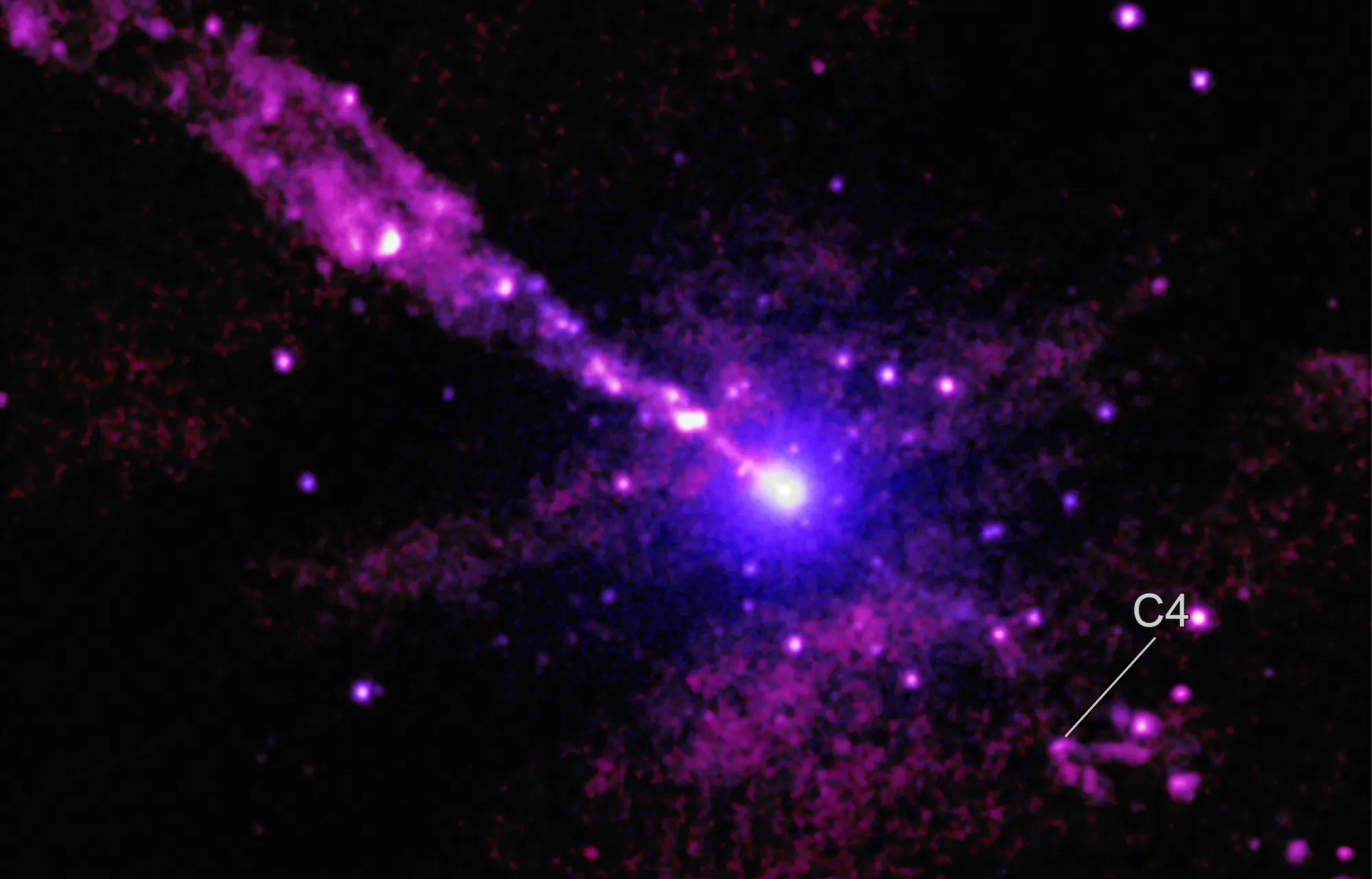
An intriguing image of a strange object blocking a beam of radiation from a monstrous black hole - Photo: NASA
According to NASA, this discovery was made in a galaxy called Centaurus A, located approximately 12 million light-years from Earth.
Centaurus A has long been of particular interest to scientists because it contains a monstrous, supermassive black hole at the center of the galaxy.
This monster continuously emits spectacular beams of light, shooting them across the universe like giant cannonballs.
The black hole ejects this stream of high-energy particles not from within itself, but from the strong gravitational and magnetic fields surrounding it.
But other anomalies were discovered by a research team from the University of Michigan, the University of Maryland, Pennsylvania State University (USA), the University of Toulouse (France), and the Israel Institute of Technology.
Writing in the scientific journal The Astrophysical Journal, the authors stated that they determined the jet stream from this black hole is traveling at nearly the speed of light.
Analyzing the deepest X-ray images ever taken of Centaurus A, they also found a V-shaped emission array connected to a bright X-ray source, something that had never been identified before.
Known as C4, this source is located inside the galaxy, blocking one of the terrifying jets of energy emanating from the black hole.
The identity of this mysterious object, as well as the forces behind its V-shaped form, remains a mystery because even the most powerful telescopes currently in existence cannot clearly see it.
However, scientists believe that this object could be a large star, possibly with a companion.
The brilliant X-rays produced by C4 may be generated by collisions between particles in the stellar wind and the stream of radiation it receives from the black hole.
Source: https://nld.com.vn/nasa-phat-hien-vat-the-ma-quai-can-duoc-ca-dai-bac-lo-den-196241227081519885.htm
![[Image] Nearly 125,000 Hanoi students completed the Literature exam for the 10th grade entrance exam.](https://vphoto.vietnam.vn/thumb/1200x675/vietnam/resource/IMAGE/2026/05/30/1780117233041_ndo_br_thiet-ke-chua-co-ten-2-png.webp)









































































































Comment (0)