

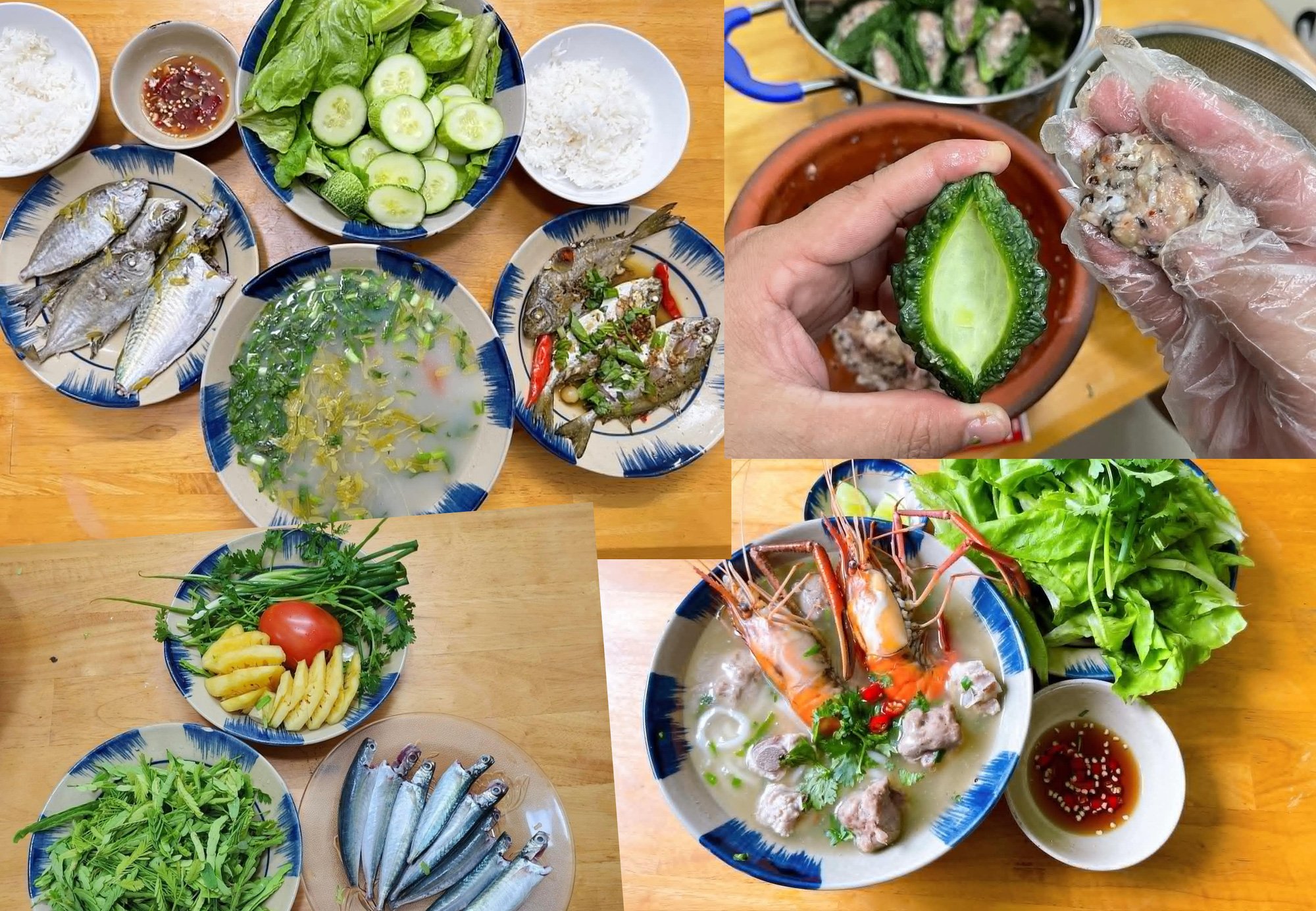
Home-cooked meal, homemade noodle soup, cooked by my husband - Photo: NHÃ XUÂN
My husband has maintained that cooking habit since we first started dating, even though I've often grumbled about why we don't just eat out instead of going to the trouble of cooking and cleaning up. Whenever that happened, he would just laugh and say, "Going to the market and cooking helps my mind relax; then I can focus solely on the food and not worry about anything else."
I admire my husband's cooking skills.
For 10 years together, our daily routine has remained the same. On weekends when we're free and not busy with work, he takes me to the market, where he personally selects each fresh fish brought in from Vung Tau, Phu Quoc, and other places. Then we stop by the vegetable stall to buy some fresh herbs, a few tomatoes, a quarter of a pineapple, and, of course, some basil leaves – and we have a delicious sour fish soup.
My husband and I, without a doubt, love sour fish soup. Sometimes it's mackerel soup, other times it's kingfish soup, scad soup with bamboo shoots, or young scad soup with tamarind leaves… whatever's in season. On days when we're too lazy to prepare a lot of dishes, a bowl of sour soup, a plate of fresh vegetables, and a small bowl of spicy chili garlic fish sauce are enough for a meal where both husband and wife nod in approval.
Because of the nature of his job, which involves traveling to many places, my husband has also learned how to cook many delicious and unusual dishes.
My husband's everyday meals sometimes open my eyes to dishes I've never even heard of, let alone eaten before, from kingfish stew with sour fruits, mackerel stew with pickled vegetables, frog soup with unripe bananas, fish noodle soup, stir-fried Tram mushrooms with eggs, anchovies braised in tamarind...
Besides his love for learning new recipes, I also admire the effort he puts into his dishes, even though he considers it "nothing special." One day, I casually mentioned I was craving stir-fried river shrimp with starfruit. The next morning, I saw him off at the market on his motorbike, and a little while later he came back with a bag of river shrimp, saying, "You have to go to the market early to get these."
Another soup that I never get tired of eating is bitter melon soup stuffed with meat. It sounds simple, but in my husband's hands, it's incredibly delicious. The bitter melon has to be wild bitter melon, small enough to be bitten twice for the best taste. The filling is minced meat mixed with a little fat for a smooth texture, sometimes with added shrimp, seasoned to taste, then pounded in a mortar with finely chopped wood ear mushrooms until it's chewy. My husband insists it has to be pounded by hand for the best flavor.
Working together, loving each other for a lifetime.
Every time I "show off" a meal my husband cooks, my friends exclaim how lucky I am to have such a skilled homemaker, while others beautifully call them "loving meals." Once, a friend commented, "You're such a great husband," to which I immediately corrected them, "I'm a successful wife."
It's true that I'm lucky, but it's more about finding a life partner who knows how to take care of the family than about not having to cook because I'm a woman. Besides, I've probably seen this kind of luck many times before.
From a young age, the family kitchen was always my father's "territory," where he cooked dishes that my siblings and I loved, such as braised pork, sour soup, taro soup, and more.
My childhood was a process of observing the division of labor within my parents' family. My mother ran a business, my father worked for the government, and whoever had free time took care of the family; if one worked, the other would do the housework. As for cooking, my mother would buy and prepare the ingredients, and the cooking itself would be my father's responsibility.
Even now, when parents have reached retirement age, no longer working and not living with their children, their cooking process remains a rhythmic and well-defined "together-based" routine.
Sometimes I find it all so complicated. After Mom prepares the ingredients, she tells Dad to cook. Once Dad finishes cooking, he calls out, "Come sprinkle some pepper and cilantro on top, then we'll serve the meal." "Why make it so difficult? Why can't one person do it all?" I've asked many times.
I only understood later that it was about the division of labor and working together, and taking care of the family together.
In my family, there's also a clear division of labor. Before meals, the wife leisurely waits for the husband to cook, and after meals, the husband relaxes watching TV while the wife cleans up. Everyone does what they're good at.
Today, there are many women who consider career goals just as important as caring for their families, and many men who consider cooking a delicious meal for their wives and children as important as their professional achievements. Scrolling through social media, you'll find countless popular TikTok, YouTube, and Instagram channels showcasing meals cooked for their wives and children.
Perhaps it's time to reconsider the outdated notion that women should be the sole breadwinners for men, or that men should be the sole helpers with household chores? Let's not monopolize the kitchen for one gender; let it be a place where anyone can cook loving meals for their loved ones.
Housework should not be considered the exclusive domain of women.
According to the prevailing mindset from time immemorial, cooking and housework have always been considered the "privilege" of women. A woman who marries a capable husband who knows how to "help" her is considered lucky.
In an article published in the New York Post in March of this year, a study by the American home cleaning service Homeaglow showed that the average American adult (both male and female) spent 34 minutes a day on housework in 2022, which, if converted to an hourly wage, is $19.69 per day. In total, they worked 208 hours, equivalent to $7,188 per year.
However, when analyzed by gender, the results show that women do more housework than men, earning $6,431 more per year in monetary terms. Specifically, men spend an average of 19 minutes per day doing housework, equivalent to $3,909 per year, while women spend an average of 49 minutes per day, equivalent to $10,341 per year.
That's why the saying "housework is women's work" isn't just a mindset in our country, but exists all over the world. Although that imbalance still exists, it's undeniable that many women today no longer consider housework to be their "exclusive" responsibility.
There is a generation of women who were born and raised without being taught by their parents that "you have to be good at housework to get married"; there is a generation of women who are busy enough with their work, their personal careers, and their social activities; there is a generation of women who stand side by side with their husbands to build a home, earning money together to take care of the family.
Of course, there are also husbands who stand shoulder to shoulder with their wives in matters of the house and kitchen.
Source: https://tuoitre.vn/nau-an-cho-nguoi-minh-thuong-20241019104107664.htm





























![[Photo] “Red Journey” 2026: Vietnamese Youth Continue Building the Bridge of Friendship Between Vietnam and China](https://vphoto.vietnam.vn/thumb/1200x675/vietnam/resource/IMAGE/2026/04/20/1776629730866_4055880775670638308-9618-4200-jpg.webp)





































































Comment (0)