

The workshop "Impact of Resolution 71-NQ/TW on Vocational Education ," held at the Ho Chi Minh City International College on the morning of October 23rd, recorded many contributions and new solutions from experts across the country.
Many positive signs
At the seminar, Dr. Khong Huu Luc, Head of the Training Management Department of Hanoi High-Tech College, announced the good news that his school had met its KPI with over 4,000 new students enrolled in 46 training programs.
"This is the first time the school has been successful in student recruitment, especially in the context of the current difficulties in vocational education recruitment," said Dr. Luc.

Dr. Khong Huu Luc, Head of the Training Management Department at Hanoi High-Tech College, announced some good news for the new academic year.
According to Dr. Luc, Resolution 71-NQ/TW of the Politburo is like a breath of fresh air for vocational education and training. Students are able to "study while earning a salary," receive tuition subsidies, and are paid internship allowances. This is not only financial support but also a two-way cooperation model between schools and businesses.
"The school has realized the spirit of 'comprehensive digital transformation in vocational education and training' as clearly stated in Resolution 71. In addition, the school also participated in supporting the '45-day digital transformation' campaign in communes and wards of Hanoi," Dr. Luc added.
Ms. Huynh Thi Thu Tam, Vice Principal of Ho Chi Minh City International College, said that the school's project linking the school, businesses, and associations has yielded many "sweet fruits," demonstrating the effectiveness of the multi-party cooperation model.
According to statistics, the employment rate for graduates is nearly 100%, with 80-92% working in their field. Approximately 67% of students receive paid internships. Fields experiencing shortages of highly skilled workers include semiconductors and automation, electrical and electronics, logistics, healthcare, and tourism.
"The quality of vocational education and training is not measured by the credits earned, but by the ability to perform tasks effectively and create value. The output must be directly linked to specific job positions. Competency standards must adhere to the Vietnamese National Skills Standards (VNSQF) and reference the ASEAN Standards (AQRF)," emphasized Ms. Tâm.
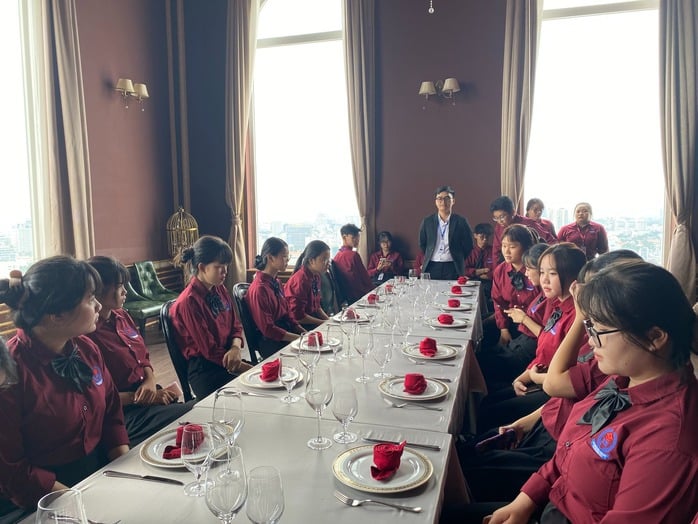
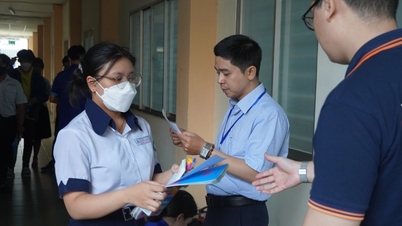
Students go on a field trip to experience the 5-star hotel management model in Ho Chi Minh City.
Improving the quality of vocational education lecturers.
At the seminar, Associate Professor Dr. Nguyen Tien Dong, Principal of Ly Thai To College (Bac Ninh), affirmed that there will be no high-quality vocational education without high-quality lecturers. When lecturers understand and are proficient in their profession, the application of technology and educational innovation will become natural. "Many vocational schools build close relationships with hundreds of businesses and organize many scientific seminars..., but these steps are still superficial, focusing on form rather than truly putting students at the core," Mr. Dong frankly stated.
Sharing the same view, Mr. Le Huy Nam, Director of the Education Department, Central Propaganda and Mass Mobilization Committee, pointed out the bottlenecks that need to be addressed.
Firstly, there are disparities in quality and management capacity among schools; although the teaching staff are highly skilled professionally, they often lack practical experience or pedagogical skills, leading to suboptimal teaching effectiveness; social prejudices against vocational training remain strong; and the links with businesses are not sustainable, mainly being individualistic.
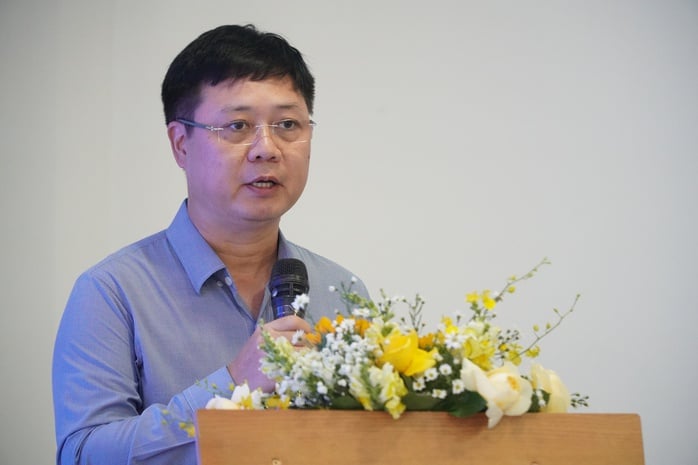
Mr. Le Huy Nam, Director of the Education Department, Central Propaganda and Mass Mobilization Committee, pointed out the bottlenecks that need to be addressed in vocational education and training.
According to Mr. Nam, Resolution 71 identifies education as one of the national strategic breakthroughs aimed at strongly developing a skilled workforce with industrial work ethics, capable of quickly adapting to the era of digital transformation and the green economy.
"The mission of vocational education and training (VET) has been elevated, not simply to train people to have a profession for employment, but to aim for mastery of the profession, and even the creation of new professions. This is a golden opportunity for VET to make strong breakthroughs," affirmed the Director of the Department of Education.
Source: https://nld.com.vn/nghi-quyet-71-nang-tam-mo-loi-cho-hang-loat-truong-nghe-phat-trien-196251023112129896.htm
![[Image] Vietnam's colorful journey of innovation](/_next/image?url=https%3A%2F%2Fvphoto.vietnam.vn%2Fthumb%2F1200x675%2Fvietnam%2Fresource%2FIMAGE%2F2025%2F12%2F14%2F1765703036409_image-1.jpeg&w=3840&q=75)





























































![[Image] Vietnam's colorful journey of innovation](https://vphoto.vietnam.vn/thumb/402x226/vietnam/resource/IMAGE/2025/12/14/1765703036409_image-1.jpeg)

























Comment (0)