

Accepting Western painting techniques and materials
- Sir, can you share about the early days when the late painter Nam Son Nguyen Van Tho participated in building the Indochina College of Fine Arts?
- When I grew up, I heard my father tell many memories about the early days of building the Indochina Fine Arts School. In those stories, my father always mentioned the memory of the first time he met his teacher and also his old friend, the French painter Victor Tardieu in Hanoi . My father affirmed that this chance meeting completely changed his life.
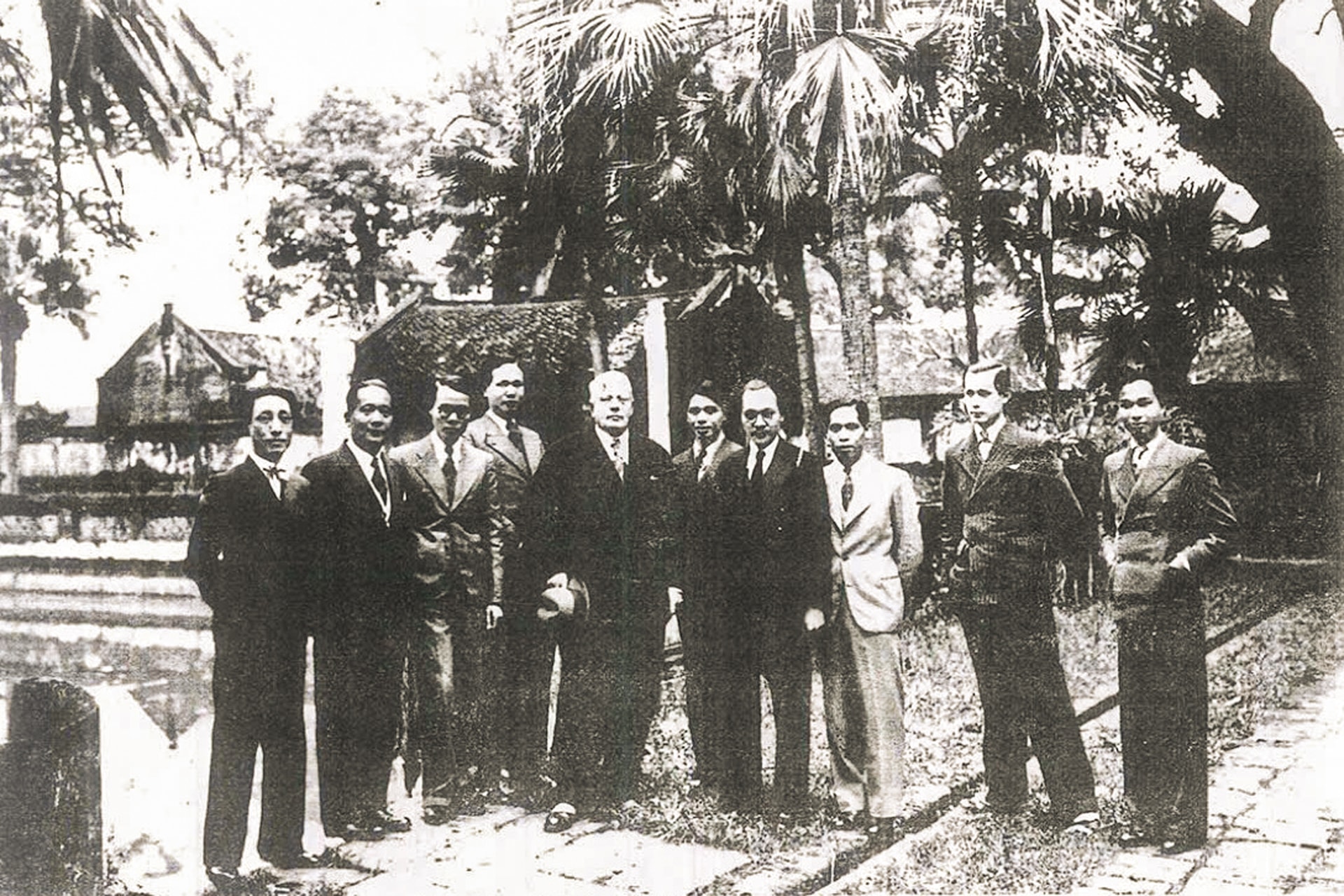
Passionate and talented in painting, my father was taught Chinese characters and drawing by Confucian scholars Pham Nhu Binh and Nguyen Sy Duc when he was young. The teachers took him to visit many temples, pagodas, and pagodas and thoroughly taught him about the ethics and culture of his ancestors. With a thorough education, my father became a civil servant of the Indochina Finance Department. Despite his busy schedule, he still took the time to paint in his spare time. While participating in decorating the Annam Student Association, he met painter Victor Tardieu. From then on, a friendship blossomed. The key thing was that his painting talent continued to develop. My father was introduced to Western painting techniques and materials such as paint mixing, canvas stretching, perspective, etc. He was the first person in Indochina to paint oil paintings in the neoclassical style.
- Excuse me, could you please go back to the original question?
- Well, I digress a bit just to answer that question. At this age, I see that the root of everything that has arisen since then is the sincere friendship between two talented friends of different ages. One is a famous and modern Western painter. The other is a painter with innate talent and a strong Asian character.
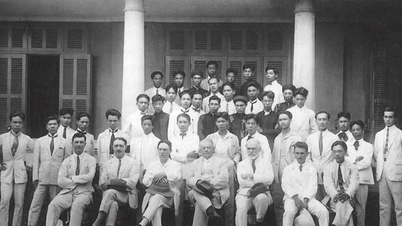
Everyone knows that from the idea to the project and construction of the Indochina Fine Arts School was a long, arduous and difficult journey. There are also documents about this process, such as the photo of my father present during the days at the school construction site. The special thing is that the construction site at that time (now at 42 Yet Kieu, Cua Nam Ward), was right near my parents' house on Nguyen Du Street today.
Maintaining the foundation of national fine arts
- I know that Mr. Nam Son wrote an Outline of Vietnamese Fine Arts. Can you tell readers more about this story?
- I was also going to mention the outline my father wrote in 1923. Before Governor General Martial Merlin signed the Decree approving the proposal of painter Victor Tardieu on the establishment of the Indochina Fine Arts School in Hanoi, my father had to convince his friend with the Outline for the establishment of the Vietnam Fine Arts School written in French.
Fortunately, to this day, my family still keeps my father's handwritten copy of the Vietnamese Fine Arts Outline in the national language. The first sentence is: "Establish a university to train talented artists to maintain the foundation of ancestral fine arts in order to reform and create an Indochinese fine arts with Vietnamese character."
- So when did painter Nam Son go to study in Paris (France)?
- In early 1925, my father arrived in Paris and was welcomed by Victor Tardieu to stay at his home. My father studied at the National School of Fine Arts, the National School of Decorative Arts... During this time, he diligently studied day and night to acquire European painting skills.
Later, my father recounted many interesting memories in Paris. What was special was that he had the opportunity to meet and become friends with great Asian painters such as Si Bei Hong (China) and Fujita Tsuguharu (Japan).
- And surely painter Nam Son had an important role in the first entrance exam (1925 - 1930)?
- My father was the judge of this competition. The first class only recruited 10 people out of more than 200 candidates. Of those, 8 studied painting, after 5 years the remaining 6 graduated. Later, they all became big names in the Vietnamese visual arts.
The generations of students at the Indochina Fine Arts College from the first class until the school closed in 1945 were very numerous. I still keep the list of students of the school. Among them, there are many famous names, who contributed many achievements to the Vietnamese fine arts such as Cong Van Trung, Tran Van Can, Bui Xuan Phai, Luong Xuan Nhi, Phan Ke An, Le Pho, Le Thi Luu, Trinh Huu Ngoc, Ton Duc Luong...
- Among the students of painter Nam Son, who do you remember most?
- I was impressed with artists like Cong Van Trung, Trinh Huu Ngoc, Luong Xuan Nhi... When my father was still alive, during the years of evacuation from Hanoi, artist Trinh Huu Ngoc still regularly cycled to visit his teacher and gave him food and provisions. In 2003, on the anniversary of my father's death, artist Cong Van Trung said: "Without teacher Nam Son, there would be no Indochina Fine Arts School, and without teacher Nam Son, there would be no artist Cong Van Trung today."
Thank you very much!
Source: https://hanoimoi.vn/nguoi-gop-phan-dat-nen-mong-cho-my-thuat-hien-dai-viet-nam-723382.html
![[Photo] General Secretary To Lam receives Vice President of Luxshare-ICT Group (China)](https://vphoto.vietnam.vn/thumb/1200x675/vietnam/resource/IMAGE/2025/11/15/1763211137119_a1-bnd-7809-8939-jpg.webp)

![[Photo] General Secretary To Lam receives Governor of Kanagawa Province (Japan) Kuroiwa Yuji](https://vphoto.vietnam.vn/thumb/1200x675/vietnam/resource/IMAGE/2025/11/15/1763204231089_a1-bnd-7718-5559-jpg.webp)
![[Photo] Panorama of the 2025 Community Action Awards Final Round](https://vphoto.vietnam.vn/thumb/1200x675/vietnam/resource/IMAGE/2025/11/15/1763206932975_chi-7868-jpg.webp)








































Comment (0)