

According to BBC Science Focus, at the GITEX Global and Expand North Star exhibitions – one of the world's largest technology and artificial intelligence events held in Dubai – reporters searched for unique, promising inventions that are poised to enter the market soon.
Flying taxis combined with self-driving cars.
Few could imagine a flying car that could connect directly with a regular four-wheeled vehicle. But that's exactly the idea behind GOVY AirCab, a flying taxi model developed by Guangzhou Automobile Group.
This vehicle is capable of vertical take-off and landing from an automated chassis on the ground, operating as flexibly as a traditional taxi, and also transforming into a flying taxi when air travel is required.
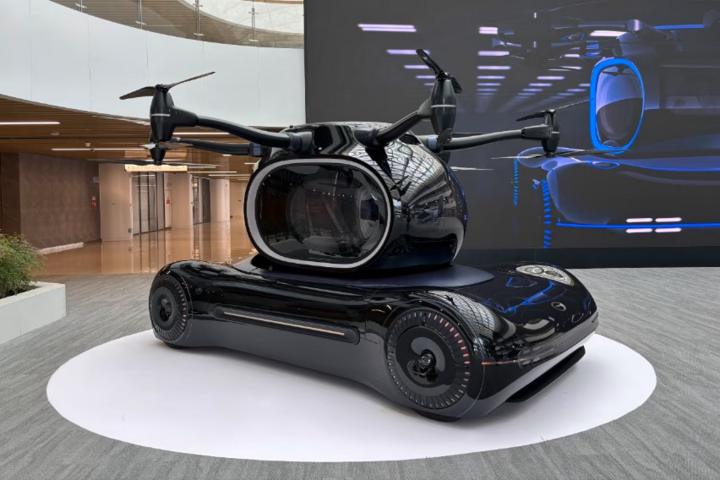
GOVY AirCab - a flying taxi that combines autonomous driving, offering seamless journeys with just a click (Source: GOVY)
“This is the latest vision for the future of transportation,” shared Hanxuan Liu, product expert at GOVY. With a seamless journey at the click of a button, users don’t need to change vehicles – simply call a ride, fly to the desired location, and then continue on to their final destination.
GOVY has completed its test flights and is awaiting safety certification. The product is expected to be publicly demonstrated at the end of next year and deployed in China within two years, before expanding to the US and Europe in about five years.
Spider silk heals the heart.
Stronger than steel yet flexible and biocompatible, synthetic spider silk is opening new avenues for medicine. The biotechnology company PrintyMed (Latvia) has mimicked the natural spinning process of spiders, creating a type of silk with high strength, flexibility, and biocompatibility that does not harm living tissue.
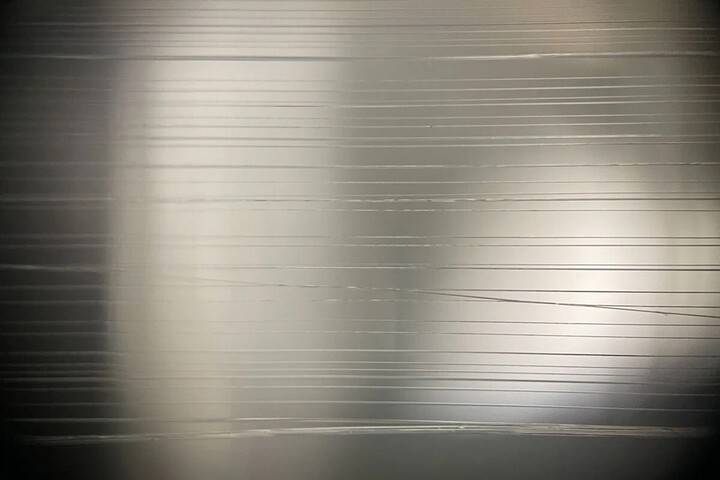
The bio-synthetic spider silk developed by PrintyMed has the potential to revolutionize medicine. (Source: PrintyMed)
In collaboration with the Latvian Institute of Organic Synthesis, the research team designed a protein that can be drawn into fibers using a biomimetic process. The result is a sustainable material that can be mass-produced and applied in many medical fields.

Synthetic spider silk is produced using a biomimetic spinning process developed by PrintyMed. (Source: PrintyMed)
PrintyMed hopes to use this type of silk to develop "organs on chips" for drug testing, manufacturing anticoagulant heart valves, wound dressings to accelerate tissue healing, and even artificial tissue frameworks – helping to alleviate the global shortage of transplant organs.
Contact lenses replace all screens.
Startup XPANCEO aims to create the world's first smart contact lenses that could replace smartphones, smartwatches, and eyeglasses.
Co-founder Roman Axelrod argues that, “current devices are too bulky, harmful to health and the environment. We need a more streamlined interface.” According to him, artificial intelligence will act as the “brain and heart,” while augmented reality (XR) technology – displayed through glasses or lenses – will become the interface of the future.
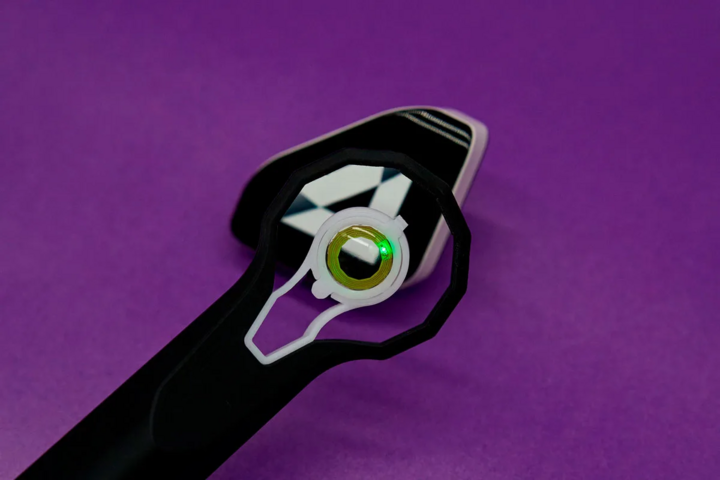
XPANCEO's experimental contact lenses are designed to replace mobile phones. (Source: XPANCEO)
This smart lens is expected to integrate many features such as bio-sensors for health tracking, night vision, zoom functionality, and the ability to display live data.
Dr. Valentyn S. Volkov stated that XPANCEO is currently in the testing phase and a complete prototype is expected by the end of next year. Because it is classified as a medical device, the development process will be closely monitored.
3D images that "float" in real life.
Voxon (Australia) is turning science fiction into reality with VLED technology, which allows for the creation of vivid 3D images that appear to float in space.
Unlike flat 3D technology, Voxon's volumetric display consists of millions of light points suspended in mid-air, creating a 360-degree image that viewers can observe from any angle.
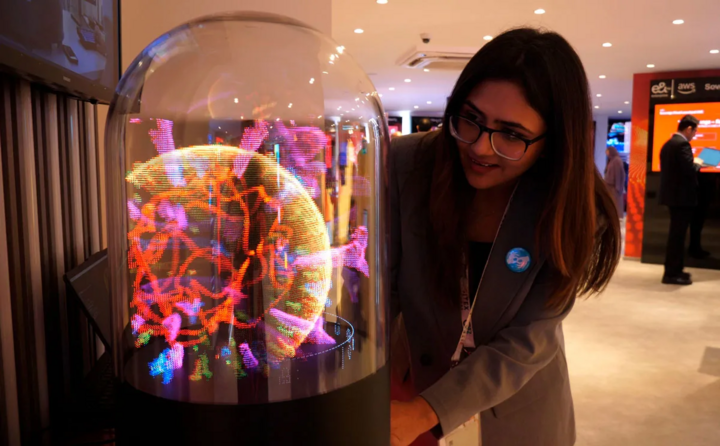
The Voxon VX2 projects 360° 3D images without the need for headphones. (Source: Voxon/Gavin Smith)
The Voxon VX2 desktop device can display medical images, molecular models, game characters, or architectural drawings in full 3D within a glass cylinder approximately 25 cm tall, without the need for glasses or headphones.
Source: https://vtcnews.vn/nhung-phat-minh-co-the-thay-doi-the-gioi-ar986119.html















































































Comment (0)