

In 2016, the world was stunned when legendary Go player Lee Se-dol was defeated by the artificial intelligence system AlphaGo.
For young Tran Tien Cong - then a graduate student in Korea - the event made him think for many days because he realized that the boundary between human intelligence and machines was fading.
“What do I need to keep up with an era that will see the explosion of artificial intelligence?” Cong asked himself.
The turning point of Vietnamese PhD students came from the event of a Korean Go player being defeated by AI ( Video : Minh Nhat - Thuong Huyen).
From a background in multi-agent systems and robotics, he branched out into machine learning, computer vision, and large language models.
In 2021, Tran Tien Cong successfully defended his PhD thesis in Computer Science and returned to Vietnam. He is currently Head of the Machine Learning Department, Faculty of Artificial Intelligence, Academy of Posts and Telecommunications Technology.
In class, he often recalls the historic match as a prime example of the pace of change in AI.
Advanced models attending the 11th National Patriotic Emulation Congress
Dr. Tran Tien Cong is currently Head of Machine Learning Department, Faculty of Artificial Intelligence, Academy of Posts and Telecommunications Technology.
During the period 2020-2025, he was the author or co-author of many highly ranked scientific articles in prestigious international journals, especially 15 articles published in SCIE journals, ranked Q1, along with many publications and topics highly appreciated domestically and internationally, demonstrating the participation of Vietnamese intelligence in high-quality research in the fields of artificial intelligence, network science, machine learning, etc.
His research topics are not only academic but also have high practical applications, contributing to socio-economic development and improving the quality of life.
Dr. Tran Tien Cong is one of the advanced models of the Ministry of Science and Technology attending the 11th National Patriotic Emulation Congress.
AI's victory challenges the whole world
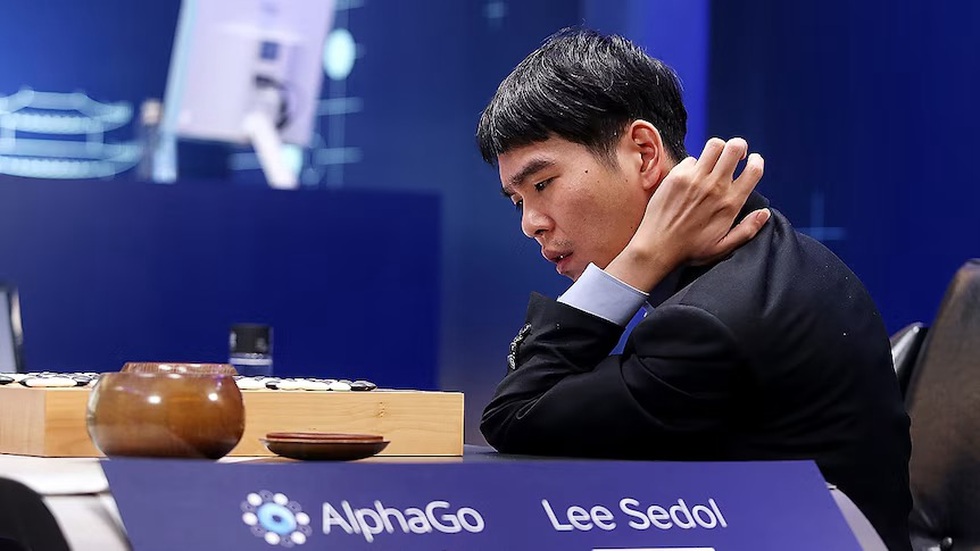
Go player Lee Se-dol in a match against AlphaGo in 2016 (Photo: Getty).
What event changed the direction of your research in Korea?
- In the first year of school, everything changed when Go player Lee Se-dol was defeated by AlphaGo, an artificial intelligence system developed by Google. It must be known that at that time, Go player Lee Se-dol was the pride of Korea, while Go is considered one of the most complex intellectual sports in the world.
At that time, not only Korea but the whole world considered this a shocking event in the field of science and technology. 10 years ago, artificial intelligence was determined to develop and have a profound impact on many fields of both science and life in the future.

According to Dr. Cong, over the past decade, AI has developed rapidly and outstandingly.
Many Korean research labs have shifted their focus to research and development of artificial intelligence. I focus more on AI, machine learning, graph research, training artificial intelligence to search data on large networks.
Not stopping at winning Go, artificial intelligence can now solve many difficult problems, beat humans in many different games and competitions. That shows how quickly and outstandingly AI has developed in the past decade.
At the same time, how has Vietnam embraced technology?
- Vietnam is not outside the flow of science and technology. When I returned to the country in 2021 and started teaching, many individuals and research units had already received technology transfer and had in-depth publications in the field of artificial intelligence, both in theory and in practical application.
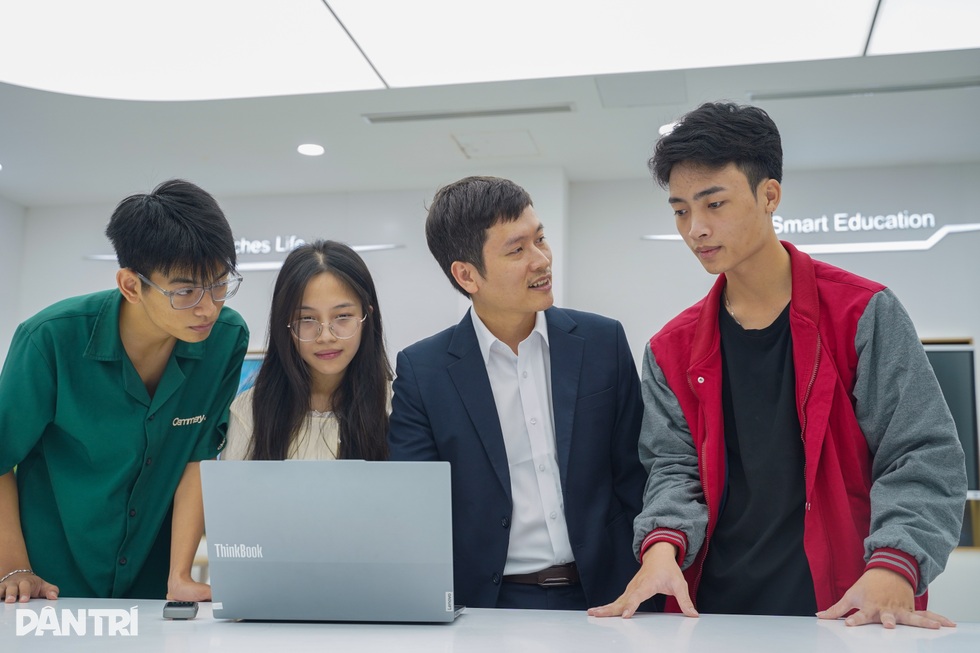
Currently, in addition to research and teaching, Dr. Tran Tien Cong also participates in training management, curriculum development, and career orientation for students (Photo: Minh Nhat).
Currently, information technology in general is an industry that always needs high-quality human resources. Many students have jobs right from their school days. That shows that this industry has many opportunities, but also challenges because technology is changing and improving every day.
60 times of trial, error and repetition
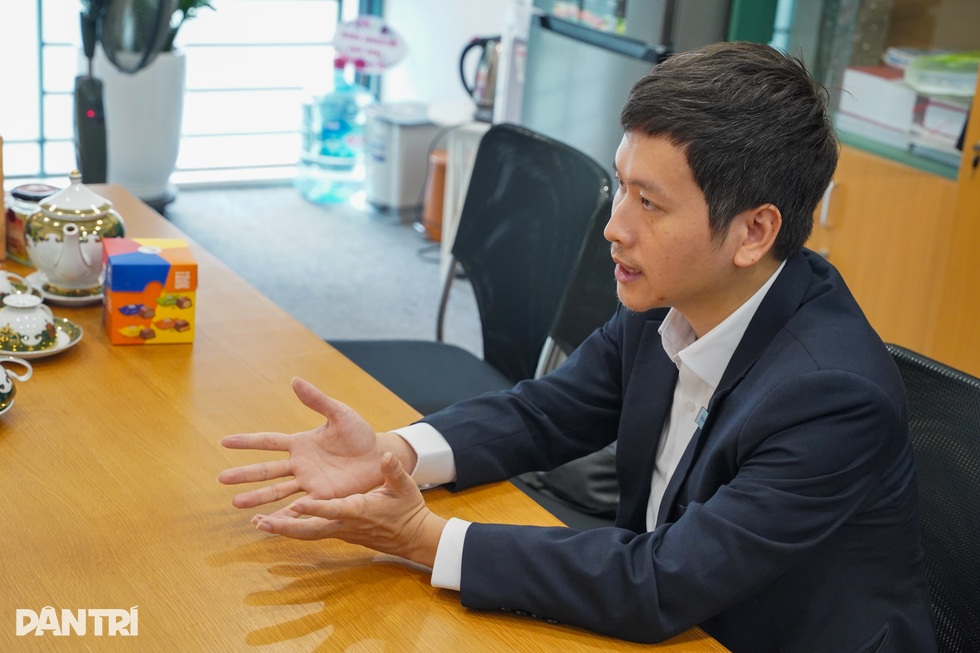
Dr. Tran Tien Cong's research focuses on solving the problem of finding hidden information in data networks (Photo: Minh Nhat).
What has been your most meaningful research work in the field of artificial intelligence to date?
- I once did a research published in IEEE Transactions on Pattern Analysis and Machine Intelligence - considered the leading journal in the field with the topic of finding hidden data in network analysis tasks through finding information in graphs, from there querying and inferring hidden information.
Suppose we ask a chatbot “Where is the lake shore?”. If we are in Hanoi, “lake shore” is understood as Hoan Kiem Lake, but if we are in Da Lat, “lake shore” is Xuan Huong Lake. When we search for information, the lack of data and context in the input will cause the computer to make mistakes.


My research focuses on solving the problem of how to search and combine information from many different sources to produce the most accurate results. Still with the example of “lake shore”, if the user wants to calculate the distance to the lake shore, artificial intelligence can infer hidden information and guess whether the user is in Hanoi or Da Lat from previous chats, the chatbot will give the correct answer.
- How did your research go?
I did that research for 3 years, and it was not published until 2019 because of the long time it took to research, review, edit, and publish. Most research in the field of artificial intelligence and computer science is like that. The research process is always “trial – error – repeat”.

An AI product researched by the Department of Artificial Intelligence.
I remember repeating that “cycle” 60 times. Each time with a different sample, each time with a different method of testing. I didn’t just stop at reasoning, I also had to run tests to see if I had calculated correctly.
For this topic, I have to come up with a suitable algorithm, then train the AI to find the hidden data. If the result is not satisfactory, I will improve it to find the suitable algorithm. The beauty of this research is that it does not have absolutely accurate results, but can only find the most suitable algorithm after dozens of trials and errors.


General research is not for the desk.
In the field of artificial intelligence, should researchers focus on practical applications more than fundamental theories?
- There is a common misconception that general, theoretical research is not as applicable as specific case studies. In fact, articles published in top journals are often general studies that can be applied in many fields.
"General, theoretical research is no less valuable than applied research because it lays the foundation for application in many different fields," said Dr. Tran Tien Cong.
Taking the example of researching how to query hidden information above, not only can chatbots be applied, but we can also use it to track hidden groups on social networks, which can be applied in many different fields.
Nowadays, artificial intelligence is applied in many fields, not just stopping at the general science and technology field. Therefore, combining the foundations, theories of AI, data... with practical surveys and effective applications will strengthen the role and practicality of research.
Questions that seem very simple when proposing a research proposal such as: How to survey the model and data? Has anyone done this research before? How can we learn from and compare previous data?... play a role in deepening one's research.

There is a commonly misunderstood idea: general, theoretical research is not as applicable as specific case studies.
In your opinion, what aspects of computer science and information technology research need to focus on investing more?
- In recent years, facilities and infrastructure have been improved and upgraded, creating favorable conditions for units and individuals to research in the field of artificial intelligence. If there is more investment in equipment and modern research labs, researchers will be able to produce more products, applications and reports.
Additionally, our database is being cleaned, creating a data warehouse so that researchers have a source to train quality models.
In an industry that is rapidly updated like information technology, research that has just been completed can be outdated or not keep up with reality. Many applied researches can be applied to reality immediately but will encounter rapid changes in technology, leading to unsustainability and difficulty in spreading. To master artificial intelligence, we need to have in-depth research and bring core technology to Vietnam.
Thank you very much!

To master artificial intelligence, we need to conduct in-depth research and bring core technology to Vietnam.
Source: https://dantri.com.vn/khoa-hoc/60-lan-thu-sai-va-hanh-trinh-dua-ten-viet-len-tap-chi-ai-hang-dau-the-gioi-20251104162220016.htm




























































![Dong Nai OCOP transition: [Article 3] Linking tourism with OCOP product consumption](https://vphoto.vietnam.vn/thumb/402x226/vietnam/resource/IMAGE/2025/11/10/1762739199309_1324-2740-7_n-162543_981.jpeg)








Comment (0)