

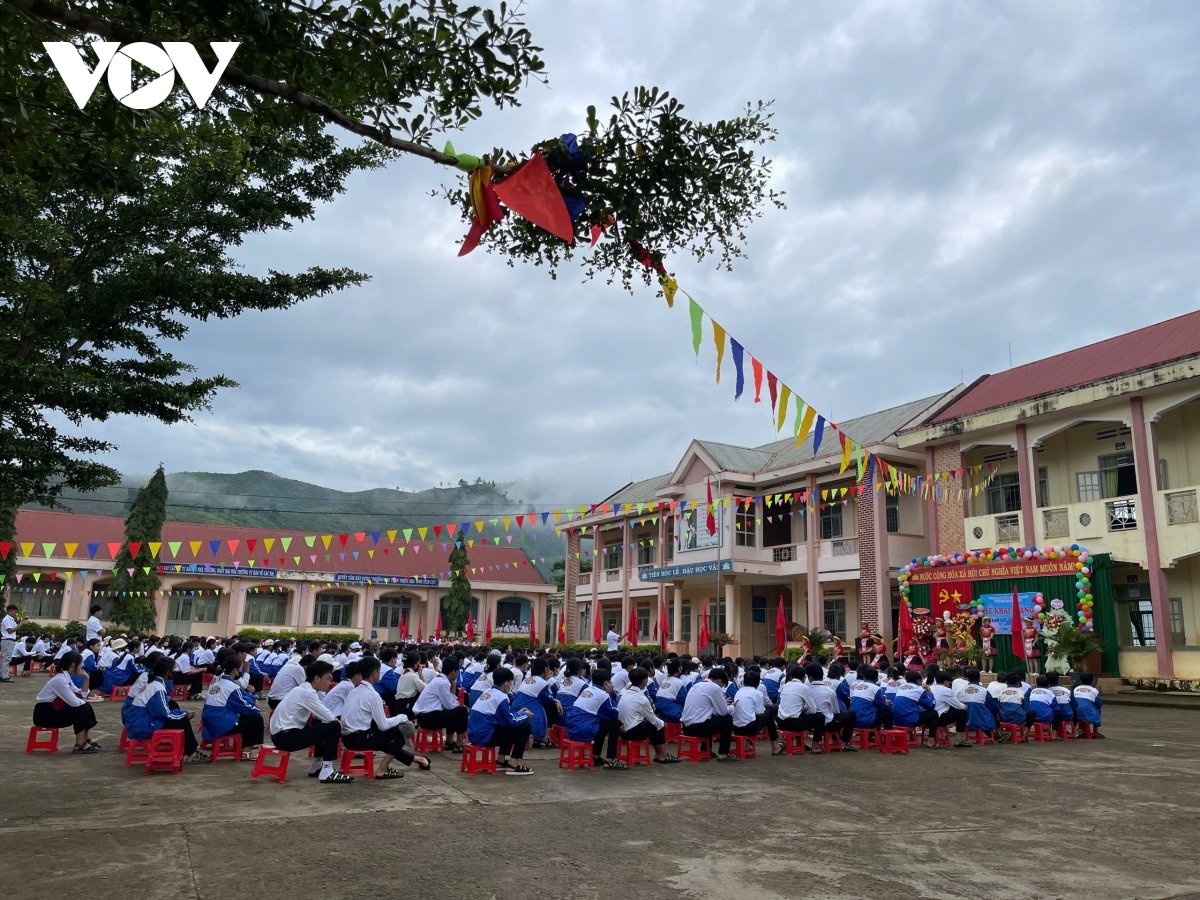
After graduating with a degree in Chemistry Education from Saigon University, Ms. Trinh Thi Thanh Thuy (25 years old), residing in Gia Nghia city, began working at Le Huu Trac Secondary and High School in Dak Ngo commune, Tuy Duc border district, Dak Nong province. For over a year, Ms. Thuy has been teaching under a labor contract as stipulated in Government Decree 111 of 2022. The school is located in a remote area, with nearly 100% of its students being ethnic minorities, and lacks adequate facilities. Meanwhile, her salary of just over 6 million VND per month and a contract duration of only 9 months per school year are insufficient to support her young teacher.

Teacher Trinh Thi Thanh Thuy said: “Currently, we only sign contracts for 9 months, which is for the school year. Actually, it's difficult because our homes are over 50km from Gia Nghia, a long distance, and the income doesn't meet our expectations. I also hope for more support policies such as fuel subsidies and more teachers, because our school is currently short of teachers.”

After four years of teaching in Ho Chi Minh City, Ms. Nguyen Thi Dung transferred to teach at Quang Hoa Junior High School in Quang Hoa commune, Dak Glong district, Dak Nong province, at the beginning of this school year. Born and raised in Quang Hoa, the young teacher wanted to return to her hometown to help the children in this particularly disadvantaged commune. Because there are no official staffing quotas, Ms. Dung is currently teaching under a short-term contract as stipulated in Government Decree 111 of 2022, with a salary of over 6 million VND and a contract duration of 9 months. Passionate about her profession and choosing to work in a remote area, Ms. Dung hopes the government will make more appropriate adjustments for contract teachers and invest more in education in remote regions.
“In a remote area like this, teachers certainly face many difficulties in their work. When I came here, to this land where I was born, with my passion and love for my homeland, I thought I could do it. I also hope the government will pay more attention to the local education situation, because it is still very difficult here. As for myself, I also hope that the contract period will be longer, about 12 months, so that with a stable economy , we can work with more peace of mind,” said Ms. Dung.
The problem is that in particularly disadvantaged areas, contract teachers do not receive preferential treatment. This creates a huge income disparity between contract teachers and tenured teachers, even when teaching at the same school.

Mr. Nguyen The Hiet, Principal of Le Huu Trac Secondary and High School (Dak Ngo commune, Tuy Duc district, Dak Nong province), analyzed: The school is located in a disadvantaged commune (classified as a "Region 3" commune), so current tenured teachers receive a 70% allowance, an initial incentive of 10 months' basic salary, and an additional incentive of 70% for the first 5 years. In reality, tenured teachers at the school earn around 20 million VND/month, while contract teachers only earn just over 6 million VND for only 9 months. According to Mr. Nguyen The Hiet, attracting teachers to a disadvantaged commune is difficult, and retaining them is even more challenging. Therefore, the government needs to make appropriate adjustments.
“The school is short 8 teachers and has already contracted 5 teachers under Decree 111. All the teachers want to contribute and stay with the school long-term. In the long run, we hope to allocate more permanent positions to the school so that the contracted teachers can take the exam, pass the selection process, and commit to working with the school for the long term,” said Mr. Hiet.
This school year, Dak Nong province is short of nearly 1,600 teachers. Mr. Phan Thanh Hai, Director of the Department of Education and Training of Dak Nong province, said that the teacher shortage has significantly affected teaching and learning, especially in remote areas and ethnic minority regions. To temporarily address this, the province has allocated 622 contract positions to the education sector under Government Decree 111 of 2022. These contract positions are a significant contribution to partially resolving the local teacher shortage.
However, currently, the relatively low income and short contract duration (9 months) do not guarantee a decent life for contract teachers. Therefore, even with contract positions available, it is difficult to attract teachers, especially for subjects like computer science and English, and in particularly disadvantaged areas.
Mr. Phan Thanh Hai stated: "When implementing contracts under Decree 111, it can be said that the salary level is not adequate to encourage contract teachers, especially in remote and disadvantaged areas. The Provincial Party Committee, the Provincial People's Council, and the Provincial People's Committee are also planning to develop a Resolution to find ways to attract teachers from remote and disadvantaged areas under this Decree."
Teaching in remote and disadvantaged areas is a difficult choice, but with a love for the profession, many teachers are still dedicating their youthful energy to the cause of education in Dak Nong. While the central government has not yet allocated sufficient staffing quotas, the local government and relevant agencies need to consider appropriate policies to help teachers feel secure in their work.
Source: https://vov.vn/xa-hoi/noi-niem-giao-vien-hop-dong-o-vung-sau-dak-nong-post1122713.vov
![[Image] The tenacious fighting spirit of Vietnamese women's football](/_next/image?url=https%3A%2F%2Fvphoto.vietnam.vn%2Fthumb%2F1200x675%2Fvietnam%2Fresource%2FIMAGE%2F2025%2F12%2F17%2F1765990260956_ndo_br_4224760955870434771-copy-jpg.webp&w=3840&q=75)

![[Image] Leaked images ahead of the 2025 Community Action Awards gala.](/_next/image?url=https%3A%2F%2Fvphoto.vietnam.vn%2Fthumb%2F1200x675%2Fvietnam%2Fresource%2FIMAGE%2F2025%2F12%2F16%2F1765882828720_ndo_br_thiet-ke-chua-co-ten-45-png.webp&w=3840&q=75)
![[Photo] Prime Minister Pham Minh Chinh receives Lao Minister of Education and Sports Thongsalith Mangnormek](/_next/image?url=https%3A%2F%2Fvphoto.vietnam.vn%2Fthumb%2F1200x675%2Fvietnam%2Fresource%2FIMAGE%2F2025%2F12%2F16%2F1765876834721_dsc-7519-jpg.webp&w=3840&q=75)
![[Live] 2025 Community Action Awards Gala](/_next/image?url=https%3A%2F%2Fvphoto.vietnam.vn%2Fthumb%2F1200x675%2Fvietnam%2Fresource%2FIMAGE%2F2025%2F12%2F16%2F1765899631650_ndo_tr_z7334013144784-9f9fe10a6d63584c85aff40f2957c250-jpg.webp&w=3840&q=75)
![[Photo] Prime Minister Pham Minh Chinh receives the Governor of Tochigi Province (Japan)](/_next/image?url=https%3A%2F%2Fvphoto.vietnam.vn%2Fthumb%2F1200x675%2Fvietnam%2Fresource%2FIMAGE%2F2025%2F12%2F16%2F1765892133176_dsc-8082-6425-jpg.webp&w=3840&q=75)


























































![[Live] Closing Ceremony and Award Presentation for the "Impressive Vietnam Tourism" Video/Clip Creation Contest 2025](https://vphoto.vietnam.vn/thumb/402x226/vietnam/resource/IMAGE/2025/12/17/1765974650260_z7273498850699-00d2fd6b0972cb39494cfa2559bf85ac-1765959338756946072104-627-0-1338-1138-crop-1765959347256801551121.jpeg)


















Comment (0)