


According to New Atlas , as part of an initiative to significantly reduce carbon emissions from maritime transport in the Gulf of Finland, operator Viking Line announced details of its plan to put the world's largest electric passenger ferry, Helios, into operation in the early 2030s.
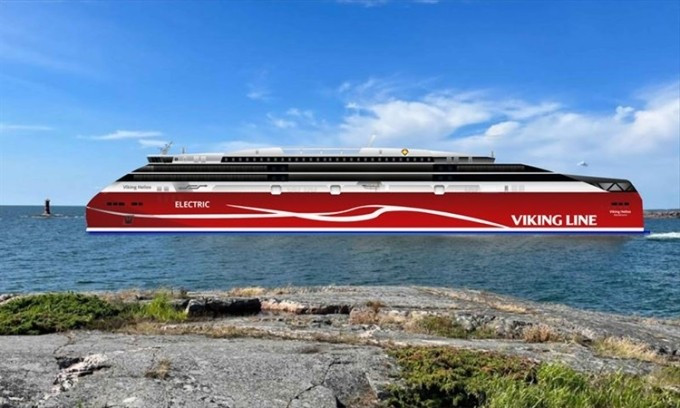
Viking Line is aiming for a vessel that is 195 meters long and 30 meters wide. Its all-electric propulsion system will achieve a top speed of 23 knots (42.5 km/h), drawing power from an 85-100 MWh battery pack.
"Helios marks a new era in maritime transport, much like the first sailing ships, steamships, and motorboats did in their time," said Jan Hanses, CEO of Viking Line. "This idea proves that large-scale zero-emission maritime transport is no longer a pipe dream."
The Helios, a collaboration between Viking Line, Rauma shipyard, and several other partners, is designed to carry up to 2,000 passengers and 650 vehicles across the Gulf of Finland from Helsinki port to Tallinn in northern Estonia, a journey of 80 km and back. The vessel also has cargo capacity. The electric ferry model is expected to require at least 30 MWh of charging, which is done when the vessel is docked.
"Increasingly stringent regulations place a heavy burden on fossil fuel-based maritime transport, but zero-emission technology will allow us to increase capacity on the Helsinki-Tallinn line. Our goal is to order two electric trains to double our current year-round capacity," Hanses said.
According to Viking Line, emissions from their fleet have decreased by nearly a third over the past 15 years. They switched to low-sulfur fuels in the early 1990s. The company launched its first liquefied natural gas (LNG) passenger ship in 2013 and added another smart ferry model in 2022.
Source: https://khoahocdoisong.vn/pha-cho-khach-bang-dien-lon-nhat-the-gioi-post1548246.html










![[INFOGRAPHIC] B&O Beo Grace, True Wireless Headphones priced at 47 million VND](https://vphoto.vietnam.vn/thumb/402x226/vietnam/resource/IMAGE/2026/02/28/1772259256704_info-tainghe-nhom-02-jpg.webp)



























































Comment (0)