

Following the group of students to a meeting with the leadership of the Vietnam Puppet Theatre to seek exhibition support and professional advice, we clearly saw the arduous journey behind their "Vietnamese Colors" project. In just over two months, with only 5 members, the student group completed a set of 3D wooden paintings integrated with AR technology, recreating 8 characteristic performing arts from the three regions of Vietnam, including: water puppetry, Cheo, Tuong, Quan Ho folk songs, Cai Luong, Hue royal court music, Chau Van, and Don Ca Tai Tu.
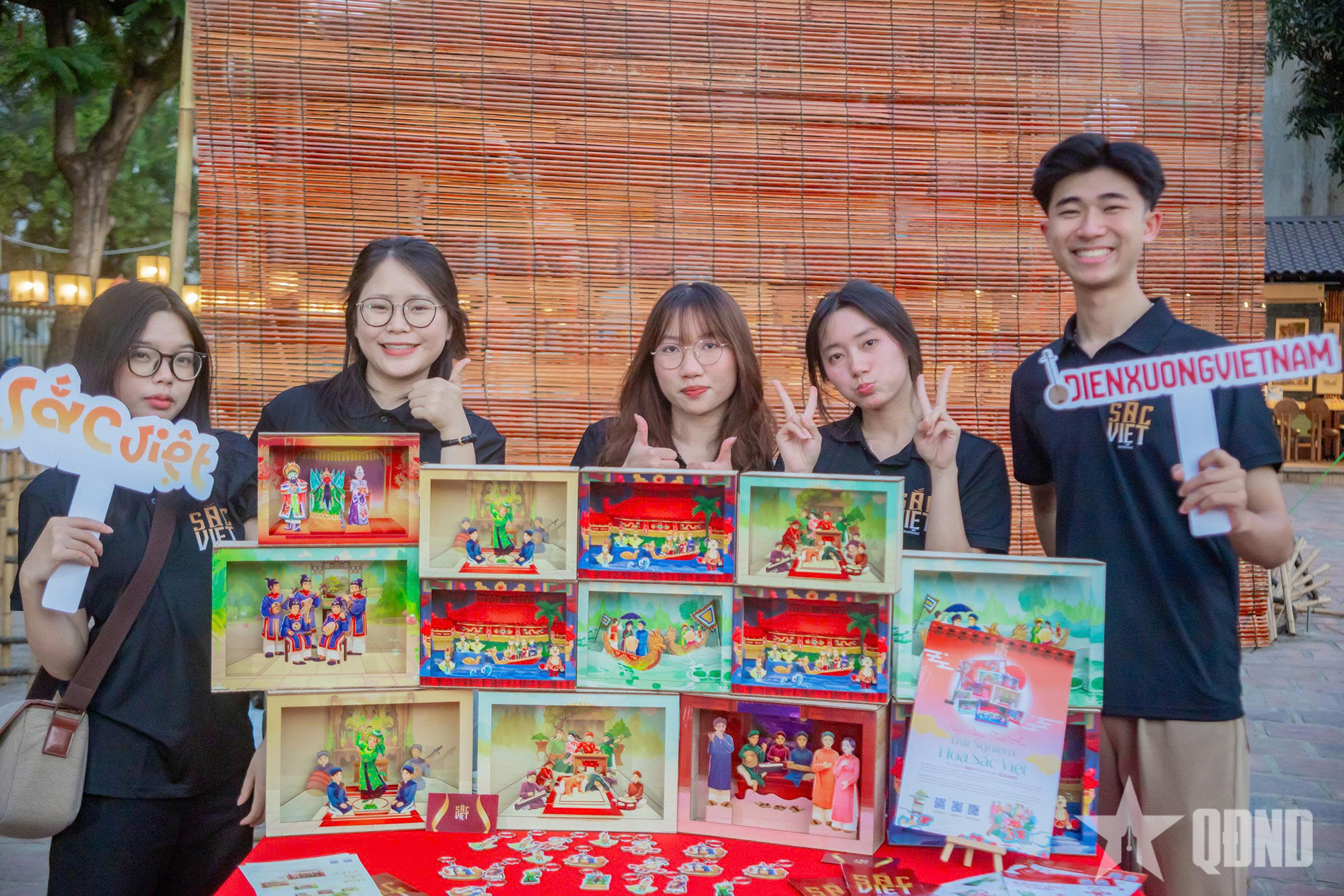 |
| Five members of the "Vietnamese Colors" project –FPT University Hanoi. |
Commenting on the project, People's Artist Nguyen Tien Dung, Director of the Vietnam Puppet Theatre, shared: “First of all, I was very moved when I held your product in my hands, because it evokes childhood memories of simple handcrafted toys. I highly appreciate this creative idea because it shows the courage of young people in bringing technology into a cultural space rich in cultural values, thereby helping puppetry and other traditional performing arts to get closer to the public, especially young audiences.”
Few people know that "Vietnamese Colors" originated from the very ordinary experiences of the students: attending performances and curious explorations of traditional folk art forms. Their initial enthusiasm gradually gave way to concern as they realized that these values were fading in contemporary life, especially among young people. From there, the group chose technology, a familiar language to their generation, to revitalize storytelling and bring heritage closer to the public.
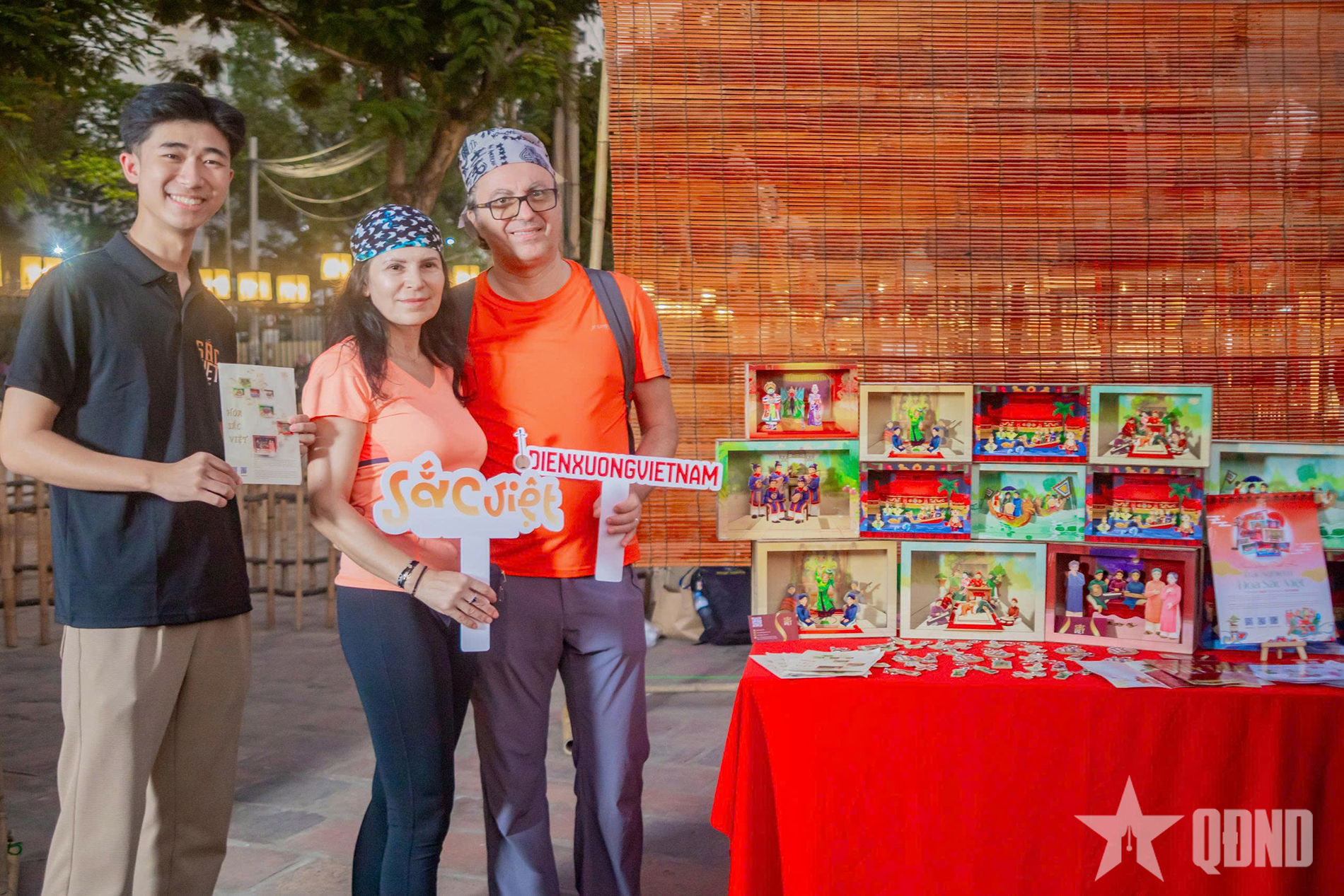 |
| Foreign tourists visit the "Vietnamese Colors" product display area at the Temple of Literature - National University. |
According to Nguyen Thi Mai, the project leader, the entire AR experience of "Sac Viet" was built by the team members themselves instead of hiring external parties, from the experience flow and images to the storytelling concept, with the desire to bring the heritage to life in the true spirit the team pursues. The core AR technology was developed in collaboration with an experienced senior member, with continuous testing and refinement to ensure product stability.
“Many art forms like Tuong, Cheo, or Hue royal court music are often considered ‘niche,’ not because they lack appeal, but because the gap between traditional stage performances and modern life is sometimes too wide. Young people today are used to fast-paced lives, vivid images, and concise content, so dedicating hours to watching a traditional performance is not easy. That’s why AR is the most natural way for us to bridge that gap,” Nguyen Mai added.
As a graduation project that also aimed at a cultural business model, the student group soon faced the most difficult challenge: balancing commercial value with preserving the original spirit of traditional art. According to the group, this balance wasn't about choosing one over the other, but about allowing both elements to coexist and complement each other: Heritage is the soul, while AR technology, wood materials, and storytelling are merely the "wings" that help spread that value.
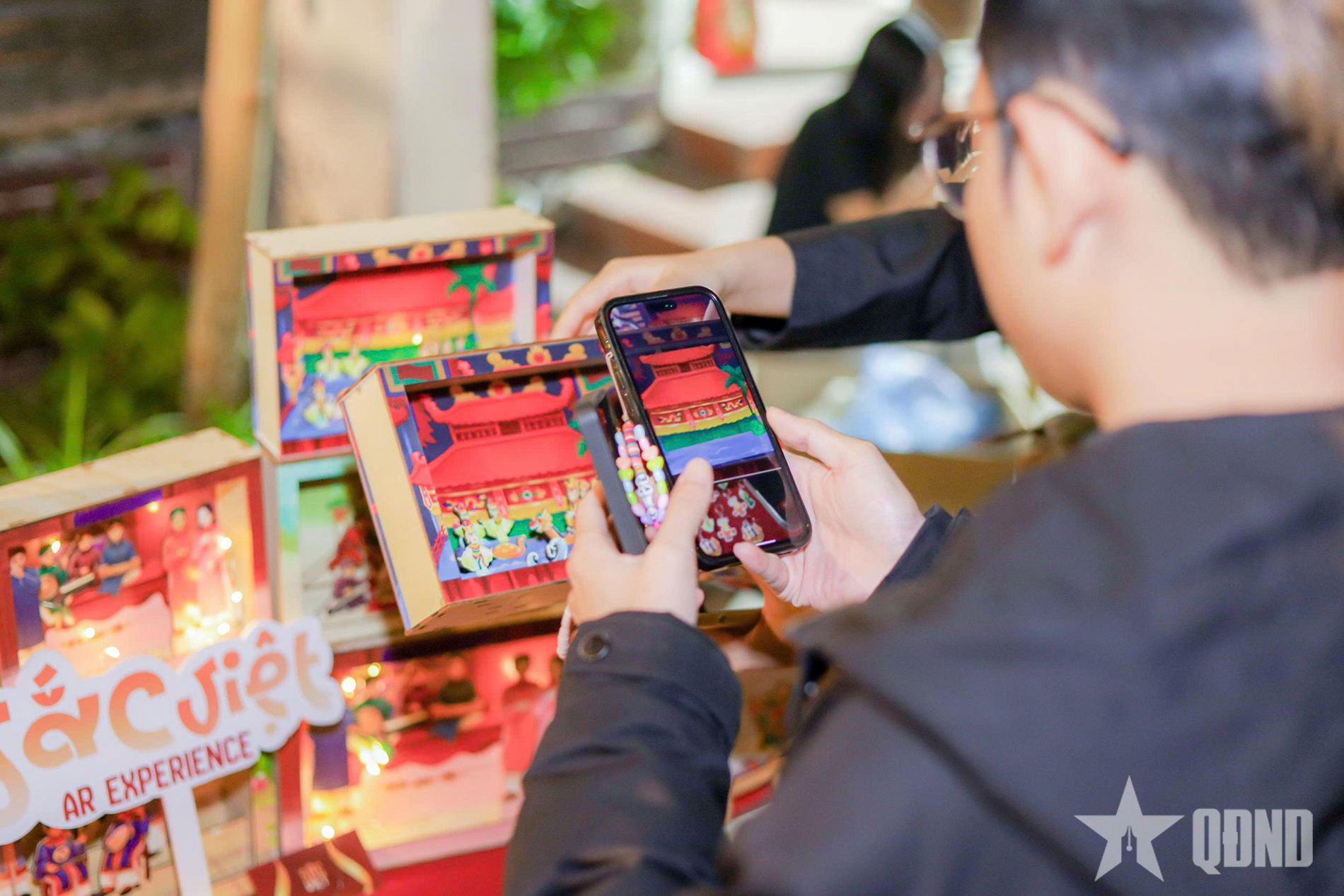 |
| Young people are excited to experience watching water puppetry through 3D wooden paintings integrated with AR technology. |
Fortunately, throughout the product development process, the team did not go it alone on their journey to revitalize the heritage. To ensure that each work retained the spirit of its respective art form, from the very beginning, the team sought the support of Ms. Ho Phuong Thao, a researcher of performing arts and author of the book "Tourist Troupes Across the World," who helped guide the content and cultural narrative. Building on this foundation, the members proactively attended performances, read and researched materials to fully understand the theatrical language of Tuong, Cheo, water puppetry, and Quan Ho folk singing.
In particular, for the water puppetry project, the team received direct guidance from People's Artist Nguyen Tien Dung, helping the AR movements of the water puppets achieve the necessary accuracy and vitality. Throughout this journey, they also had the unwavering support of Ms. Cung Thi Anh Ngoc, lecturer in Business Administration at FPT University Hanoi. According to Ms. Ngoc: “Sac Viet showed me that when young people are given confidence, the right direction, and are not limited by old ways, they can completely transform cultural heritage into a creative and economic resource. With the mindset, technology, and storytelling style of their generation, they not only absorb but also renew the heritage, infusing it with contemporary vitality and taking culture further.”
The most memorable milestone for "Sac Viet" was the moment the AR application was officially approved by the system. After days of anxious waiting, the notification from the App Store brought immense joy to the entire team, because from then on, the product was no longer just an idea or prototype, but could now operate and tell the story of culture through movement and sound. From that moment on, "Sac Viet" was put on display for the public to experience firsthand. The surprised looks when scanning the AR images from the 3D paintings and seeing the water puppetry appear on the phone screen confirmed that more than two months of hard work were completely worthwhile.
Technology cannot instantly make young people fall in love with cultural heritage, but it can create a first touch that sparks curiosity. From curiosity to exploration, then understanding and love – that is the journey that "Vietnamese Colors" aims for. When a painting speaks, when a stage movement appears in virtual space, perhaps viewers will want to step out of the screen to touch the real stage. For the team behind it, heritage belongs not only to the past but to us today; preservation is not about keeping it as it is, but about giving heritage a reason to continue living.
Source: https://www.qdnd.vn/van-hoa/doi-song/sac-viet-hanh-trinh-nguoi-tre-lam-moi-di-san-bang-cong-nghe-ar-1017144
![[Live] 2025 Community Action Awards Gala](/_next/image?url=https%3A%2F%2Fvphoto.vietnam.vn%2Fthumb%2F1200x675%2Fvietnam%2Fresource%2FIMAGE%2F2025%2F12%2F16%2F1765899631650_ndo_tr_z7334013144784-9f9fe10a6d63584c85aff40f2957c250-jpg.webp&w=3840&q=75)

![[Photo] Prime Minister Pham Minh Chinh receives Lao Minister of Education and Sports Thongsalith Mangnormek](/_next/image?url=https%3A%2F%2Fvphoto.vietnam.vn%2Fthumb%2F1200x675%2Fvietnam%2Fresource%2FIMAGE%2F2025%2F12%2F16%2F1765876834721_dsc-7519-jpg.webp&w=3840&q=75)
![[Image] Leaked images ahead of the 2025 Community Action Awards gala.](/_next/image?url=https%3A%2F%2Fvphoto.vietnam.vn%2Fthumb%2F1200x675%2Fvietnam%2Fresource%2FIMAGE%2F2025%2F12%2F16%2F1765882828720_ndo_br_thiet-ke-chua-co-ten-45-png.webp&w=3840&q=75)
![[Photo] Prime Minister Pham Minh Chinh receives the Governor of Tochigi Province (Japan)](/_next/image?url=https%3A%2F%2Fvphoto.vietnam.vn%2Fthumb%2F1200x675%2Fvietnam%2Fresource%2FIMAGE%2F2025%2F12%2F16%2F1765892133176_dsc-8082-6425-jpg.webp&w=3840&q=75)



























![[Photo] Prime Minister Pham Minh Chinh attends the Vietnam Economic Forum 2025](https://vphoto.vietnam.vn/thumb/402x226/vietnam/resource/IMAGE/2025/12/16/1765893035503_ndo_br_dsc-8043-jpg.webp)
















Comment (0)