

TAY NINH - With unwavering perseverance, Mr. Huynh Quoi has successfully cultivated organic durian in a challenging area, requiring customers to place orders in advance.
Do not "disturb" the land.
Upon arriving at Suoi hamlet, Hung Thuan commune (Trang Bang town, Tay Ninh province), we heard the locals tell the story of Mr. Huynh Van Quoi's success in becoming wealthy from durian cultivation.
With its barren, sandy-gray soil, Trang Bang town is only suitable for rubber trees and short-term crops like peanuts. However, with unwavering perseverance, Mr. Huynh Quoi has made this land profitable with his thriving organic durian orchard spanning over 26 hectares, bearing an abundance of fruit.
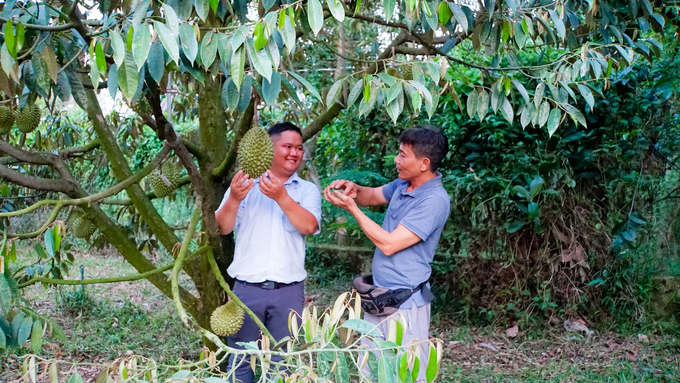
Mr. Quoi (right) excitedly shares the results of his organic durian farming with the reporter. Photo: Tran Trung.
Leading us on a tour of his orchard, Mr. Quoi explained that he had put in a lot of effort to enrich the soil to achieve the orchard's current state. After experimenting with various farming methods, he chose the organic microbial method to ensure that each durian fruit was both "delicious" and "healthy." "Delicious" means it can awaken all five senses with every bite of the durian flesh. "Healthy" means it's good for your health.
"All the fertilizers I research and develop are antioxidants, helping to rejuvenate the soil and plant cells. My durians have a subtly sweet taste, not an overpowering sweetness," Mr. Quoi shared.
Furthermore, to pursue organic farming , Mr. Quoi also uses microorganisms to transform organic matter in the soil instead of chemical herbicides. In particular, with the motto of not "disturbing" the soil, Mr. Quoi leaves the soil in its natural state, nourishing it with mulch, green manure, etc. After mowing, the grass returns organic matter to the soil, and earthworms in the soil help retain moisture and nutrients for the plants.
Mr. Quoi further explained that the most important part of a durian tree is its root system. Due to the characteristics of the sandy-gray soil, which drains quickly, Mr. Quoi invested in a water-saving irrigation system to ensure sufficient moisture for a healthy root system. Thanks to the dense vegetation and advanced irrigation methods, water penetrates evenly, sufficiently, and deeply into the soil, helping the trees grow and develop steadily.
From a barren, sandy-gray soil, Mr. Huynh Quoi's durian orchard has transformed into a vibrant, darker landscape. As we walked through the orchard, we felt the soil was loose and crumbly, sinking beneath our feet. Almost the entire surface of the orchard was covered with a thick, moist layer of earthworm castings.
Standing next to a durian tree ready for harvest, Mr. Quoi shared that growing durian organically is easier than growing it traditionally. He explained that in the beginning, the investment costs for organic durian farming increase due to the need for more organic fertilizers to improve the soil. Furthermore, dealing with pests and diseases on durian trees is also more difficult than with traditional farming.
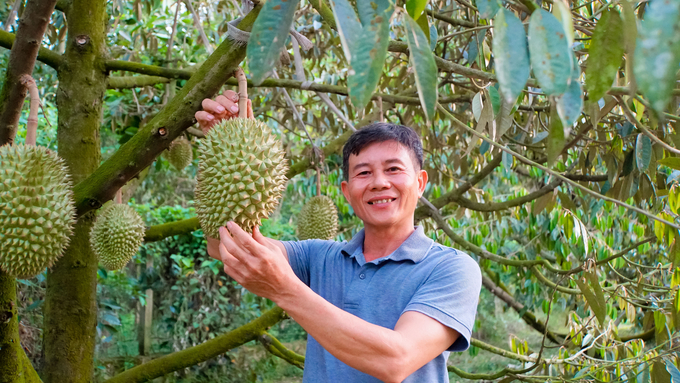
By nourishing the soil, Mr. Quoi's organic durian trees thrive in this challenging land. Photo: Le Binh.
"With traditional durian farming, pest and disease problems can be solved simply by spraying chemical pesticides. However, with organic durian farming, pest and disease control is more challenging. Over the past six years, this farming method has resulted in more fertile soil, longer-lasting green and durable trees, and higher yields," Mr. Quoi said.
Bringing durian to digital platforms.
According to Mr. Quoi, in the beginning, despite cultivating his produce organically, his farm still faced difficulties getting its products to consumers. "Necessity is the mother of invention," and during the Covid-19 pandemic, he tried selling durian on social media. Surprisingly, his farm's durian was warmly received by consumers.
Furthermore, organically grown durians are harvested gradually according to the ripeness of the fruit, rather than all at once like conventional durians. Previously, due to limited land, he mainly sold durians online through social media. In recent years, with a larger area of durian trees ready for harvest, Mr. Quoi was also the first person in Tay Ninh to participate in the Grab Connect project.
Mr. Quoi argued that with traditional distribution methods, buying and selling transactions are conducted and completed right in the orchard, leaving farmers with no opportunity to "name" their products or promote their brands. Therefore, even though the quality and flavor of the durian are different from the average, the benefits are not significant.
By leveraging the technological power of the Grab platform and the multi-channel marketing and communication capabilities of the Grab super app, Mr. Huynh Quoi's durians were even given a green label by the Grab Connect team, carefully affixed to the stem, bearing the name "Huynh Quoi - Delicious and Healthy Agricultural Products." Thus, Huynh Quoi branded durians quickly made their way to the digital market and reached consumers.
Mr. Quoi further stated that thanks to organic durian farming, the value of durian is significantly higher than that of conventional durian. He cited the example that the current price of conventional durian at the farm is around 80,000 VND/kg, while his durian sells for 100,000 - 120,000 VND/kg.
"I hope my approach will spread to many other farming households. Through this, their products will be sold on technology platforms, and these farmers will gradually participate in the digital transformation process and benefit from the digital economy ," Mr. Quoi expressed.
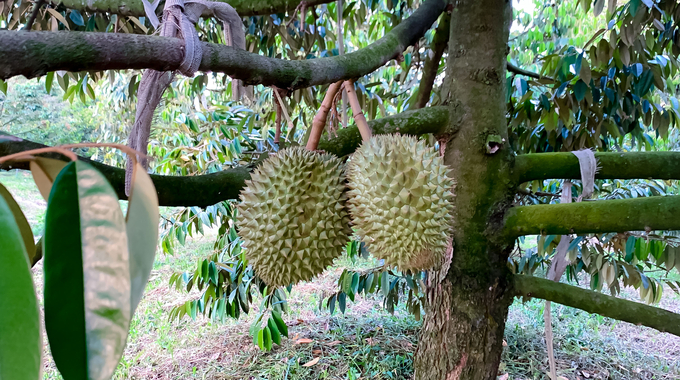
Tay Ninh province is gradually developing durian production according to organic standards. Photo: Le Binh.
According to the Department of Agriculture and Rural Development of Tay Ninh province, the area planted with durian in the province has now reached over 5,000 hectares. The area planted with durian in Tay Ninh has been expanding in recent years, but it is still not enough to meet the market demand both within and outside the province.
Mr. Nguyen Dinh Xuan, Director of the Department of Agriculture and Rural Development of Tay Ninh province, added that organic farming is the inevitable direction today. However, in reality, the path to achieving the goal of organic agricultural production—ensuring both high productivity and quality while also yielding high economic efficiency—is not easy at all.
Compared to the market demand for durian in the province, the area planted with durian in Tay Ninh is not yet large. The shift to organic production, which yields higher income, is in line with the province's agricultural development orientation. However, durian cultivation must follow the correct direction, be suitable for the soil conditions, apply scientific and technical advancements, and be closely linked to market supply chains.
"Currently, there is high demand for durian in the market, partly due to increased purchases from China, but it is impossible to predict when the durian market will become saturated. Therefore, before deciding to switch to growing durian trees, people need to consider sustainable, systematic, and cautious investment to avoid risks," advised Mr. Nguyen Dinh Xuan, Director of the Department of Agriculture and Rural Development of Tay Ninh province.
Source: https://nongsanviet.nongnghiep.vn/sau-rieng-huu-co-tren-vung-dat-kho-khach-muon-an-phai-dat-truoc-d397814.html
![[Image] Shipbuilders exposed to steel and record-breaking heat.](https://vphoto.vietnam.vn/thumb/1200x675/vietnam/resource/IMAGE/2026/06/04/1780545781745_ndo_br_img-5402-4683-jpg.webp)











![The Essence of Viet Bac Villages: [Part 3] The Precious Fragrance of Nghinh Tuong](https://vphoto.vietnam.vn/thumb/402x226/vietnam/resource/IMAGE/2026/05/29/1780020600366_5237-tinh-tuy-ban-lang-viet-bac-bai-3-chuyen-o-nghinh-tuong-050626_700.jpeg)
![The Quintessence of Northern Vietnam's Villages: [Part 2] The Famous Cassava Noodles of Kunming](https://vphoto.vietnam.vn/thumb/402x226/vietnam/resource/IMAGE/2026/05/28/1779937455892_3929-3144-mien-dong-15-nongnghiep-023138.jpeg)
![The Essence of the Village: [Part 1] Wine on the mountain, tea in the clouds - Bang Phuc](https://vphoto.vietnam.vn/thumb/402x226/vietnam/resource/IMAGE/2026/05/27/1779841729178_3821-1jpg-nongnghiep-103814.jpeg)




















![[Video] Sunset at Lap An Lagoon – Where the sun sets over the fishing nets](https://vphoto.vietnam.vn/thumb/1200x675/vietnam/resource/IMAGE/2026/05/31/1780192137701_beach-landscape-sea-water-nature-grass-745871-pxhere-com.jpeg)























Comment (0)