

Waiting for leasing mechanism, waiting for coordination procedures
In the late afternoon at the Cultural and Sports Center of Ba Ria Ward, the training atmosphere is still bustling. Badminton groups, volleyball groups, some people practice physical exercises; children and adults participate in pickleball... All create a familiar and lively community rhythm. To promote the movement, the ward regularly organizes sports tournaments such as: mini football, volleyball, badminton, pickleball... attracting a large number of people.
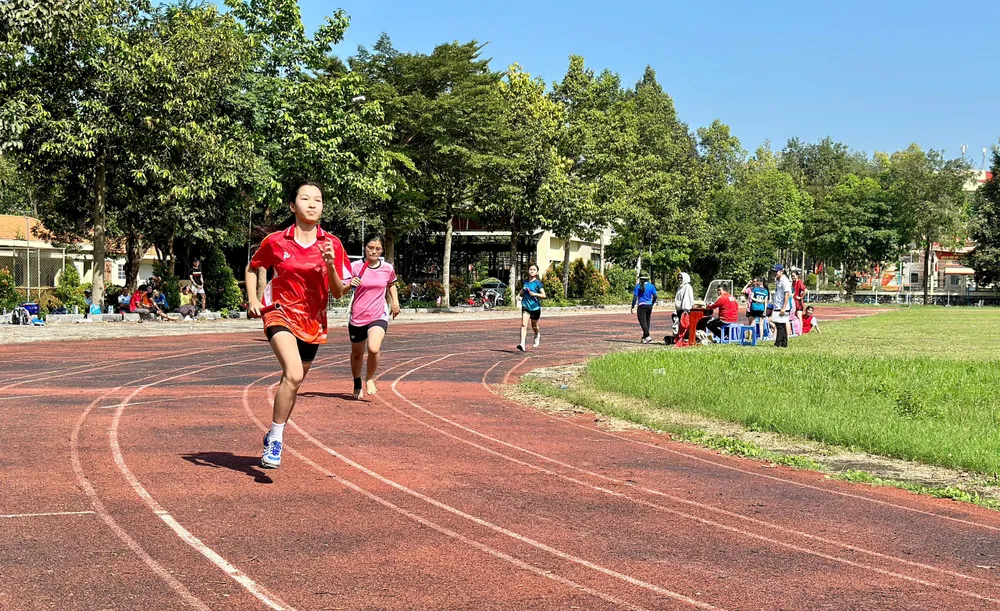
Ba Ria Ward is one of the most stable localities after the merger of Phuoc Trung, Phuoc Nguyen, Long Toan and Phuoc Hung wards. The entire Cultural and Sports Center, Multi-purpose Gymnasium and football stadium are all under the direct management of the ward. Mr. Vo Hoang Trung, Vice Chairman of the People's Committee of Ba Ria Ward, said: "The new model helps cultural and sports institutions to be closer to the people and operate more practically. Previously, many things had to be scheduled and requested from superiors, so sometimes it was delayed. Now the ward manages directly, so the organization of clubs, sports movements or cultural activities is more flexible." Although the operation is stable, the problem of coordination in the use of facilities between localities has not been resolved. Mr. Vo Hoang Trung added: "Some communes and wards in the area do not have their own centers, so when they want to borrow the grounds, they have to send documents. This process sometimes causes inconvenience for both sides."
In addition to coordination procedures, to improve the quality of cultural and sports centers in the long-term development roadmap, resources for reinvestment are needed. One of the problems is that each center needs a mechanism to generate revenue, not just relying on public resources. The Cultural - Sports - Information Center of Dat Do commune with an area of over 6.3 hectares, has a swimming pool, gymnasium, soccer field, volleyball court, pickleball court, indoor stage and outdoor gymnastics practice area. After the merger, the commune organized many badminton, pickleball, soccer tournaments... to create a healthy playground, improving the spiritual life of the people. However, despite having a large-scale infrastructure system, the center has not been able to apply the socialization or leasing mechanism to have more resources for reinvestment. Ms. Lu Thi Tuyet, Director of the Center, said: "All facilities are currently completely free for the people. Because there is no mechanism for leasing public assets, the center is open freely."
While the need for exercise and community activities of the people is increasing, the cultural and sports institutions in the East and Southeast of Ho Chi Minh City are "stuck" between the new model and the old mechanism. The movement has not slowed down, but to develop sustainably and adapt to the expanding urban scale, the centers need a clear legal framework.
Confused about the name and function
After the merger, although in the same city, the names of the cultural and sports institutions in the East and Southeast of Ho Chi Minh City have not been unified. In the former Binh Duong province, depending on the ward or commune, there are the following names: Cultural - Information and Sports Center or Cultural - Sports and Broadcasting Center or Cultural - Information and Broadcasting Center. In the former Ba Ria - Vung Tau province, the centers were rearranged with the name of Cultural - Information and Sports Center. This also reveals some limitations compared to the Cultural and Sports Service Supply Center model, because the service supply centers have more diverse functions, including performing administrative procedures and providing essential services according to local requirements and a wider scope of activities, including many different fields depending on the needs of local authorities.
According to Ms. Bui Ngoc Vi, other centers in the Binh Duong area were previously called cultural - sports and broadcasting centers, but in Lai Thieu ward, the name is cultural - information and sports center. In terms of operation, it is basically the same as other public service units under the People's Committee of other wards. However, as a unit that inherited the activities of the Thuan An City Cultural - Information - Sports Center (formerly), the broadcasting activities of the center are being deployed inter-ward, to support and meet the general propaganda tasks of the wards in the area.
The Ngai Giao Commune Cultural - Sports - Information Center has been invested synchronously with a mini soccer field, tennis court, volleyball court and indoor stage. The commune also manages the Binh Ba Stadium of more than 8,100m2 , considered one of the most beautiful natural grass fields in the area, suitable for organizing mass tournaments and suitable sports events. However, Ms. Le Thi Ngoc Lam, Vice Chairman of the People's Committee of Ngai Giao Commune, informed: The cultural and sports institutions currently retain their old names. Ho Chi Minh City is planning to change the name to "Center for Cultural and Sports Services of Wards and Communes" to unify the name throughout the city.
In the former Binh Duong province, there were 9 communes and wards that established cultural - sports and broadcasting centers. Lai Thieu ward was the center of Thuan An city in the past, with many activity centers, specifically the youth activity center, political center, cultural - information and sports center. Currently, Lai Thieu ward still has a political center under the ward Party Committee, cultural - information and sports center managed by the ward People's Committee, while the youth activity center has ceased operation.
According to the project of Lai Thieu Ward People's Committee, the Youth Activity Center was merged into the Ward Culture - Information and Sports Center. However, due to the urgent need to serve educational activities, the Ward People's Committee temporarily handed over the headquarters of the Youth Activity Center to a local secondary school for management and use. In addition to the confusion about the name, Lai Thieu Ward Culture - Information and Sports Center also encountered difficulties in determining the direct management level for some areas such as grassroots information work, specifically radio and broadcasting activities. At the same time, the policy of paying royalties to reporters of the radio department has not been guided, so up to now the center has not had a solution.
Ms. Bui Ngoc Vi, Director of Lai Thieu Ward Culture - Information and Sports Center, further analyzed: "The division of authority and responsibility is sometimes still confused between the state management function and the public service unit. There is no specific guidance document system for the new Culture - Sports - Information Center model, specifically there are no new regulations on the functions, tasks, powers as well as the scope of activities for the ward-level Culture - Information - Sports Center, leading to confusion for the locality."
Once the two-level local government model has taken shape, the legal framework for grassroots cultural and sports institutions needs to be issued promptly and synchronously, before small differences become major barriers. Because only when the name is unified, functions are clear, powers are transparent and financial and socialization mechanisms are fully regulated, can the centers operate in their proper roles: serving the people, leading the movement and creating the foundation for cultural and sports life in the expanded urban area.
Source: https://www.sggp.org.vn/tai-cau-truc-thiet-che-van-hoa-the-thao-co-so-bai-2-thiet-che-on-dinh-co-che-con-khuet-post826318.html


![[Photo] Prime Minister Pham Minh Chinh receives President of Cuba's Latin American News Agency](/_next/image?url=https%3A%2F%2Fvphoto.vietnam.vn%2Fthumb%2F1200x675%2Fvietnam%2Fresource%2FIMAGE%2F2025%2F12%2F01%2F1764569497815_dsc-2890-jpg.webp&w=3840&q=75)






















































Comment (0)