

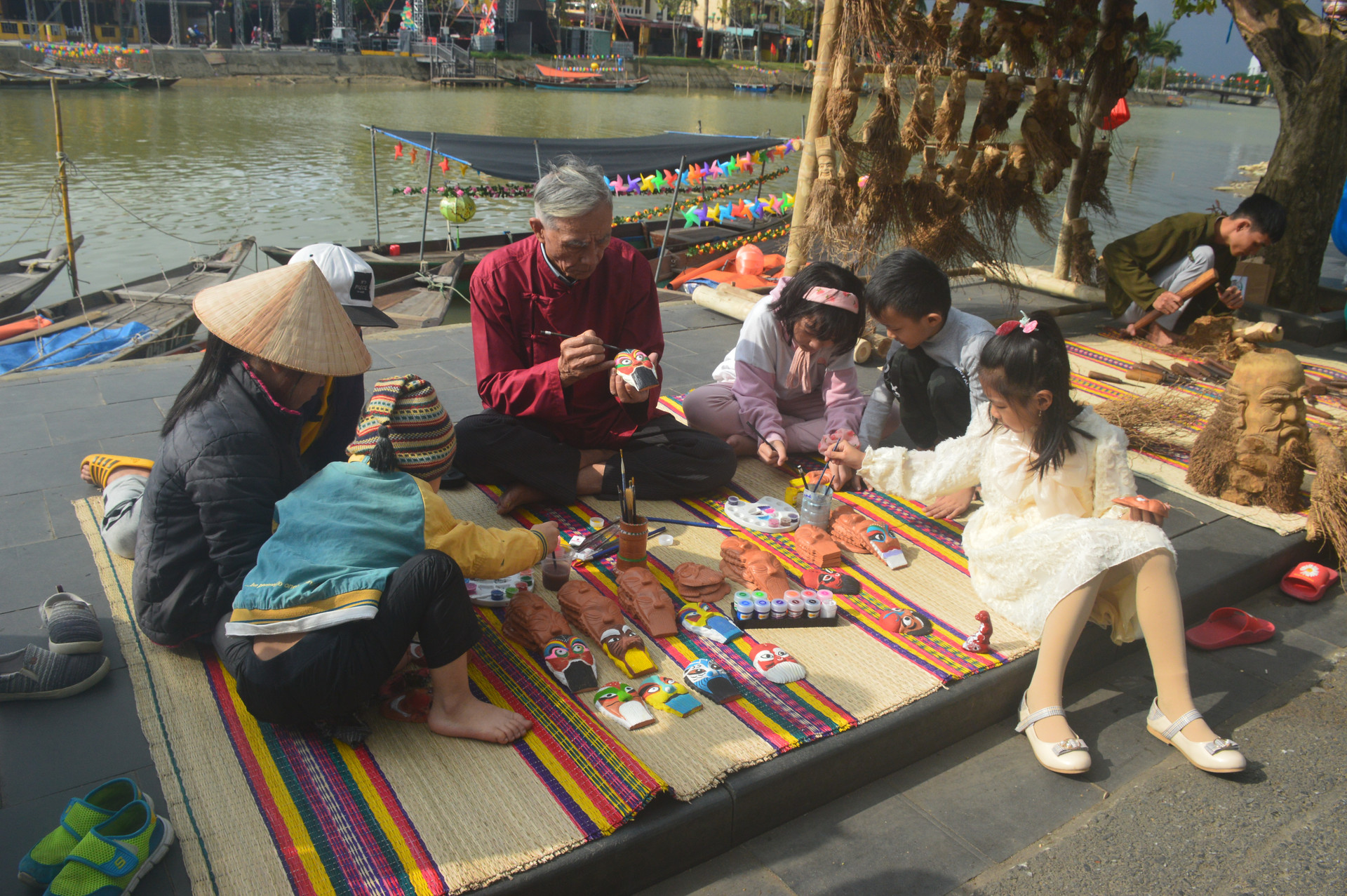
Each product from the traditional craft village embodies the essence of the local homeland.
Evoking memories and weaving together the interconnected stories of the craft village network is a way for tourists to experience Quang Nam's cultural tourism while simultaneously enhancing the value of craft village tourism.
Touching the land's past
Starting from Kim Bong carpentry village, a circular route through the craft villages in the "oasis" of Cam Kim will surely attract many tourists.
Starting from the traditional boat-building space of Kim Bong - the once glorious "capital" of boat building in Quang Nam province.
The journey continues with experiences in various crafts, from basket weaving to mat weaving, and concludes with noodle making.
At each stop, visitors gain a deeper understanding of the lives of the residents decades, even centuries ago, as well as the stories of adaptation and reliance on nature for generations in this "flood-prone" area.
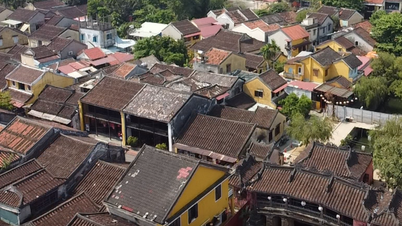
Extending to the wards of Hoi An Dong, Hoi An Tay, and the island commune of Tan Hiep, most of the more than 50 traditional craft villages in this area are linked to the formation of the ancient town of Hoi An, and therefore carry many fascinating stories.
Sitting down to polish pottery, trying to weave a paulownia hammock, or carving bamboo and coconut leaf paintings, memories of an entire trading port region at the confluence of rivers and seas emerge, becoming an unforgettable impression for tourists on their trip.
In many destinations, from the mountains to the sea, traditional crafts, through various approaches, are gradually becoming a cornerstone for attracting cultural tourism.
From the Co Tu women diligently weaving brocade (Ben Giang commune) to the drops of fish sauce that have persistently dripped down for centuries in the coastal villages of Nam O (Hai Van ward) and Cua Khe (Thang An commune), these traditions have touched the emotions of tourists, giving these craft villages a stronger reason to exist.
In addition, there are still many traditional craft villages that preserve the ups and downs of life in the region, especially those along the Thu Bon River such as Ban Thach mat weaving, Ma Chau silk weaving, and Nong Son agarwood production… if integrated into tourism, they would convey many fascinating historical stories to visitors.
According to Mr. Phan Xuan Thanh, Permanent Vice Chairman of the Da Nang Tourism Association, craft villages are where the traditional cultural values of the region are embodied.
Traditional craft villages often clearly reflect the nature-dependent lifestyle of our ancestors. If approached correctly with a focus on greening the destination, these villages are valuable materials for building high-end tourism products that are highly favored by high-quality tourists.
We need more vitality for handicraft village tourism.
Most craft villages in the city are more or less oriented towards linking with the tourism market to create added value and open up more opportunities to maintain the vitality of the craft villages.
.jpeg)
However, in reality, only a few craft villages near the city center or on the outskirts of the ancient town of Hoi An can attract a consistent number of visitors to sustain cultural tourism activities at the destination.
Mr. Le Hoang Ha, Director of Hoi An Unique Tourism Services Co., Ltd., commented: “First and foremost, the products of traditional craft villages must be self-sustaining in the commercial market. Cultural tourism associated with craft villages should only be considered a supplementary factor, helping to improve livelihoods and enhance the value of the destination so that craft village activities can be sustainably maintained.”
According to the general assessment of travel businesses, most handicraft village tourism products in Da Nang are still quite monotonous, lacking in-depth experiences, and mainly limited to sightseeing and souvenir sales.
Conversely, those involved in traditional craft villages believe there is still a certain gap between them and the network of travel agencies, making it difficult to create product systems and experiential chains that meet customer needs.
Besides the lack of unique and engaging stories about traditional crafts, promoting cultural tourism linked to these craft villages perhaps requires more spaces showcasing their cultural identity, leading visitors closer to the craft communities.
For example, at the Au Lac cultural space (Go Noi commune), going beyond simply experiencing traditional crafts, impressive stories about the landscape are conveyed through works such as "The Sacred Soul of the Mountains and Rivers," "Thu River and Ngoc Mountain," and "God of Agriculture," captivating visitors and encouraging them to stay and learn about the local wood carving art.
For over a year now, this has been an indispensable destination in the Da Nang experience for passengers on the luxury S-Journey train when it stops at Tra Kieu station.
According to Mr. Bui Van Tieng, Chairman of the Da Nang City Historical Science Association, cultural tourism is one of the pillars in the development of the cultural industry.
This is an area where Da Nang has a strong advantage, therefore it is necessary to quickly develop more levers linked to the essence of traditional craft villages, such as the Ngu Hanh Son Historical and Cultural Park and the Thanh Chiem Cultural Park.
When these spaces are developed, attention should be paid to connecting them to existing destination routes and developing new axes by stringing together historical narratives; this will certainly make them attractive and capable of sustainable tourism development.
Source: https://baodanang.vn/tham-thau-van-hoa-tu-du-lich-lang-nghe-3323496.html
![[Photo] General Secretary and President To Lam presides over a working session with the Central Policy and Strategy Committee on the development of the materials industry.](https://vphoto.vietnam.vn/thumb/1200x675/vietnam/resource/IMAGE/2026/05/21/1779359935432_a3-bnd-3129-1412-jpg.webp)

![[Photo] National Assembly Chairman Tran Thanh Man working with the Standing Committee of the Law and Justice Committee](https://vphoto.vietnam.vn/thumb/1200x675/vietnam/resource/IMAGE/2026/05/21/1779378929214_ndo_br_1-4610-jpg.webp)




















































































Comment (0)