

On the morning of February 27th, concluding the Government's Standing Committee meeting with state-owned enterprises on tasks and solutions contributing to double-digit economic growth and rapid and sustainable national development, Prime Minister Pham Minh Chinh requested state-owned enterprises to implement six pioneering initiatives to accelerate, break through, and reach the finish line together with the whole country.

Also attending were Deputy Prime Ministers Bui Thanh Son, Ho Duc Phoc, and Mai Van Chinh; leaders of ministries, central agencies; leaders of key economic development provinces and cities; and leaders of state-owned corporations, general companies, and enterprises.
According to the Ministry of Finance, in 2023, the country had 671 state-owned enterprises, including 473 enterprises where the State held 100% of the charter capital and 198 enterprises where the State held more than 50% of the charter capital. The total assets of state-owned enterprises were nearly 3.9 trillion VND; total revenue was over 2.6 trillion VND, with pre-tax profit of 211 trillion VND and contributions to the state budget exceeding 365 trillion VND. State-owned enterprises play a key and dominant role in several sectors such as energy security, food, telecommunications, petroleum, and finance.
In recent times, businesses have actively restructured and improved their production and business efficiency. The Standing Committee of the Government has worked with state-owned enterprises to listen, exchange ideas, discuss, and propose solutions to maximize resources, renew growth drivers, and promote new growth drivers, contributing to accelerating and breaking through the economy in 2025, towards the country's sustainable development goals.
At the conference, while expressing support and determination to work together with the whole country to achieve the 8% growth target in 2025 and double-digit growth in the following years, business leaders acknowledged that this goal is a major challenge.
Representatives of businesses stated that, in recent times, the Party and State have implemented many mechanisms and policies; the Government has decisively directed efforts to remove bottlenecks and obstacles to facilitate business development. However, there is still a time lag between policy and practice.
Delegates proposed the urgent implementation of new policies and guidelines; the need for flexibility in macroeconomic management; strong and clear decentralization in the management of state capital invested in enterprises; separation and demarcation of state management functions from the functions of capital owners and enterprises; granting more power to state-owned enterprises; increasing the proactive role of enterprises in decisions on the use of investment capital and the procurement of assets to serve their production and business activities; reducing direct intervention by the representative agency of the owner; enhancing autonomy, accountability, and limiting losses, waste, embezzlement, and corruption; and implementing policies to socialize and attract investment capital, especially large-scale projects…
After leaders of ministries and agencies delivered speeches and answered questions from businesses, concluding the conference, Prime Minister Pham Minh Chinh requested the Government Office to compile the opinions of businesses and submit them to the Prime Minister for assignment of tasks to ministries and agencies in accordance with the "five clear" principles: "clear person, clear task, clear time, clear responsibility, clear results" to remove obstacles and create favorable conditions for businesses to develop and contribute to the rapid and sustainable development of the country.
While acknowledging that state-owned enterprises have made significant contributions to macroeconomic stability, promoting growth, ensuring major economic balances, and contributing substantial revenue to the national budget, the Prime Minister noted that these achievements are still primarily concentrated in a few large enterprises. He observed that the majority of remaining enterprises have not been as efficient in their production and business operations as desired, and have not significantly contributed to the country's economic growth.
Wishing for the development of state-owned enterprises, contributing even more strongly to promoting rapid, strong, and sustainable economic growth, and propelling the country forward in the coming years to achieve the two centenary goals: by 2030, Vietnam will be a developing country with modern industry and high middle income, and by 2045, it will become a developed country with high income. The Prime Minister believes that it is necessary to change mindsets and approaches; to closely adhere to and respect reality, using reality as a benchmark; to mobilize the strength of the people; to review, supplement, and perfect institutions and laws towards a more open, market-oriented, socialist-oriented economic system as a lever and support for mobilizing resources for national development; to diversify markets, products, and supply chains, and to participate deeply in global supply chains; and to proactively apply new science and technology to increase labor productivity and reduce resource use. Reforming governance towards a smart approach…, with the motto "institutions must be transparent, governance must be smart, and infrastructure must be seamless."
Stating that the State plays a crucial role in creating, designing, and implementing macroeconomic policies to ensure political stability, social order and security, macroeconomic stability, policy stability, and development according to practical realities; and at the same time, designing tools to mobilize maximum social resources for development, using public investment to lead private investment, especially promoting public-private partnerships in all fields…, the Prime Minister requested that state agencies listen, absorb, and be open-minded in order to resolve the practical problems and difficulties faced by businesses; tasks falling under the authority of a particular sector or level must be resolved by that sector or level.
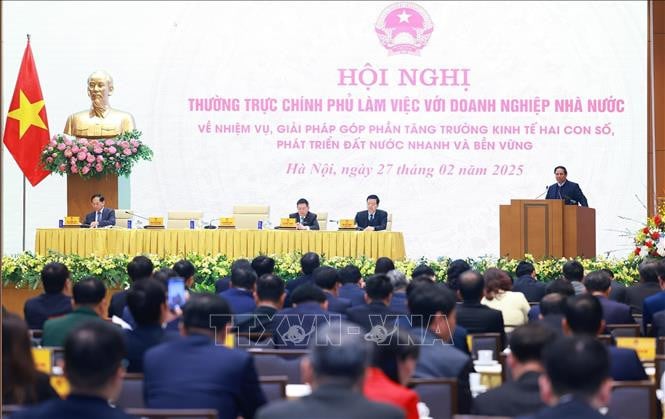
The Prime Minister requested that businesses, especially state-owned enterprises, implement six pioneering initiatives: Pioneering in innovation, digital transformation, and the development and application of science and technology; pioneering in making more positive and effective contributions to the three strategic breakthroughs in institutions, infrastructure, and human resources; pioneering in accelerating and achieving breakthroughs in effective development, making practical contributions to the inclusive, comprehensive, and sustainable growth and development of the country; pioneering in developing the digital economy, green economy, circular economy, sharing economy, knowledge economy, and creative economy; pioneering in participating in ensuring social security, especially in eliminating temporary and dilapidated housing and building social housing for workers; pioneering in creating high value-added goods, participating in global value chains, supply chains, and production chains, expanding regionally and internationally to contribute to enhancing national competitiveness and brand.
Prime Minister Pham Minh Chinh requested that businesses develop plans and scenarios, set growth targets to contribute to the country; and propose mechanisms and policies for the Government, ministries, and localities to consider, supplement, amend, and resolve based on their functions, duties, and powers. “Proposals and recommendations from businesses that fall under the authority, functions, duties, and powers of a particular ministry or level should be handled by that ministry or level; if they cannot be handled, they should report to the Prime Minister,” the Prime Minister noted.
Directing the continued improvement of government mechanisms and policies such as Resolution 58, Resolution 01, and Resolution 158 of the National Assembly, especially the amendment of Law 69/2014/QH14 on the management and use of state capital invested in production and business at enterprises, the Prime Minister requested the continued implementation of Resolution 18-NQ/TW on streamlining the organizational structure, improving the effectiveness and efficiency of state management; reducing costs to increase labor productivity and lower production costs.
Regarding the proposals from businesses, the Prime Minister assigned Deputy Prime Minister Ho Duc Phoc to handle them, emphasizing a receptive and open-minded approach to making amendments. This includes considering overall effectiveness, accepting risks while ensuring the stability and growth of businesses; fostering the intelligence, dynamism, and creativity of each entity, business, and individual; creating space for businesses to innovate and be held accountable under the law for their decisions; and ensuring a harmonious balance of interests between the State, the people, and businesses.
The Prime Minister hopes that businesses will uphold the spirit of patriotism, have aspirations, look far ahead, think deeply, act on a grand scale, grasp the realities on the ground, respond flexibly to the situation, and together with the whole country accelerate, break through, and reach the finish line, leading the country to rapid and sustainable development.
Source



![[Photo] Two flights successfully landed and took off at Long Thanh Airport.](/_next/image?url=https%3A%2F%2Fvphoto.vietnam.vn%2Fthumb%2F1200x675%2Fvietnam%2Fresource%2FIMAGE%2F2025%2F12%2F15%2F1765808718882_ndo_br_img-8897-resize-5807-jpg.webp&w=3840&q=75)


































































Comment (0)