

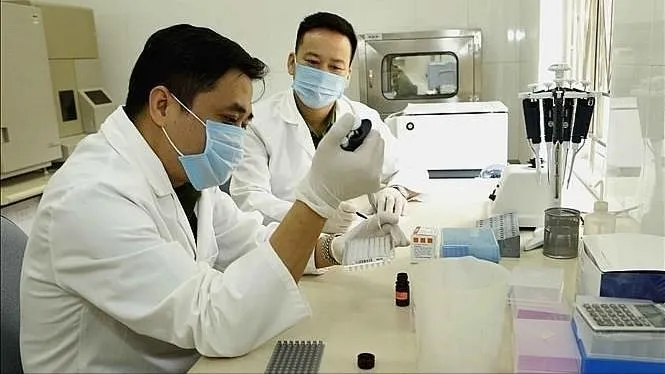
The draft submission from the Government regarding the draft Law on Judicial Expertise (amended), proposing important changes and additions to the current law (Law on Judicial Expertise of 2012), has just been sent to the Ministry of Justice for review.
One of the most important new points in this draft is the expansion of the scope of socialization in forensic examination activities.
While the 2012 Law on Judicial Expertise only permitted the establishment of judicial expertise offices (non-governmental organizations) in three fields: forensic medicine, forensic psychiatry, and property valuation, the draft law proposes expanding the establishment of judicial expertise offices to many other specialized fields with high and specific needs, such as DNA, digital and electronic technology, documents, physical evidence data, cultural and historical artifacts, etc., in order to better meet the diverse expertise needs of society. Judicial expertise offices will be established as private enterprises or partnerships in accordance with the Law on Enterprises.
In addition, the draft includes provisions on professional experience. Judicial experts must have at least 5 years of professional experience in their field of study after graduating from university. For judicial experts working on a case-by-case basis, the experience requirement is at least 3 years.
The rights and obligations of forensic experts on a case-by-case basis have also been supplemented; accordingly, provisions have been added regarding the exemption from legal liability for forensic experts and forensic expert organizations in cases where the expert's conclusion is inaccurate due to objective errors and not due to their fault (except in cases of intentional wrongdoing).
The new regulations are expected to be a step forward in administrative procedure reform, simplifying the expert assessment process. Accordingly, procedures for appointing, dismissing, and terminating the employment of judicial experts; establishing and dissolving judicial expert assessment organizations or offices will be simplified.
The time frame for conducting forensic examinations is specifically regulated for each type of case (maximum 2 months for simple cases, 3 months for complex cases or those involving multiple fields)...

Source: https://www.sggp.org.vn/to-chuc-ngoai-cong-lap-du-kien-duoc-cap-phep-giam-dinh-adn-post807376.html





















































![[Video] Sunset at Lap An Lagoon – Where the sun sets over the fishing nets](https://vphoto.vietnam.vn/thumb/1200x675/vietnam/resource/IMAGE/2026/05/31/1780192137701_beach-landscape-sea-water-nature-grass-745871-pxhere-com.jpeg)







































Comment (0)