

A worthy successor to Ho Chi Minh's ideology.
After the 1954 Geneva Agreement, Comrade Le Duan voluntarily remained in the South to lead the revolutionary movement under extremely difficult and harsh conditions. In the U Minh forest in 1954, he drafted the "Outline of the Southern Revolution," an important strategic document that laid the foundation for the resistance war against the US, paving the way for the issuance of Resolution 15 of the Central Committee of the Party (1959) - a historic decision allowing the combination of political struggle with revolutionary violence.
Comrade Le Duan delivered the Political Report at the Third National Congress of the Vietnam Workers' Party, held in Hanoi from September 5 to 10, 1960. (Photo: VNA archives) |
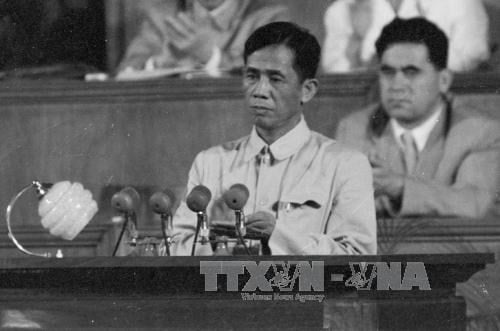
From the Third Party Congress (1960), in his capacity as First Secretary, Comrade Le Duan directly led and directed the entire resistance war against the US to save the nation. According to VNA, he, along with the Central Committee and the Politburo, successfully resolved theoretical and practical revolutionary issues in the context of complex international developments.
At the Third Congress, the political report presented by Le Duan affirmed the independent and self-reliant path of the Vietnamese revolution. In the historical context at that time, choosing a correct and appropriate policy for the revolution was not easy.
Vietnam was not the only divided country. During the same period, there were also East and West Germany, and North and South Korea. In the temporary truce between the two "factions," people often spoke of "peaceful competition" or "protracted staking," but rarely of armed struggle, national liberation, or the reunification of the two regions. Comrade Le Duan also affirmed that the path forward for the revolution in the South was the path of Vietnam. It was the revolutionary path of the Vietnamese people, pursued by the Vietnamese people for their just goals.
Shaping the "People's War" strategy
From 1960, in his capacity as First Secretary of the Central Committee of the Party, Comrade Le Duan was primarily responsible to the Politburo and the Central Committee for the revolutionary movement in the South, directly preparing and drafting documents to concretize and gradually refine the revolutionary line, and determining the strategy for liberating the South and unifying the country. One of his most outstanding contributions was shaping and persistently implementing the "people's war" strategy - a protracted, all-encompassing, and nationwide war.
General Secretary Le Duan welcomes the delegation of the Cuban Party and Government led by President Fidel Castro on their visit to Vietnam, September 12, 1973. (Photo: VNA archives) |
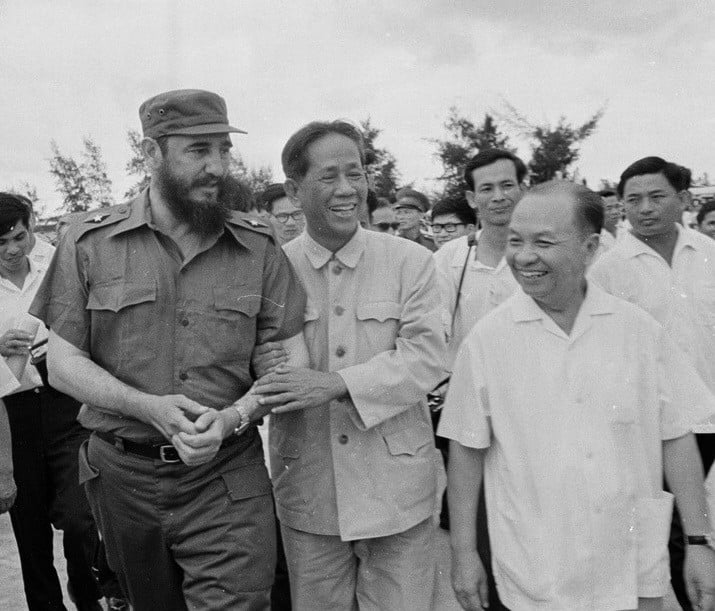
In his book *Vietnam's American War: A History*, historian Pierre Asselin writes: "Among the key figures in Hanoi, Le Duan was the most vocal promoter of the war, advocating the use of armed struggle as the primary means of unifying the country. His influence on strategic planning in the war against the United States was unparalleled."
The "people's war" strategy was concretized by building a three-tiered armed force (main force, local forces, and militia/guerrilla forces), expanding the revolutionary grassroots movement in urban, rural, and mountainous areas, and combining political and military struggle.
The General Offensive and Uprising: Creating a Historical Turning Point
Right from the 11th Central Committee Conference (March 1965), the resolution of the Party Central Committee clearly stated: it is necessary to resolutely defeat the war of aggression waged by the US imperialists, without illusions about the possibility of peace, and without waiting for the goodwill of the US imperialists.
On April 24, 1980, General Secretary Le Duan visited the 202nd Tank Brigade, the unit that captured the Saigon puppet regime's General Staff Headquarters on April 30, 1975. (Photo: VNA archives) |
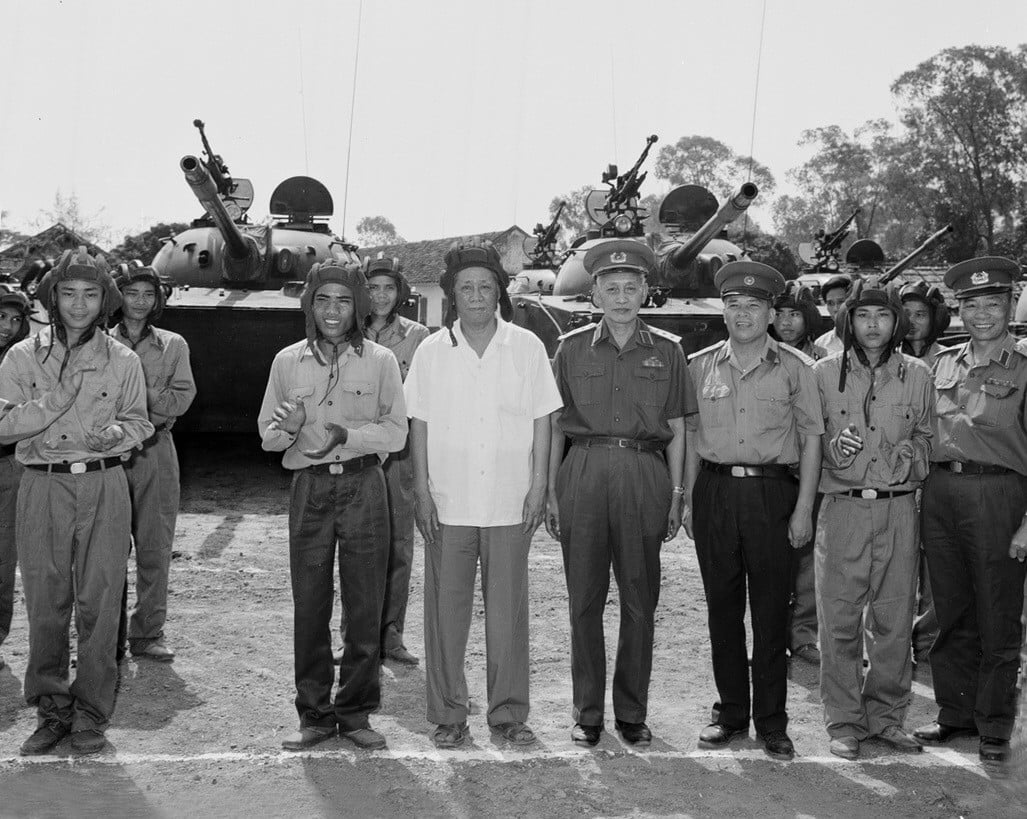
That strategic direction was concretized by the Tet Offensive of 1968. In his book "Vietnam's American War: A History," historian Pierre Asselin analyzes that, although the Tet Offensive did not achieve its immediate military objectives, it caused a profound psychological shock to the American public, fundamentally changing America's perception of the war.
According to later historical analyses, the Tet Offensive of 1968 is considered a crucial "psychological turning point," shaking the political will of the United States toward the Vietnam War.
Following his visit to Vietnam, journalist Walter Cronkite stated on CBS News (February 1968) that the war would "end in a stalemate" and called for honorable negotiations. This statement contributed to a profound decline in American public confidence in the possibility of winning the war.
This consistent strategic policy continued to develop to its climax in the Spring 1975 General Offensive and Uprising, leading to complete victory, the liberation of the South, and the reunification of the country.
A historical significance recognized internationally.
The historical role of General Secretary Le Duan has been widely recognized by international friends.
In the article "The Man Who Won Vietnam's War" published in Foreign Policy magazine on April 30, 2021, researcher Mark Atwood Lawrence assessed: "Le Duan, more than any other Vietnamese leader, was the true architect of the victory of the Vietnamese revolution, even though he remains little known outside of Vietnam."
The New York Times, in an article dated July 11, 1986, also commented: "Le (Le Duan) is considered the chief architect of Hanoi's war strategy against the United States."
General Secretary Le Duan (right) visits the German Democratic Republic (October 15, 1975). Photo: VNA archives. |
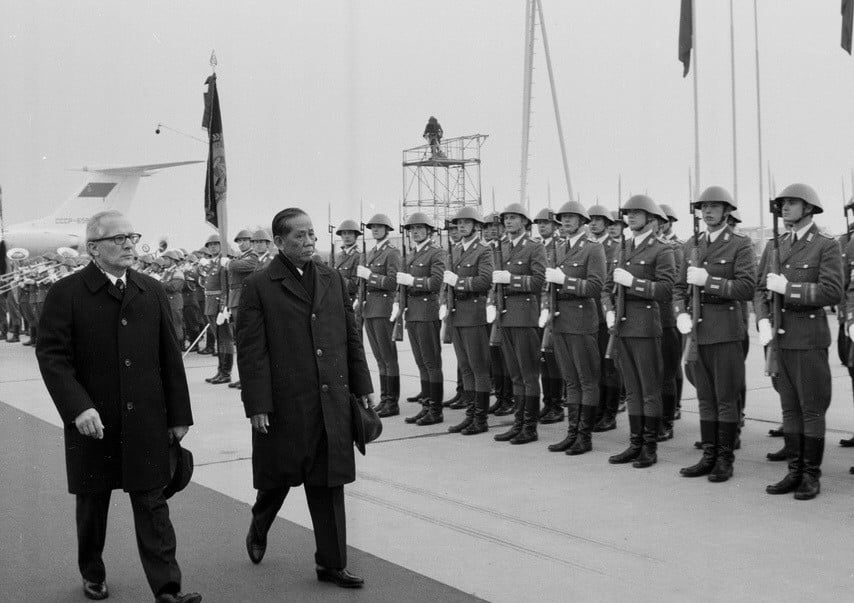
When General Secretary Le Duan passed away in July 1986, leaders of many countries sent condolences to Vietnam. In his condolence message, General Secretary of the Communist Party of the Soviet Union Mikhail Gorbachev affirmed: Comrade Le Duan was a staunch fighter, an outstanding leader, who dedicated his entire life to the Vietnamese revolutionary cause and the international communist movement.
From Havana, Cuban State Council President Fidel Castro praised General Secretary Le Duan as a great friend of the Cuban people, who dedicated his entire life to the cause of Vietnam's national liberation and the world revolutionary cause.
The Guardian (UK) also noted: "Le Duan was the chief strategist of Vietnam's military campaigns in the war with the US, always maintaining a hardline stance."
These assessments affirm the historical stature of General Secretary Le Duan: a steadfast and creative strategic leader who made a tremendous contribution to the great victory of the Vietnamese revolution in the struggle for independence and national reunification.
Having overcome the challenges of history, General Secretary Le Duan left a profound mark on the struggle for national independence and reunification. His practical strategic thinking, unwavering spirit, and decisiveness are valuable lessons that continue to be relevant in the building and development of the country today.
Source: https://thoidai.com.vn/tong-bi-thu-le-duan-kien-truc-su-vi-dai-cua-cong-cuoc-thong-nhat-dat-nuoc-213094.html
![[Photo] Prime Minister Pham Minh Chinh receives the Governor of Tochigi Province (Japan)](/_next/image?url=https%3A%2F%2Fvphoto.vietnam.vn%2Fthumb%2F1200x675%2Fvietnam%2Fresource%2FIMAGE%2F2025%2F12%2F16%2F1765892133176_dsc-8082-6425-jpg.webp&w=3840&q=75)
![[Live] 2025 Community Action Awards Gala](/_next/image?url=https%3A%2F%2Fvphoto.vietnam.vn%2Fthumb%2F1200x675%2Fvietnam%2Fresource%2FIMAGE%2F2025%2F12%2F16%2F1765899631650_ndo_tr_z7334013144784-9f9fe10a6d63584c85aff40f2957c250-jpg.webp&w=3840&q=75)
![[Image] Leaked images ahead of the 2025 Community Action Awards gala.](/_next/image?url=https%3A%2F%2Fvphoto.vietnam.vn%2Fthumb%2F1200x675%2Fvietnam%2Fresource%2FIMAGE%2F2025%2F12%2F16%2F1765882828720_ndo_br_thiet-ke-chua-co-ten-45-png.webp&w=3840&q=75)


![[Photo] Prime Minister Pham Minh Chinh receives Lao Minister of Education and Sports Thongsalith Mangnormek](/_next/image?url=https%3A%2F%2Fvphoto.vietnam.vn%2Fthumb%2F1200x675%2Fvietnam%2Fresource%2FIMAGE%2F2025%2F12%2F16%2F1765876834721_dsc-7519-jpg.webp&w=3840&q=75)





















































Comment (0)