

It is unknown when the sound of the royal court drums first appeared in Hoang Phu (Hoang Hoa), but today, in all major and minor events of the village and commune, in cultural and artistic activities, the sound of drums played by folk artisans, those who have dedicated their lives to preserving and promoting the beauty of traditional culture, always resonates.
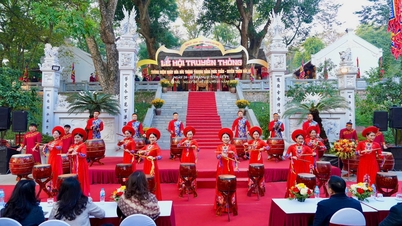
 The Hoang Phu Royal Drum Club performs at the village festival. Photo: Van Anh.
Phu Khe village belongs to the two communes of Hoang Phu and Hoang Quy (Hoang Hoa district). The Phu Khe village communal house was recognized as a national historical, cultural, architectural, and artistic relic in 1992. Here, every year in the second lunar month, the Ky Phuc Festival takes place, the largest festival of the village, which has been maintained for hundreds of years. The Phu Khe village festival is famous for its traditional court drumming art. The drumming, passed down from hundreds of years ago, resonated during the Grand Celebration of the 1000th Anniversary of Thang Long - Hanoi and continues to echo today, present in all important cultural activities and events of the district and commune.
To preserve and develop the art of traditional court drumming, in 2004, Hoang Phu commune established the Hoang Phu Court Drumming Club. From an initial 19 members, the club has now grown to 40 people with 20 years of experience. A unique and encouraging sign is that the Hoang Phu Court Drumming Club brings together both young and old members, a rare occurrence among traditional art clubs. This demonstrates that traditional art always holds a strong appeal for everyone, regardless of age, as long as it is nurtured with love and led by passionate and responsible individuals.
One of the pioneers who spared no effort, money, or even life in restoring and preserving the art of royal drum performances is Meritorious Artisan Le Minh Triet, the club's chairman, a first-generation member, and a key contributor to its establishment. Born into a family with no artistic background, Mr. Triet admitted he lacked natural talent for traditional arts. However, from a young age, he loved attending village festivals. While his peers were captivated by the vibrant and dazzling performances, Mr. Triet focused his attention on the drum performances. He felt the dynamism of the festival began with the stirring sound of the drums. He knew that "the drums are like the soul guiding the festival," and from then on, he independently researched and learned to play the drums. He particularly enjoyed the art of royal drum performances, an art form that had existed in the village for a long time, and whose sound was the most familiar to the villagers. By adulthood, Mr. Triet possessed a wealth of knowledge about court drumming, and was proficient in playing various types of drums and knew how to perform all drum pieces.
Before 2004, traditional art forms, including the traditional court drumming, had no place to be performed in the village, and no one was still practicing the craft. Seeing this sad reality, Mr. Triet sought out families who still knew the craft and cherished the traditional drumming to encourage them to establish a club. Initially, when the club lacked funding and confidence, Mr. Triet dedicated much effort, passion, and money to maintaining it. After 20 years of preserving and developing the art form, he can now proudly say: "In this land, every spring, everyone eagerly awaits the Ky Phuc festival in January. It's not only an occasion to remember and honor those who pioneered this place, a time for people in the region to gather, enjoy the spring, and have fun with the hope of a peaceful and prosperous year, but also an opportunity for the village to listen to the traditional court drumming and watch the artisans perform." Confirming his words, he told us: "One day, just follow the procession and the rhythmic drumming, and you'll be overwhelmed by the festive atmosphere. Normally, this place is quiet; most villagers work far away, only returning for Tet (Lunar New Year) and festivals. But as soon as the festival drums sound, everyone gathers, and the essence of this land awakens and shines brightly."
Mr. Triet's dedication has attracted many young people to learn drumming and become members of the club. Le Van Huan, one of the young artisans, is only 32 years old but already plays the large drum skillfully and is proficient in many court drumming pieces. He said: “To play court drumming well, you have to practice diligently. Court drumming has many sets and pieces, each with its own meaning and playing style. Besides that, the performance style requires skillful and harmonious movements.”
A drum performance at a village communal house usually involves 25 participants, while at larger festivals with spacious performance areas, the number can reach 35-40. Traditional attire includes men wearing red ceremonial clothing and women wearing four-panel dresses and headscarves. The court drums used in village communal house ceremonies consist of 11 pieces such as: procession drums, welcoming drums, peace drums, stirring drums, drumming with drumsticks, bowing drums, re-concern drums, and three-concern drums... During the performance, the artists not only play the drums but also incorporate many beautiful movements such as drumstick dancing, turning, and changing drumming positions, making the court drum performance not only musical but also a captivating dance that attracts viewers. The drum piece most often performed by the artists of the club is the 18-beat procession drum. The drum performance utilizes a variety of drums such as bong drums, ban drums, and large drums...
The sound of the traditional drums of Hoang Phu commune has now spread far and wide to many other localities in the province. Many places have established village drum clubs and invited the distinguished artisan Le Minh Triet to teach. Speaking about this joy, Mr. Triet said: "Now, I wish for nothing more than for more people to learn, for young people to know and learn traditional art forms, because they are the essence of our nation's culture. And we are always ready to contribute and teach."
Van Anh
Source





























































Comment (0)