

Hanoi – Since the summer of 2023, Thao's family's living expenses have suddenly increased by 30% due to rising rent, electricity, and water costs, along with the start of school for her two children.
Previously, they rented a room in Me Tri Ha, Nam Tu Liem district for 3 million VND per month, with water costing 30,000 VND per cubic meter and electricity 4,000 VND per kilowatt-hour. Each month, the family spent approximately four million VND on rent, electricity, and water.
Following the price adjustment, rent increased to 3.5 million VND, water to 35,000 VND/cubic meter, and electricity to 4,500 VND/kWh. Food costs also increased by about 15% compared to before, mainly due to rising grocery and gas prices.
"The pressure is even greater now that our eldest daughter is starting first grade and our son is old enough to go to kindergarten," said Nguyen Thi Thao, 35. They want to send their children to public schools to save money, but without a household registration, they're spending a considerable amount more. The total tuition fees for both children have now increased by three million dong compared to before.
"Previously, with a total income of around 18 million VND per month, my family had just enough to cover our expenses, but since everything has increased in price, we're always short of money each month," Thao said.
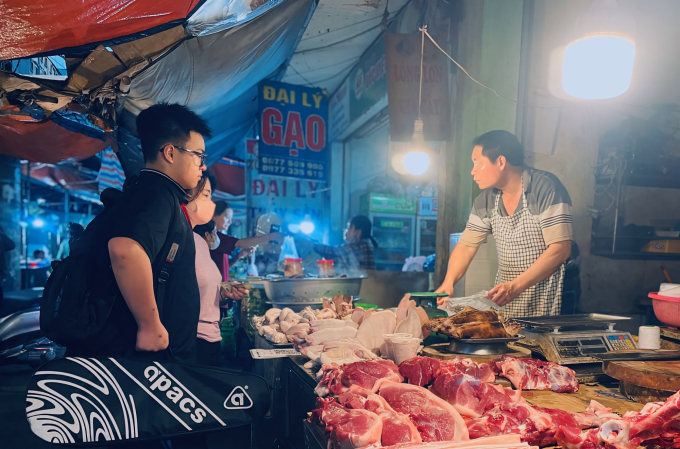
People buy food at a local market in Co Nhue, Bac Tu Liem, Hanoi on the afternoon of April 6. Photo: Phan Duong
Ms. Thao's story further reinforces the findings of the recently published Spatial Cost of Living Index (SCOLI) report by the General Statistics Office, which shows that Hanoi has the highest cost of living in Vietnam.
Data from the Hanoi Statistics Department also shows that the average consumer price index (CPI) for the first two months of this year increased by 5% compared to the average of the same period last year. Eight out of eleven commodity groups saw average CPI increases, including education ( up 38.33%); housing, electricity, water, fuel and construction materials (up 5.24%); food and catering services (up 2.92%); and other goods and services (up 7.38%).
According to Associate Professor Dr. Ngo Tri Long, former Director of the Institute for Market and Price Research ( Ministry of Finance ), even compared to international standards, Hanoi is considered a city with a high cost of living. "For the past two years, real estate prices have skyrocketed, causing increases in everything from buying a house to renting a home or shop, and prices have followed suit," said Dr. Long.
Meanwhile, Talentnet's 2023 Compensation and Benefits Report, based on a survey of 638 businesses nationwide, shows that Hanoi, despite being a key economic hub, has a basic annual salary that is 12% lower than Ho Chi Minh City, and even 10% lower than other southern provinces and cities.
According to Mr. Long, another point to note is the difference between nominal salary and real salary. Nominal salary is the amount of money an employee receives monthly from their employer or company. Real salary is a tangible product that can be received (purchased).
"Prices rising faster than wages is pointless; people's lives will be affected, especially the poor, the unemployed, and those with reduced incomes after the pandemic," the expert said.
In reality, every time there's news of a salary increase, market prices almost immediately skyrocket, and the increased salary often doesn't compensate for inflation. Ironically, many families, like Ms. Thao's, are not among those receiving the raise.
Since giving birth to her second child three years ago, Ms. Thao quit her job as a supermarket cashier to stay home, taking care of her children and selling goods online because "her salary wasn't enough to cover the cost of sending them to private school." Her husband, Mr. Minh, works in construction, but due to industry fluctuations after Covid-19, his salary has been halved for the past two years, and with less work, he has had to take on extra work as a motorbike taxi driver. "We try our best to keep our income from decreasing, but all expenses have increased," the husband said.
Whenever gas prices fluctuate or gasoline prices rise, the couple feels "backed into a corner." Especially since they live in rented accommodation, and electricity and water are charged at commercial rates, every summer Thao just waits until her child is fast asleep before turning off the air conditioner and switching to a fan.
According to a survey by the Institute of Trade Union Workers, in the first half of 2023, the average income of workers reached VND 7.88 million per month while spending was VND 11.7 million, an increase of 19% compared to 2022. A report by the auditing firm PwC on consumer habits in Vietnam in 2023 also noted that 62% said they had to cut back on unnecessary expenses.
Interviews conducted by VnExpress with dozens of young families revealed that most said they needed their parents' support to survive in the capital.
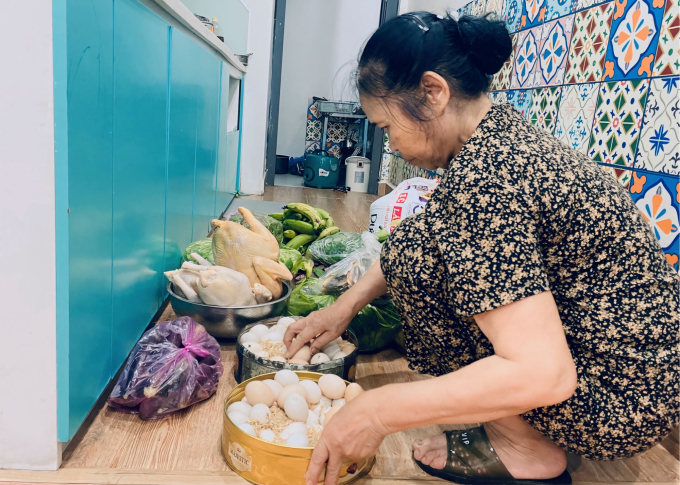
The food for Ms. Thu Hang's family in Ha Dong district was sent from her parents in the countryside on April 7th. Photo: Provided by the interviewee .
On Sunday, April 7th, the families of Thu Hang's siblings from Cau Giay, Nam Tu Liem, and Hoai Duc districts gathered at her house in Ha Dong district to distribute the food their parents had sent from their hometown.
A few days prior, they had received phone calls from their parents asking what they wanted to eat and what they wanted to buy so their grandparents could prepare. The result was a 50kg bag of rice and two boxes of groceries, including meat, fish, eggs, vegetables, and even local specialties like fish sauce, rice rolls, and fermented pork sausage. "Even herbs, chili peppers, and lemons were packed in bags for each family," said Hang, 38, from Thanh Hoa province.
Hang said that since her siblings got married, her mother had the opportunity to come to Hanoi to take care of the grandchildren and clearly felt the high cost of living in the capital, so she used this method to reduce pressure on her children.
"My mother was shocked when she bought a bunch of water spinach for 17,000 dong and pork trotters for 110,000 dong per kilogram, while in the countryside, two bunches of water spinach cost 5,000 dong and pork trotters cost 30,000 dong per kilogram. A bowl of pho in the city is even more than three times as expensive as in the rural market," she shared.
The significant price and cost differences between localities are sometimes one of the reasons for the trend of leaving the city for the countryside. On social media groups, many people share about the significant reduction in living costs when they leave Hanoi or Ho Chi Minh City and move to coastal areas in Central Vietnam or the Central Highlands.
A family who moved from Hanoi to Da Nang in 2023 said they saved more than half their expenses. The biggest savings were in education, which decreased by 70% compared to before, because Da Nang offers free tuition, and extra classes for children only cost a few tens to a few hundred thousand dong per month per subject. Food costs are now two-thirds of what they used to be.
For example, the family of Tan Nguyen, 37, who moved from Hanoi in late 2022 to live in Nha Trang, has saved a third of their living expenses. "If we sent our children to public schools or rented cheaper houses, we could save half. Meanwhile, the food is fresh and cheap, the air is clean, so the health of the whole family has improved, and we've significantly reduced the number of hospital visits," the father of three shared.
Associate Professor Ngo Tri Long stated that the state's goal in price management has always been price stabilization. Stabilization does not mean rigidity, resistance to change, or keeping prices unchanged, but rather adapting to changing environmental factors and input costs. Therefore, to ensure the real wages of the people, it is necessary to ensure adequate living conditions and material standards, with wage increases being only one factor.
Secondly, it's crucial to implement appropriate tax and financial policies. For example, personal income tax should encourage hard work; exploiting workers by imposing high taxes can easily backfire.
Thirdly, and one of the most practical solutions, is to pay attention to price control when raising wages, avoiding a situation where wages increase before prices rise. Measures are needed to stabilize prices while improving the quality of goods and services.
Personal finance advisor Lam Tuan, a member of the Vietnam Financial Advisors Community, advises that recording all daily and monthly expenses is advisable to gain a clear picture of the family's financial situation, thereby prioritizing spending according to necessity.
For Thu Hang's family, thanks to the chickens and vegetables that her grandparents regularly send up twice a month, they only need to spend an additional five million dong each month on food and groceries for four family members.
"Thankful for my parents' support over the years, my husband and I have been able to buy a house on installments and raise two children with our meager civil servant salaries," Ms. Hang shared.
Staying in the city and buying a house was once a dream for Thao and Minh, but the daily grind of worrying about rent, utilities, and baby supplies has shattered that dream.
After six months of struggling to make ends meet, the couple decided to go their separate ways at the end of 2023. She took their two children back to her hometown in Hai Hau, Nam Dinh province to live with her paternal grandparents, while he remained in the city. She said that living with her husband's parents wasn't exactly comfortable, but it eased the financial pressure.
"Since my wife and children returned, I've given up my rented room and am living at the construction site, trying to work a few more years to save up some capital to build a house back in my hometown," Minh said.
Quynh Nguyen - Phan Duong
Source
![[Live] 2025 Community Action Awards Gala](/_next/image?url=https%3A%2F%2Fvphoto.vietnam.vn%2Fthumb%2F1200x675%2Fvietnam%2Fresource%2FIMAGE%2F2025%2F12%2F16%2F1765899631650_ndo_tr_z7334013144784-9f9fe10a6d63584c85aff40f2957c250-jpg.webp&w=3840&q=75)
![[Photo] Prime Minister Pham Minh Chinh receives the Governor of Tochigi Province (Japan)](/_next/image?url=https%3A%2F%2Fvphoto.vietnam.vn%2Fthumb%2F1200x675%2Fvietnam%2Fresource%2FIMAGE%2F2025%2F12%2F16%2F1765892133176_dsc-8082-6425-jpg.webp&w=3840&q=75)
![[Image] Leaked images ahead of the 2025 Community Action Awards gala.](/_next/image?url=https%3A%2F%2Fvphoto.vietnam.vn%2Fthumb%2F1200x675%2Fvietnam%2Fresource%2FIMAGE%2F2025%2F12%2F16%2F1765882828720_ndo_br_thiet-ke-chua-co-ten-45-png.webp&w=3840&q=75)

![[Photo] Prime Minister Pham Minh Chinh receives Lao Minister of Education and Sports Thongsalith Mangnormek](/_next/image?url=https%3A%2F%2Fvphoto.vietnam.vn%2Fthumb%2F1200x675%2Fvietnam%2Fresource%2FIMAGE%2F2025%2F12%2F16%2F1765876834721_dsc-7519-jpg.webp&w=3840&q=75)


























































![[Photo] Prime Minister Pham Minh Chinh attends the Vietnam Economic Forum 2025](https://vphoto.vietnam.vn/thumb/402x226/vietnam/resource/IMAGE/2025/12/16/1765893035503_ndo_br_dsc-8043-jpg.webp)


































Comment (0)