

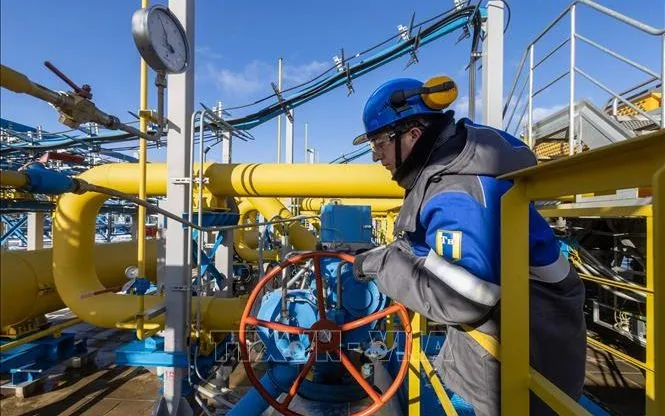
Illustrative photo - Photo: Bloomberg/VNA
LNG prices in the United States are rising sharply, in the context that the country has just recorded a record amount of fuel exports abroad, adding to the cost-of-living crisis, one of the issues that is creating political pressure on President Donald Trump.
Wholesale natural gas prices in the US have increased by more than 70% in the past 12 months. Specifically, the benchmark LNG Henry Hub price closed the trading session on December 5 at $5.29/million BTU, the highest since December 21, 2022 - the time when the global energy market was shaken by the outbreak of the Russia-Ukraine conflict, affecting the global gas supply.
The price increase comes amid growing concerns among Americans about rising living costs, contradicting President Trump’s claim that he has reduced energy prices in his first year in office. Another factor impacting LNG prices is the sharp increase in demand for heating electricity due to cold weather across the US.
President Trump has made boosting LNG exports and increasing domestic gas production a priority to fuel the explosive energy demand for artificial intelligence (AI), a goal he has outlined as part of his strategy to unleash “American energy dominance.” But he is facing growing opposition from domestic consumers and industry, fueled by concerns that rising electricity prices are exacerbating the “cost-of-living crisis” and undermining competitiveness.
“As North America exports more gas, it also imports higher price swings,” said Clark Williams-Derry, a senior fellow at the Institute for Energy Economics and Financial Analysis (IEEFA). “This is good news for the gas industry, which has seen a significant increase in revenues, but not so good for US consumers who rely on gas for heating or electricity.”
Many experts believe the US gas market may be entering a period of structural change, with some of the additional LNG production diverted to exports and to meet the expected surge in demand from energy-hungry AI data centers. The Industrial Energy Consumers Association (IECA), which represents energy-intensive manufacturers, has called on the government to prioritize domestic demand over exports.
According to a Yahoo/YouGov survey released last week, the percentage of Americans who believe President Trump has caused prices to rise (49%) is twice as high as the number who believe he has helped reduce prices (24%).
During his 2024 campaign, Mr. Trump pledged to cut energy prices in half within his first 12 months in office—a message that resonated with voters hurt by high inflation and energy costs under former President Joe Biden. But since President Trump took office in January 2025, electricity and gas prices in the U.S. have continued to rise, rising 5.1% and 11.7%, respectively, in September 2025 compared to the same period last year, according to the U.S. Bureau of Labor Statistics.
The US Energy Information Administration (EIA) forecasts that the average price of natural gas paid by power plants this year will increase by 37%, while the industrial sector will pay 21% more than the average in 2024. Residential and business consumers are expected to pay about 4% more than last year.
The United States exported a record 9.41 million tons of LNG in September, up nearly 20% from the same month a year earlier, according to EIA data. U.S. LNG is playing a key role in helping Europe weather its worst energy crisis in decades as the region tries to reduce its dependence on Russian gas. Spain, France, the United Kingdom and the Netherlands are among the main destinations for U.S. LNG.
U.S. gas producers and LNG companies have dismissed the idea that exports are the cause of higher retail prices, arguing that the U.S. still has plenty of gas to tap. Instead, they say the big bottleneck is a lack of new pipelines and storage facilities due to political barriers. But analysts say rapidly growing LNG supplies, demand for electricity from data centers, and rising costs at some fields like Haynesville will continue to keep gas prices high.
Source: https://vtv.vn/gia-khi-dot-tai-my-tang-vot-100251208085411492.htm
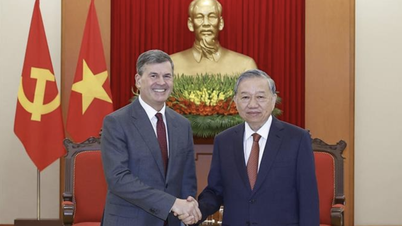
![[Photo] General Secretary To Lam receives the Director of the Academy of Public Administration and National Economy under the President of the Russian Federation](/_next/image?url=https%3A%2F%2Fvphoto.vietnam.vn%2Fthumb%2F1200x675%2Fvietnam%2Fresource%2FIMAGE%2F2025%2F12%2F08%2F1765200203892_a1-bnd-0933-4198-jpg.webp&w=3840&q=75)

































































































Comment (0)