

Bringing new solutions
In Vietnam, rapid urbanization has raised many pressing issues such as: how to effectively plan to meet the needs of population growth and protect the environment; how to apply modern technology while preserving cultural identity and historical values; and, more importantly, how to resolve the conflict between growth and sustainable development.
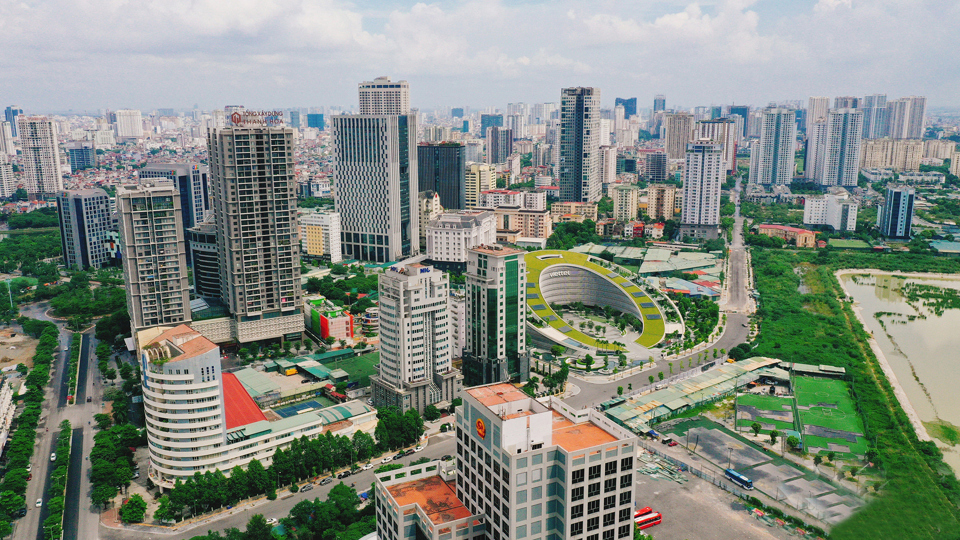
According to Dr. Architect Nguyen Van Hai - President of the Hanoi Architects Association: “For architecture and urban planning – fields that play a crucial role in shaping living spaces, managing urban resources, and sustainable development – AI has brought about remarkable advancements, comprehensively changing the face of planning and architecture. AI provides new solutions, from big data simulation to predict planning trends to automation in architectural design, and supports the construction of smart cities where the quality of human life is prioritized.”
Architect Pham Hoang Phuong from the National Institute of Architecture also believes that AI can be deployed across all stages of architectural design to automate processes, improve efficiency, and quickly create high-quality projects at lower costs. This includes gathering information and assessing the current state of construction sites; researching and proposing design ideas; implementing technical design content; and converting it for application in modern construction processes in line with the industrialization of construction…
Sharing this view, many architects believe that AI and digital tools based on big data have significantly impacted how architects shape and simulate building designs. AI helps architects make the most of the vast amount of data available, while also suggesting solutions to complex problems. This technology can simplify the design process, minimize errors, optimize forecasting time, and reduce project effort.
These data-driven tools support architects and urban planners by providing them with insights and recommendations based on data analysis. For example, algorithms can be used to track and predict the quantity or materials a building will need to operate. To generate more high-performance design options, architects can build upon their preferred designs, adapting them to suit community needs while minimizing environmental impact.
Specifically applying AI in planning and architecture.
According to experts, although no projects have yet been entirely designed and constructed using AI, the application of AI in planning and architecture in Vietnam has begun to yield concrete results. Hoang Anh, Director of SOS Solutions Services Co., Ltd., stated that the initial effectiveness of AI applications in construction management and licensing is being demonstrated in several major cities such as Hanoi, Ho Chi Minh City, and other cities nationwide.
The application of AI has enabled maximum automation of the entire design process. All information regarding general planning, zoning plans, detailed plans, urban design, house design specifications, etc., is automated and collected as input to create house models. The accuracy of cadastral map data, precise to the centimeter and millimeter, allows for a faster drawing process and produces models that accurately reflect the current situation. To date, SOS's data system has approximately 2 million houses that have been automatically licensed.
In 21 districts of Ho Chi Minh City, residents are choosing the Smart City service, which features an automated process for obtaining and processing construction permits.
Specifically, from the first step of selecting the Smart City construction permit service, citizens will enter their land title information (land title, sheet number, plot number, location of the construction permit application, and house design). The AI will automatically create a design drawing based on the house design and the citizen's requirements, create a permit application dossier, and submit it to the public service portal.
The next step involves AI creating architectural spatial models, construction design documents, and construction cost estimates, along with implementation solutions. The system then automatically checks and processes the construction planning standards, generates a set of construction permit documents, digitally signs them, and automatically delivers the results to the investor. AI will manage and monitor construction activities, ensuring compliance with regulations.
Artificial intelligence is ushering in a new era for the architecture industry, optimizing design, planning, and construction processes; however, many challenges remain. Dr. Trinh Hong Viet, an architect from the National Institute of Architecture, assesses that, during the initial implementation phase, several issues have been identified, such as the fact that AI technology in Vietnam is primarily applied to the initial stages of conceptual design. Some new technologies are integrated into conventional software platforms, leading to conflicts with hardware.
The application of AI in the engineering design and construction phases of projects still needs time to be perfected. Therefore, it is necessary to promote research and application of AI technology platforms in the fields of architecture and urban planning, based on selecting platforms suitable for the practical conditions in Vietnam, as well as prioritizing research on the localization of some AI platforms to optimize and clearly express the identity of Vietnamese architecture.
Applying digital technologies , especially AI, to build data and optimize the use of data architecture will increase labor productivity and reduce operating costs, while contributing to enhancing the competitiveness of businesses.
Our company has designed 96 high-rise projects in 16 provinces and cities, constructing 52,600 apartments and over 8 million square meters of floor space. Due to the nature of repetitive tasks with data fragmentation and difficulty reusing past data for new projects, applying AI can shorten the time by 1/100 to 1/1,000.
Chairman of the Board of Directors of Cubic Architecture Joint Stock Company,
Architect Tran Vu Lam
Source: https://kinhtedothi.vn/xu-huong-ung-dung-ai-trong-quy-hoach-kien-truc.html

![[Photo] Two flights successfully landed and took off at Long Thanh Airport.](/_next/image?url=https%3A%2F%2Fvphoto.vietnam.vn%2Fthumb%2F1200x675%2Fvietnam%2Fresource%2FIMAGE%2F2025%2F12%2F15%2F1765808718882_ndo_br_img-8897-resize-5807-jpg.webp&w=3840&q=75)






























































































Comment (0)