

Challenges from extreme weather
Climate change is no longer a distant prediction but is clearly evident in every field and orchard in the Mekong Delta. For An Giang, a province at the headwaters of the Mekong River, these impacts are even more severe with droughts, unusual floods, increased pest outbreaks, and localized flooding or salinization of the land. In this context, changing the crop structure is not just an option but has become an urgent requirement to protect farmers' livelihoods and sustain agricultural growth.
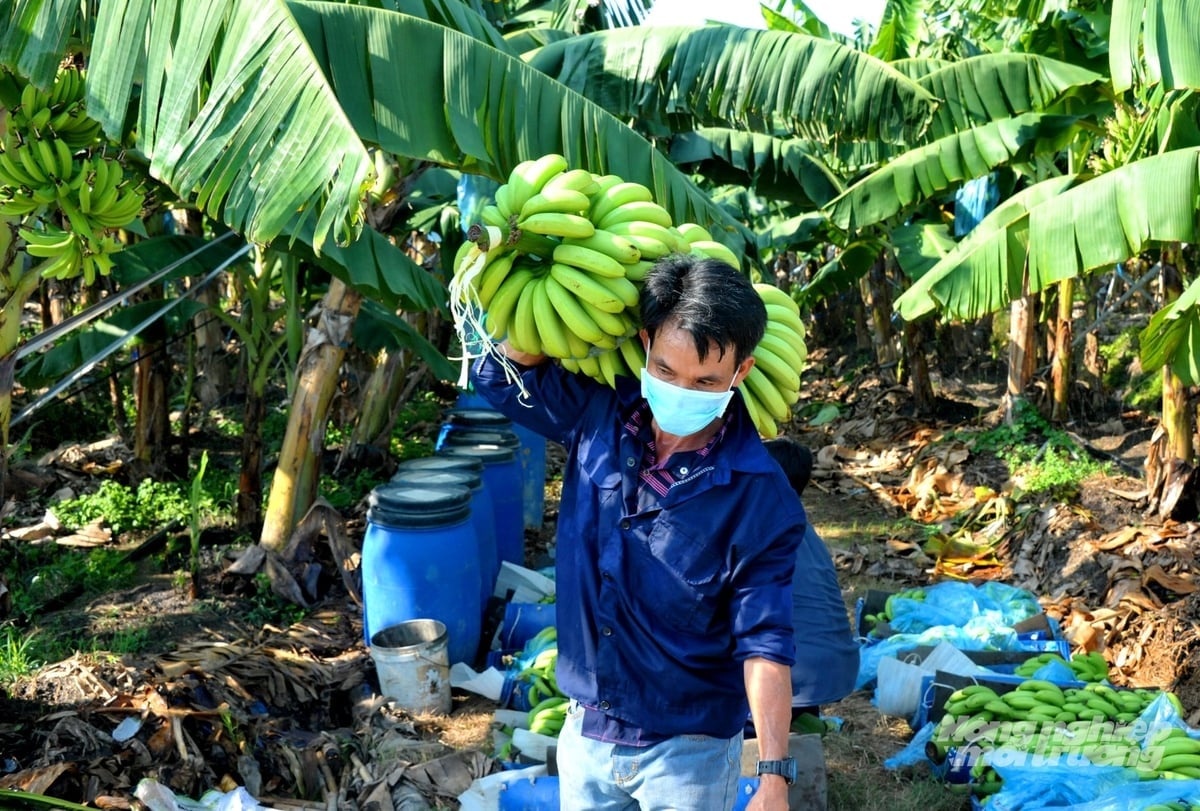
Farmers in An Giang province harvest bananas in areas where inefficient rice fields have been converted to fruit orchards, contributing to increased income and adaptation to climate change. Photo: Le Hoang Vu.
In recent years, unpredictable weather patterns have exposed the limitations of traditional rice-based agriculture. In many localities, rice yields are low, input costs are high, and prices are volatile. Particularly in upstream communes such as Vinh Xuong, Khanh Binh, Tan An, and the Cu Lao Gieng area, erratic rainfall and sunshine increase pest and disease outbreaks, posing significant risks to rice farmers.
The obvious consequence is a decline in household income, forcing a segment of rural laborers to leave their fields in search of livelihoods in urban areas. This is a problem not only of economic importance but also of social stability, compelling the local agricultural sector to find new, more flexible, and sustainable directions.
According to Mr. Tran Thanh Hiep, Deputy Director of the Department of Agriculture and Environment of An Giang province, the province has identified crop restructuring as a key solution in its climate change adaptation strategy. Specifically for the 2025 winter-spring crop season, the entire province converted 2,748 hectares of low-yield rice land to vegetable and fruit cultivation. Of this, vegetables accounted for 568 hectares, cash crops over 1,005 hectares, and fruit trees over 1,174 hectares.
Not stopping at short-term figures, in the period 2020–2025, An Giang has converted over 30,000 hectares of low-yield rice land to higher-value crops. The total area of fruit trees in the province currently reaches 21,485 hectares, notably mangoes with nearly 13,000 hectares. Vegetable crops are maintained at a stable area of over 50,000 hectares each year, concentrated in Chau Phu, Cho Moi, Phu Tan, Thoai Son and the Chau Doc ward area.
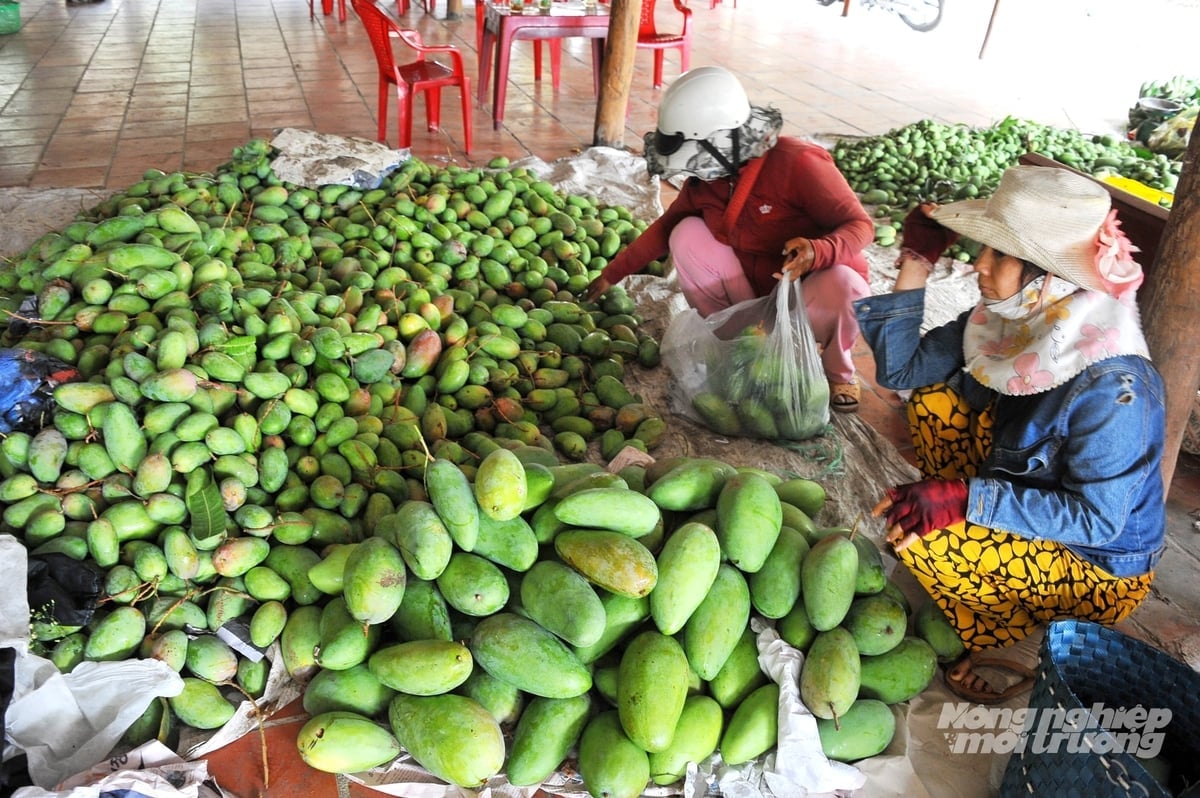
Mangoes from An Giang are purchased and sorted at post-harvest collection points, serving both domestic consumption and export markets, creating a stable outlet for the crop conversion area. Photo: Le Hoang Vu.
It's not just about "changing the plants," it's about changing the way you do it.
According to managers, crop restructuring is not simply about replacing rice with another crop. The key factor is selecting crop varieties that are suitable for the soil, water conditions, climate adaptability, and market demand. In recent years, in addition to vegetables, An Giang has encouraged the development of high-economic-value fruit trees such as mangoes, jackfruit, guavas, oranges, tangerines, and durians.
Simultaneously, many integrated production models such as rice-aquaculture and garden-pond-livestock farming have been widely adopted. These models not only help farmers mitigate risks from natural disasters but also make good use of land and water resources, creating diverse income streams on the same cultivated area.
Vinh Xuong commune is one of the leading localities in converting inefficient rice land. In just the last 5 years, farmers here have boldly converted about 600 hectares of rice fields to fruit tree cultivation, mainly Keo mangoes and Hoa Loc mangoes.
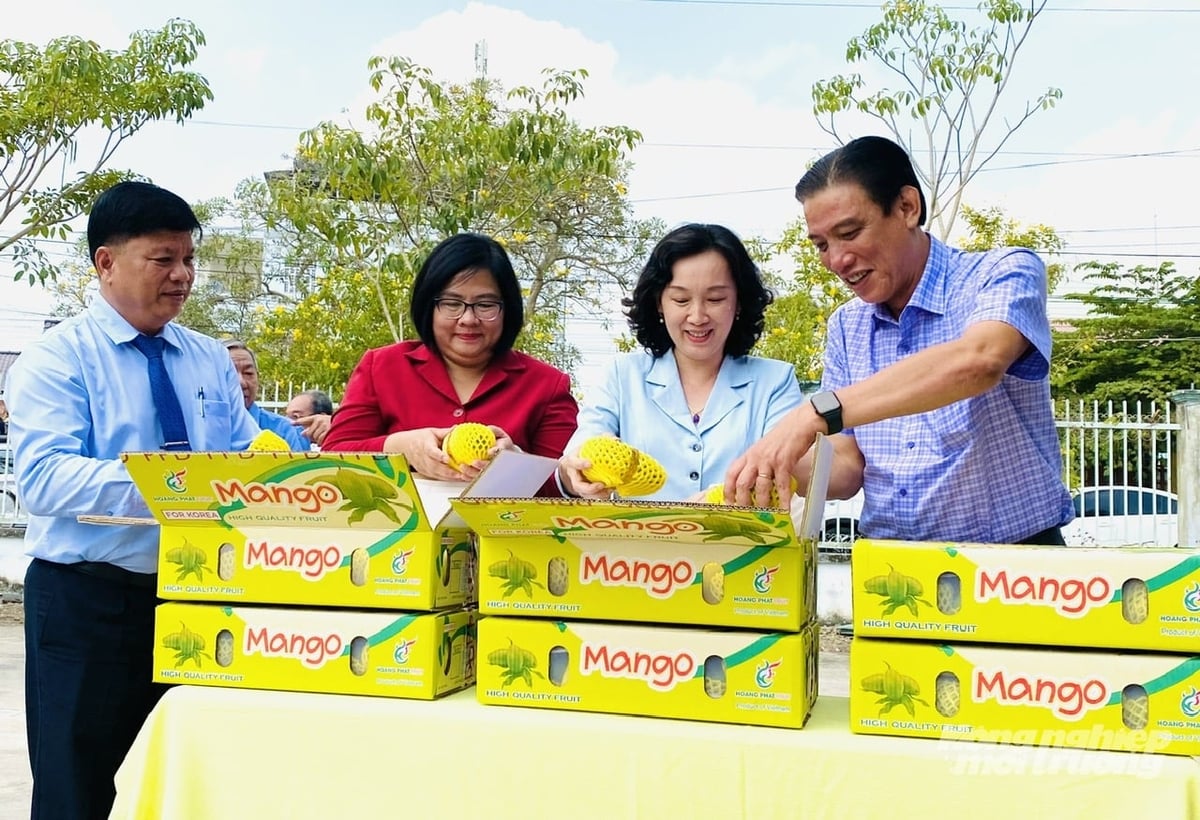
Packaging mangoes for export in Cho Moi commune, An Giang province, demonstrates the effectiveness of production and consumption linkages between farmers and businesses in restructuring crop patterns to adapt to climate change. Photo: Le Hoang Vu.
Mr. Huynh Van Hiep, Director of Vinh Xuong Fruit Cooperative, said: "Previously, farmers relied almost solely on rice cultivation, resulting in low income and even losses during unfavorable weather conditions. Since switching to concentrated mango cultivation with established consumption linkages, farmers' lives have changed significantly. In particular, the cooperative's mango products have entered the export chain to demanding markets, creating a foundation for long-term sustainable production."
To ensure the transformation is effective, An Giang's agricultural sector has identified science and technology as key factors. Many localities have applied water-saving irrigation systems and drip irrigation for fruit trees, helping to reduce costs and adapt better to drought conditions. New drought-resistant, salt-tolerant, and pest-resistant crop varieties have been introduced into production, gradually replacing older varieties.
In addition, the province is gradually building an early warning system for natural disasters and pests, helping farmers proactively prevent risks. Technical training and the transfer of scientific and technological advancements are being promoted through cooperatives, cooperative groups, and the grassroots agricultural extension network.
Mr. Tran Thanh Hiep, Deputy Director of the Department of Agriculture and Environment of An Giang province, added that an important lesson learned from practice is that crop conversion is only successful when linked to the market. Therefore, An Giang focuses on developing new-style cooperatives, strengthening linkages between farmers and businesses in production and consumption. Through guaranteed purchase contracts, traceability, and quality standards, local agricultural products are gradually participating in sustainable value chains, avoiding the situation of "bumper harvest, low prices." Along with that, policies supporting credit, plant varieties, and infrastructure serving production are implemented synchronously, creating motivation for farmers to confidently make the conversion.
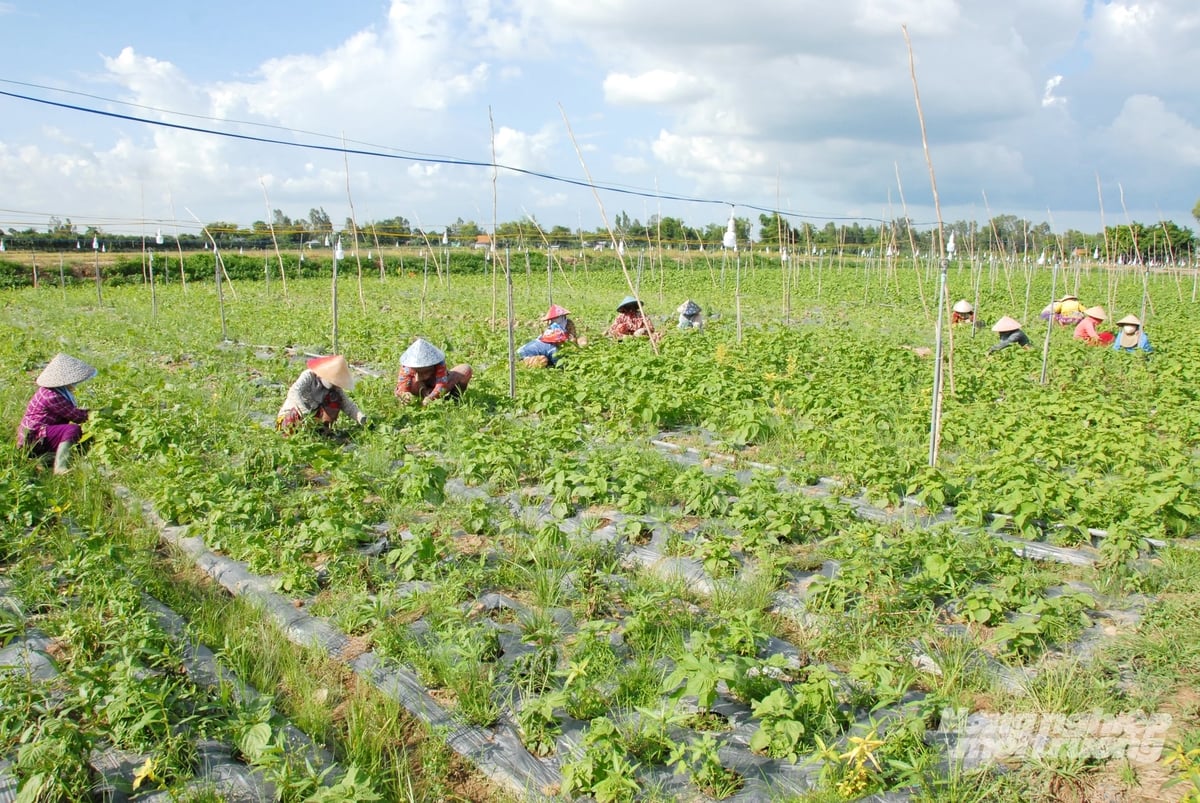
Farmers in An Giang province cultivate vegetables on converted rice land, applying new techniques to reduce weather risks and increase production value. Photo: Le Hoang Vu.
“In the context of increasingly severe climate change, restructuring crop patterns is seen as a crucial solution for An Giang to both minimize risks and increase added value per unit area. However, for this approach to be effective in the long term, close coordination between the government, the agricultural sector, businesses, and farmers is needed.”
In this model, the government plays the role of "conductor" in planning and direction; farmers are the implementers, and businesses are the bridge to the market. When these links operate synchronously, the transformation of crop structure will not only be a temporary solution, but will become the foundation for a smart, flexible, and sustainable agricultural sector in An Giang province that adapts to climate change," said Mr. Tran Thanh Hiep, Deputy Director of the Department of Agriculture and Environment of An Giang province.
Source: https://nongnghiepmoitruong.vn/an-giang-tai-cau-truc-cay-trong-de-tang-thu-nhap-nong-dan-d789842.html

![[Photo] Prime Minister Pham Minh Chinh receives the Governor of Tochigi Province (Japan)](/_next/image?url=https%3A%2F%2Fvphoto.vietnam.vn%2Fthumb%2F1200x675%2Fvietnam%2Fresource%2FIMAGE%2F2025%2F12%2F16%2F1765892133176_dsc-8082-6425-jpg.webp&w=3840&q=75)
![[Live] 2025 Community Action Awards Gala](/_next/image?url=https%3A%2F%2Fvphoto.vietnam.vn%2Fthumb%2F1200x675%2Fvietnam%2Fresource%2FIMAGE%2F2025%2F12%2F16%2F1765899631650_ndo_tr_z7334013144784-9f9fe10a6d63584c85aff40f2957c250-jpg.webp&w=3840&q=75)

![[Image] Leaked images ahead of the 2025 Community Action Awards gala.](/_next/image?url=https%3A%2F%2Fvphoto.vietnam.vn%2Fthumb%2F1200x675%2Fvietnam%2Fresource%2FIMAGE%2F2025%2F12%2F16%2F1765882828720_ndo_br_thiet-ke-chua-co-ten-45-png.webp&w=3840&q=75)
![[Photo] Prime Minister Pham Minh Chinh receives Lao Minister of Education and Sports Thongsalith Mangnormek](/_next/image?url=https%3A%2F%2Fvphoto.vietnam.vn%2Fthumb%2F1200x675%2Fvietnam%2Fresource%2FIMAGE%2F2025%2F12%2F16%2F1765876834721_dsc-7519-jpg.webp&w=3840&q=75)





































![[Live] Closing Ceremony and Award Presentation for the "Impressive Vietnam Tourism" Video/Clip Creation Contest 2025](https://vphoto.vietnam.vn/thumb/402x226/vietnam/resource/IMAGE/2025/12/17/1765974650260_z7273498850699-00d2fd6b0972cb39494cfa2559bf85ac-1765959338756946072104-627-0-1338-1138-crop-1765959347256801551121.jpeg)


















Comment (0)